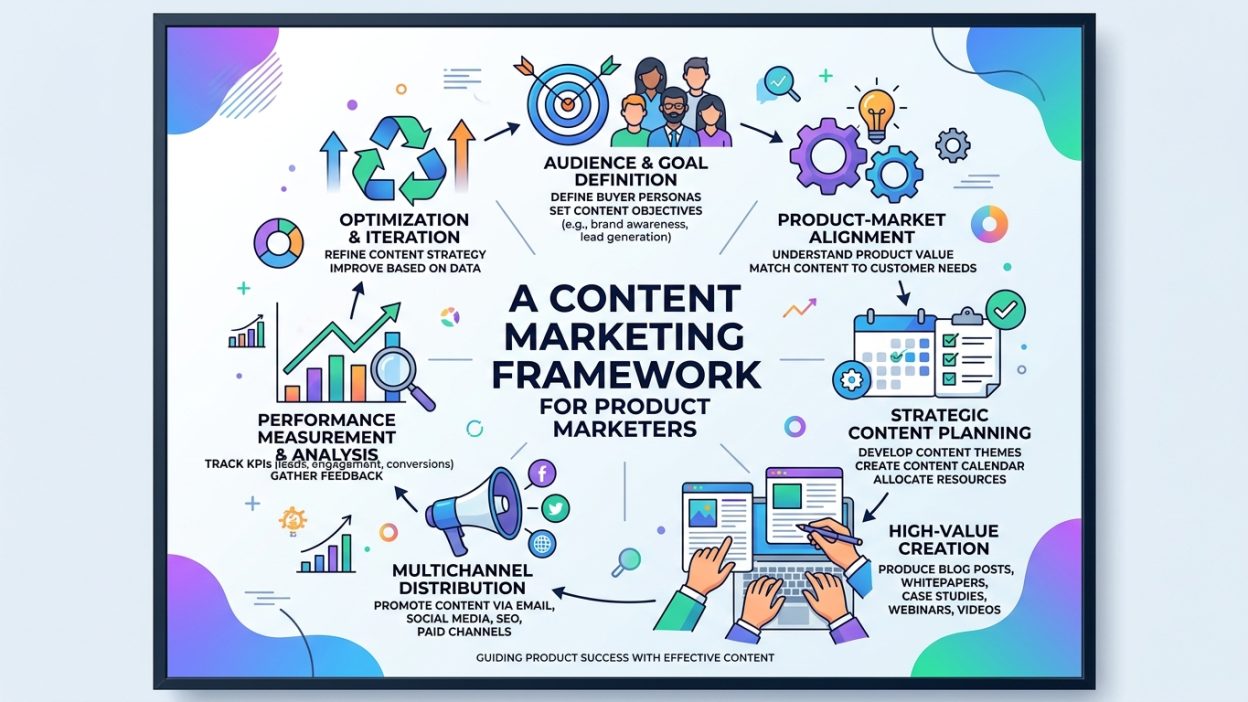
A successful content marketing framework empowers product marketers to drive growth. By aligning messaging with user intent, understanding buyer personas, and strategically distributing content, teams can increase engagement, generate qualified leads, and ultimately boost long-term customer retention and product sales.
Product marketing and content marketing often operate in separate silos. Product marketers focus on positioning, messaging, and go-to-market strategies. Content marketers spend their time writing blog posts, crafting emails, and building SEO traction. When these two disciplines do not communicate, companies end up with confusing messaging and disconnected buyer journeys.
Building a robust content marketing framework bridges this gap. It provides a structured approach for translating complex product features into compelling stories that resonate with target audiences. This alignment ensures that every piece of content—from a top-of-funnel blog post to a highly technical whitepaper—serves a specific purpose in driving product adoption.
This guide explores how product marketers can build an effective content framework. You will learn how to map content to the buyer’s journey, define clear user personas, and measure the success of your product-focused content assets.
The Core Pillars of a Product-Led Content Strategy
Before creating new assets, product marketers must establish a strong foundation. A successful content marketing framework relies on a deep understanding of the customer and the specific problems the product solves.
Developing Accurate Buyer Personas
Creating content without a specific audience in mind wastes resources. Product marketers must conduct qualitative and quantitative research to build accurate buyer personas. You need to understand the pain points, motivations, and daily workflows of your target users. Talk to your sales team, listen to customer support calls, and send out surveys to gather real-world data.
Once you have this data, document your personas clearly. Outline their job titles, primary goals, software preferences, and the specific challenges that your product alleviates. These personas will act as a compass for every piece of content your team produces.
Mapping the Buyer’s Journey
Different stages of the buyer’s journey require different types of content. A prospect who has just realized they have a problem needs educational material. A prospect evaluating different vendors needs technical comparisons and case studies.
Break the journey down into three distinct phases:
- Awareness: Focus on high-level industry problems. Use blog posts, social media updates, and short videos to capture attention.
- Consideration: Explain how to solve the problem. Offer webinars, detailed guides, and templates that demonstrate your product’s value without being overly promotional.
- Decision: Prove that your product is the best solution. Distribute case studies, competitor comparison matrices, and detailed ROI calculators.
Building the Framework Step-by-Step

A framework is only as good as its execution. Product marketers must establish clear workflows to ensure content gets created, distributed, and analyzed efficiently.
Establish Clear Messaging Themes
Your content must reflect your product’s core value propositions. Develop a messaging matrix that maps your product features to specific customer benefits. For every feature, identify the underlying value it provides to the user. Use these themes as the foundation for your content calendar, ensuring that all published material reinforces your main product narratives.
Collaborate with the Content Team
Product marketers rarely write every piece of content themselves. You must establish a strong feedback loop with your dedicated content writers. Create detailed content briefs that outline the target persona, the specific product features to highlight, and the desired call-to-action. Regular alignment meetings will help writers understand the nuances of the product, resulting in more accurate and persuasive content.
Measure and Optimize Performance
Content marketing requires continuous optimization. Product marketers should track metrics that align with business goals. Monitor traffic, lead generation, and conversion rates for specific product pages. Pay attention to how often sales representatives use your enablement content during pitches. Use this data to refine your strategy, update underperforming assets, and double down on formats that resonate with your audience.
Content Distribution Channels That Drive Product Visibility
Creating great content is only half the battle; distribution determines success. Product marketers should focus on channels where their audience actively engages. Organic search through SEO-driven blog posts builds long-term traffic, while social media platforms amplify reach and brand awareness. Email marketing remains highly effective for nurturing leads and guiding them through the buyer journey. Additionally, partnerships, guest posts, and community platforms like forums or niche groups can expand visibility. A multi-channel distribution strategy ensures your content reaches the right audience at the right time, maximizing both engagement and product discovery.
Leveraging Data-Driven Content Decisions
Data should guide every content decision product marketers make. Analyze user behavior, engagement metrics, and conversion rates to understand what resonates. Tools like analytics dashboards and heatmaps reveal how users interact with your content. Identify high-performing topics and replicate their success with similar assets. At the same time, optimize or remove underperforming content to maintain quality. Data-driven insights also help refine targeting, ensuring that your messaging aligns with real user intent. This approach minimizes guesswork and enables continuous improvement, making your content marketing efforts more efficient and impactful.
Personalization in Product Content Marketing
Personalization enhances user experience by delivering relevant content to specific audience segments. Product marketers can use behavioural data, demographics, and past interactions to tailor content. For example, returning users might see advanced product tutorials, while new visitors receive introductory guides. Personalized email campaigns can significantly improve open and click-through rates. Dynamic website content further enhances engagement by adapting messaging based on user profiles. By addressing individual needs and preferences, personalization strengthens relationships, increases trust, and improves conversion rates, ultimately driving more effective product adoption.
Integrating Product Updates into Content Strategy
Regular product updates provide valuable opportunities for fresh content creation. Each new feature or improvement can be transformed into blog posts, tutorials, case studies, or video demos. This not only keeps your audience informed but also reinforces your product’s evolving value. Product marketers should align content releases with product development cycles to maintain consistency. Highlighting real-world use cases for new features helps users understand their benefits quickly. This approach ensures that your content remains relevant, supports customer retention, and encourages users to explore new functionalities.
Building Thought Leadership Through Product Content
Establishing authority in your industry builds trust and credibility. Product marketers can achieve this by publishing in-depth guides, research reports, and expert insights. Sharing unique perspectives on industry trends positions your brand as a reliable source of knowledge. Collaborating with industry experts or hosting webinars further strengthens credibility. Thought leadership content should focus on solving real problems rather than directly promoting products. Over time, this approach attracts a loyal audience that values your expertise, making them more likely to trust and choose your product over competitors.
Repurposing Content for Maximum ROI
Repurposing content allows product marketers to maximize the value of existing assets. A single blog post can be transformed into social media snippets, infographics, videos, or email newsletters. This approach saves time while maintaining consistent messaging across platforms. Repurposing also helps reach different audience segments who prefer varied content formats. For example, a detailed guide can be condensed into a short video for quick consumption. By extending the lifecycle of content, marketers can increase visibility, reinforce key messages, and achieve better returns on their content investment.

Frequently Asked Questions
1. What is the difference between product marketing and content marketing?
Product marketing focuses on positioning, pricing, and understanding the target market to drive demand and usage of a specific product. Content marketing involves creating and distributing valuable, relevant content to attract and engage a defined audience. While product marketing dictates the “what” and “who,” content marketing often dictates the “how” through storytelling and distribution channels.
2. How do I know which content formats work best for my product?
The best format depends entirely on your target audience and the complexity of your product. Highly technical B2B software often benefits from detailed whitepapers and documentation. Visual or consumer-focused products thrive on short-form video and social media graphics. Test multiple formats and measure engagement metrics to see what resonates.
3. How often should product marketing update existing content?
You should review core product content at least every quarter. Whenever your company releases a major product update or shifts its strategic messaging, audit your existing content library. Outdated screenshots, old feature names, and obsolete value propositions can confuse prospects and hurt your brand’s credibility.
4. What role does SEO play in a product content framework?
Search Engine Optimization (SEO) ensures that prospects can find your product when they search for solutions to their problems. Product marketers should collaborate with SEO specialists to identify high-intent keywords related to the product’s features. Incorporating these keywords naturally into landing pages and blog posts drives sustainable, organic traffic.
5. How can we ensure the sales team actually uses the content we create?
Sales enablement content only works if sales representatives know it exists. Store all content in a centralized, easily searchable repository. Hold regular training sessions to explain how and when to use specific assets during the sales cycle. Additionally, solicit feedback directly from the sales team to ensure the content meets their practical needs.
6. What are the best metrics for measuring product content success?
Metrics vary based on the content’s goal. For top-of-funnel content, track page views, time on page, and social shares. For bottom-of-funnel content, track lead conversions, pipeline generated, and the win rate of deals that interacted with specific case studies or comparison guides.
7. Should product marketing create content for existing customers?
Absolutely. Customer retention is just as important as acquisition. Product marketers should develop onboarding guides, feature release notes, and best-practice tutorials. This content helps users get maximum value from the product, reducing churn and encouraging upsells or expansions.
8. How do we balance educational content with promotional product pitches?
Follow the 80/20 rule. Roughly 80% of your content should focus on educating the audience, solving their industry problems, and providing genuine value without a hard sell. The remaining 20% can directly promote your product, highlight specific features, and push for a purchase decision.
9. Can a small startup implement a comprehensive content framework?
Yes. Startups do not need to execute every single content format at once. Start small by defining one primary buyer persona and mapping out a simple three-stage buyer journey. Create a few high-quality assets for each stage, measure their impact, and scale your efforts as your resources grow.
10. How do product release cycles impact the content calendar?
Product release cycles should dictate major content pushes. When planning a launch, work backward from the release date. Schedule teaser content to build anticipation, launch-day assets (like press releases and feature blogs) to drive immediate awareness, and post-launch tutorials to ensure successful adoption.
Next Steps for Product Marketers
Implementing a robust content marketing framework transforms how your target audience perceives and interacts with your product. Moving forward, focus on continuously refining your strategy based on analytics and user feedback. Great product marketing is never static. It requires testing different formats, measuring engagement metrics, and adapting to industry shifts. Start by auditing your current assets to identify gaps in the buyer journey. Then, collaborate closely with your sales and product teams to ensure alignment. By prioritizing valuable content and maintaining consistent messaging, you will establish strong brand authority, foster customer loyalty, and drive sustainable growth for your own business.