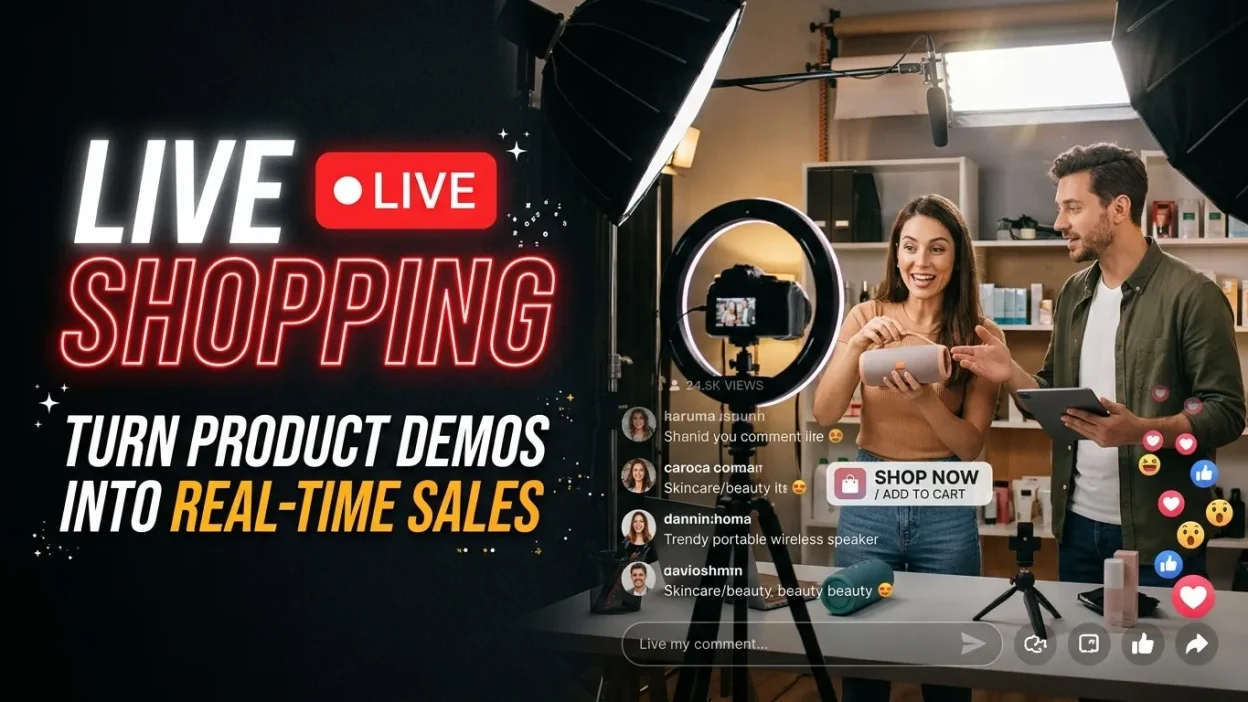
Live Shopping combines live video demonstrations, interactive conversations, and instant purchasing to help brands build trust, answer customer questions, and convert engaged viewers into buyers.
Imagine a customer looking at a skincare product online. The product page includes attractive photographs, a list of ingredients, customer reviews, and a discount. Yet the customer still has questions. How does the product feel? What does the texture look like? Is it suitable for their skin type? Will the results match the claims in the advertisement?
Traditional online shopping often requires customers to search for answers across several pages before they feel confident enough to purchase. Live Shopping creates a different experience by allowing shoppers to watch a real-time demonstration, ask questions, see the product in action, and potentially buy it without leaving the shopping experience.
This approach brings some of the personal interaction associated with physical retail into digital commerce. Instead of relying entirely on static product images and written descriptions, brands can demonstrate how products work while responding directly to customer concerns.
The appeal goes beyond entertainment. People want to reduce the uncertainty involved in buying something they cannot physically inspect. Seeing a product used, hearing a detailed explanation, and receiving an immediate response can make the decision easier.
For businesses, Live Shopping offers an opportunity to combine product education, customer engagement, social interaction, and conversion within a single experience. However, success depends on more than attracting viewers. The presentation must be relevant, the product must deliver genuine value, and the purchasing process must be convenient.
When implemented strategically, real-time product demonstrations can help brands answer objections, establish credibility, and make online shopping more interactive. This guide explains how the model works, why customers respond to it, how to build an effective selling experience, and which metrics businesses should monitor to evaluate performance.
What Is Live Shopping?
Live Shopping is a digital commerce format in which a host demonstrates or discusses products through a live video broadcast while viewers interact with the presentation and, where the platform supports it, purchase featured items in real time.
The host might be a brand representative, product specialist, creator, influencer, or knowledgeable customer. During the broadcast, viewers can watch demonstrations, submit questions, respond to polls, explore product links, and participate in promotional activities.
The purchasing journey varies by platform. Some services provide integrated checkout, while others direct viewers to a product page, marketplace listing, or retailer’s website.
The defining feature is the combination of live interaction and a convenient path to purchase.
How Live Shopping Works
A typical session follows a straightforward sequence:
-
Product discovery: A shopper encounters a scheduled broadcast through a brand’s social account, website, app, or creator’s content.
-
Live demonstration: The host introduces the product, explains its features, and demonstrates relevant use cases.
-
Audience interaction: Viewers ask questions, request close-ups, and share concerns through live comments or other interactive features.
-
Product consideration: The host explains specifications, pricing, sizing, availability, compatibility, or other purchase-related details.
-
Purchase opportunity: Viewers follow a product link or use an integrated checkout to complete their orders.
-
Post-session engagement: The business follows up appropriately, provides customer support, and evaluates sales and engagement results.
Not every viewer purchases immediately. Some may watch to learn about a product, save it for later, or return after comparing alternatives.
That is why businesses should evaluate the full customer journey rather than assuming that every successful broadcast must generate an immediate transaction.
Live Shopping Versus Traditional E-Commerce
Traditional e-commerce usually depends on product pages, images, written descriptions, search filters, reviews, and checkout flows. These tools remain essential because they allow customers to research products at their own pace.
Live Shopping adds a human demonstration and a real-time conversation to that foundation.
| Feature | Traditional e-commerce | Live Shopping |
|---|---|---|
| Product presentation | Images, text, recorded media | Live demonstrations and explanations |
| Customer questions | Forms, reviews, chat, or support | Questions during the broadcast |
| Interaction | Often asynchronous | Real-time when the audience is active |
| Product discovery | Search, recommendations, category pages | Hosts, demonstrations, and audience participation |
| Buying process | Product page and checkout | Integrated checkout or linked product page |
| Main advantage | Convenient, self-directed browsing | Immediate clarification and interactive discovery |
| Main limitation | Some questions may remain unanswered | Requires preparation, hosting, and live audience engagement |
These formats should complement one another. A live demonstration can help a customer understand a product, while a detailed product page provides specifications, delivery information, policies, and other information needed before checkout.
Is Live Shopping the Same as Livestreaming?
No. Livestreaming is a broad format for broadcasting video in real time. It can be used for gaming, education, entertainment, events, interviews, or community discussions.
Live Shopping specifically connects a live broadcast to a commercial product-discovery and purchasing experience.
A creator who livestreams a general conversation is not necessarily conducting a shopping session. A creator who demonstrates a kitchen appliance, answers questions about its features, and directs interested viewers to buy it is using livestreaming for commerce.
This distinction matters when planning content. A successful shopping broadcast needs a clear product purpose and a useful path from interest to purchase.
Why Live Shopping Influences Customer Buying Decisions
Online shoppers do not make decisions based on product information alone. They also consider trust, convenience, perceived risk, emotional appeal, and whether a product appears suitable for their needs.
Live Shopping brings these factors together in a format that allows businesses to explain products while responding to customer concerns.
It Reduces Product Uncertainty
One of the biggest challenges in e-commerce is that customers cannot physically examine a product before ordering it.
A photograph may show a handbag’s appearance, but it might not communicate its flexibility, storage capacity, or how it looks when carried. A clothing model may show an outfit, but shoppers may still want to understand the fabric, fit, and movement.
A live demonstration can address these questions more directly.
For example, a host selling a travel backpack could show its compartments, demonstrate how much it holds, and explain the difference between its materials. Viewers can request additional details rather than relying entirely on the information initially presented.
Live Shopping becomes especially useful when customers need to see a product’s practical performance before deciding whether it meets their expectations.
It Builds Trust Through Human Interaction
Customers often hesitate when a product description feels exaggerated or important information is missing.
A knowledgeable host can explain both benefits and limitations, demonstrate realistic use cases, and acknowledge questions that require further verification. This transparency can make the shopping experience more credible.
Trust does not automatically follow from appearing on camera. It develops when the demonstration matches the product’s actual capabilities, the host answers questions honestly, and the brand communicates clear purchasing terms.
If a product has limitations, explaining them may prevent unsuitable purchases and reduce disappointment after delivery.
For Live Shopping to create lasting value, credibility must take priority over exaggerated claims or pressure-based selling.
It Creates a Sense of Participation
Traditional product pages allow shoppers to browse independently, but they rarely create the same feeling of participating in a shared event.
During a live broadcast, viewers can ask questions, react to demonstrations, suggest products for the host to feature, and learn from questions submitted by other shoppers.
This interaction can make product discovery more engaging. A customer who was uncertain about one feature may find the answer in another viewer’s question.
The result is an experience that combines product education with community participation.
However, audience interaction should remain optional. Some customers prefer to watch quietly, and businesses should not require people to comment or disclose personal information to access basic product details.
It Helps Customers Visualize Ownership
People often evaluate products by imagining how they will fit into their everyday lives.
A furniture demonstration might show how a compact table works in a small apartment. A cooking session might demonstrate how a kitchen tool simplifies meal preparation. A clothing presentation could show how one jacket works with several outfits.
Live Shopping helps translate abstract product features into recognizable situations.
Instead of simply stating that a product is versatile, the host can demonstrate multiple uses. Instead of describing a complicated setup process, the host can show each step.
This practical context helps customers judge suitability and makes the presentation more useful than a sequence of promotional claims.
It Can Encourage Timely Decisions Without Manipulation
Live events create a shared moment when customers can learn about products together. A scheduled launch, a genuine limited-time promotion, or an exclusive demonstration may give viewers a reason to pay attention now rather than postpone their research.
Nevertheless, urgency must be truthful.
A business should not invent stock shortages, reset countdown timers deceptively, or claim that a discount expires when it does not. Such tactics may produce short-term transactions but can damage customer trust.
A responsible Live Shopping strategy makes the event engaging through useful demonstrations, transparent offers, and clear product information rather than artificial pressure.
Which Products Work Best for Live Shopping?
Not every product requires a live demonstration. The format is most useful when customers benefit from seeing how something looks, works, fits, or compares with alternatives.
The decision should be based on the customer’s information needs, the product’s demonstration potential, and the economics of producing a session.
| Product category | Demonstration opportunity | Questions to address |
|---|---|---|
| Beauty and skincare | Texture, application, shade, packaging | Ingredients, suitability, application method |
| Fashion and accessories | Fit, styling, material, movement | Sizing, measurements, care instructions |
| Electronics | Setup, features, practical operation | Compatibility, performance, warranty |
| Home and kitchen | Assembly, preparation, everyday use | Dimensions, cleaning, maintenance |
| Fitness equipment | Adjustments, setup, exercise technique | Safety, space requirements, user suitability |
| Food and beverages | Preparation, serving, packaging | Ingredients, allergens, storage |
| Hobbies and crafts | Tools, techniques, finished results | Materials, difficulty, required accessories |
| Digital products | Interface, workflow, practical use | Features, subscriptions, integrations |
Beauty and Personal Care
Beauty products are well suited to visual demonstrations because customers often want to understand application, texture, color, and finish.
A host can show how a cosmetic product is applied, explain shade differences, or demonstrate the intended use of a tool. Viewers can ask questions about ingredients and directions for use.
Claims must remain accurate and appropriate. A demonstration should not imply that a product guarantees medical outcomes or that a particular result will be identical for every customer.
Fashion and Accessories
Fashion broadcasts can help customers understand fit, fabric movement, styling options, and proportions.
A host might demonstrate how a garment looks when standing, sitting, or moving, then explain measurements and sizing guidance. Accessories can be shown from multiple angles to reveal details that static photographs may not communicate clearly.
Live Shopping can also help retailers explain how products coordinate with items customers may already own.
Accurate sizing information remains important because camera angles, lighting, and individual body differences can affect how clothing appears on screen.
Electronics and Home Products
Electronics demonstrations can reduce uncertainty about controls, installation, connectivity, and everyday performance.
A host selling headphones, for example, might demonstrate the controls, explain device compatibility, and show how to access settings. A home appliance presentation could demonstrate setup, maintenance, and cleaning.
The host should distinguish verified specifications from personal impressions. If a feature cannot be tested during the broadcast, it should be explained using reliable product documentation rather than unsupported promises.
Products That Need More Consideration
Some purchases involve complex specifications, significant expense, or individual requirements. These products can still benefit from live demonstrations, but the host should allow enough time for detailed questions.
For technical equipment, business software, or expensive household products, viewers may need a follow-up consultation, a specification sheet, or a comparison guide before purchasing.
A Live Shopping session should make the next decision easier, even when the customer is not ready to buy immediately.
How to Plan a High-Converting Live Shopping Session
An effective broadcast begins well before the camera turns on. Product selection, audience research, demonstration planning, technical preparation, and checkout design all influence the experience.
Step 1: Choose One Clear Objective
A session becomes confusing when it tries to achieve too many unrelated goals.
Before planning the content, decide what the broadcast should accomplish. Possible objectives include introducing a new product, demonstrating a best-selling item, answering recurring customer questions, launching a collection, or increasing sales of a specific category.
A focused objective helps the host decide what to demonstrate, which questions to anticipate, and which metrics to review afterward.
For example, a retailer launching a new coffee machine could focus on setup, brewing options, cleaning, and the differences between available models.
Live Shopping should have a clear customer benefit in addition to a commercial target.
Step 2: Understand the Audience’s Questions
Review customer support messages, product reviews, search queries, social comments, and questions asked by previous buyers.
These sources can reveal the information customers need before purchasing.
A skincare audience might want to understand application order and ingredient compatibility. Electronics shoppers might care more about battery life, device compatibility, and warranty coverage.
Organize the most common questions into a short list and use them to structure the demonstration.
When the presentation answers real concerns, the session becomes more useful and less dependent on aggressive promotional language.
Step 3: Build a Demonstration Script
A script should guide the host without making the broadcast feel like a rigid advertisement.
A practical structure includes:
-
A short opening explaining what viewers will learn.
-
An introduction to the product and its intended audience.
-
A demonstration of the most important features.
-
Answers to common questions and objections.
-
A clear explanation of pricing, availability, and purchasing options.
-
A concise recap and invitation to explore the product.
Leave room for questions throughout the session rather than postponing every interaction until the end.
Live Shopping works best when the host can respond naturally while keeping the central product story understandable.
Step 4: Prepare the Product and Demonstration Environment
Test every feature that will be demonstrated. Charge devices, prepare any required accessories, confirm internet stability, and ensure that the product is ready for use.
Check the camera angle, sound quality, lighting, and background. Viewers should be able to see important product details without struggling to understand the host.
If multiple products will appear, organize them in the order they will be discussed. Prepare backup equipment where a technical failure would interrupt the presentation.
Technical preparation may seem unremarkable, but it prevents avoidable interruptions that can undermine confidence in the brand.
Step 5: Make Purchasing Easy
A viewer who decides to buy should not have to search through multiple pages to identify the correct product.
Use clear product labels, accessible links, accurate pricing, and a checkout process that works well on mobile devices.
Where supported, pin the product currently being demonstrated. If checkout happens on a separate website, explain exactly where the link leads and what customers should expect next.
Live Shopping loses much of its practical advantage when the purchasing process is confusing or unnecessarily long.
Step 6: Rehearse the Important Moments
A rehearsal helps the host identify missing information, awkward transitions, and technical issues before the session begins.
Practice showing the product at the correct distance, switching between demonstrations, reading viewer questions, and explaining the purchase process.
The host should also know how to respond when a question cannot be answered confidently. Acknowledging uncertainty and promising a verified follow-up is better than inventing a response.
Step 7: Review the Broadcast Afterward
Record the session where permitted and make the recording available when the platform supports it.
Review the questions viewers asked, the points at which participation increased or declined, the products that attracted interest, and any technical problems.
Compare the findings with sales, conversion, and customer support data.
The purpose of reviewing a Live Shopping session is not simply to determine whether it looked professional. It is to identify improvements that make the next session more informative, accessible, and commercially effective.
Choosing the Right Live Shopping Platform
The platform you choose affects audience reach, purchasing convenience, interactive features, and the amount of control your business has over customer data.
There is no universally best platform. The right choice depends on where your audience spends time, how customers prefer to buy, and whether your team can manage the required technical setup.
Social Media Platforms
Social platforms can help brands introduce products to audiences who already follow creators, communities, or businesses.
Their advantages may include familiar video interfaces, audience interaction, creator partnerships, and access to existing social followers. Depending on the platform and region, shopping features and checkout options may differ.
Before selecting a platform, confirm its current live-video capabilities, commerce eligibility requirements, product restrictions, and purchasing options. Do not assume that every account can access the same features.
Brand-Owned Websites and Apps
A brand-owned website or app can offer greater control over product presentation, customer experience, and integration with existing commerce systems.
Businesses may be able to connect live video with product pages, inventory information, customer accounts, and checkout processes. The exact capabilities depend on the tools and integrations being used.
However, owning the destination does not automatically create an audience. Brands must attract viewers through email, search, social content, paid campaigns, or existing customer relationships.
A website-based Live Shopping strategy is particularly useful when a business wants to combine demonstrations with detailed product information and a consistent branded experience.
Creator-Led Shopping Experiences
Creators can introduce products to audiences that already value their opinions or expertise.
A relevant creator may explain a product in a familiar style, demonstrate how it fits into everyday life, and answer questions from an established community.
The strongest partnerships depend on audience relevance and credibility rather than follower count alone.
Before launching a creator-led Live Shopping campaign, agree on product claims, disclosure requirements, commission structures, promotional codes, content ownership, and reporting arrangements.
The creator should have enough product knowledge to answer common questions accurately. If a technical question falls outside their expertise, they should direct the viewer to a reliable source rather than speculate.
How to Compare Platforms
Use a structured evaluation rather than choosing a platform solely because competitors are using it.
| Evaluation factor | What to check |
|---|---|
| Audience fit | Are your intended customers active on the platform? |
| Shopping features | Can viewers access relevant products during the broadcast? |
| Checkout | Is purchasing integrated or handled through an external destination? |
| Analytics | Can you measure views, clicks, conversions, and revenue? |
| Mobile experience | Does the session work smoothly on common mobile devices? |
| Integration | Can the platform connect with your store and analytics systems? |
| Cost | Are there hosting, software, creator, or transaction fees? |
| Data access | What customer and performance data can you legitimately access? |
| Regional availability | Are the required commerce features supported in your market? |
A platform should be judged by its ability to support the intended customer journey, not by the number of features it advertises.
Promoting Live Shopping Before the Broadcast
Even a well-produced session cannot generate meaningful results if the intended audience never discovers it.
Promotion should communicate what viewers will learn, why the product demonstration is useful, and when the event will take place.
Build Anticipation With Short-Form Content
Publish short videos that preview the product or reveal a question the upcoming session will answer.
For example, a homeware retailer might publish a short clip showing the difference between two storage solutions and invite viewers to attend a live demonstration comparing their capacity and practical uses.
The preview should create curiosity without hiding essential information behind exaggerated promises.
A broader Social Commerce Marketing strategy can help connect product discovery across social content, creator activity, and shopping destinations.
The objective is to create a consistent journey from initial interest to informed purchasing, rather than treating every social post as an isolated sales opportunity.
Use Clear Event Invitations
A useful invitation should tell people what is being demonstrated, who the session is for, and when it will happen.
For example, instead of writing, “Join our exciting live event,” a retailer could explain that the session will demonstrate three compact kitchen appliances, compare their features, and answer questions about cleaning and storage.
This gives potential viewers a concrete reason to attend.
Send reminders through appropriate channels, but avoid excessive messaging. Customers should be able to manage communication preferences and opt out where applicable.
Partner With Relevant Creators
A creator’s audience should have a genuine reason to care about the product.
A cooking creator may be a natural fit for kitchen equipment, while a technology educator may be better suited to demonstrating productivity tools.
For example, a TikTok Product Promotion campaign could use short videos to introduce a product and direct interested viewers toward an eligible live demonstration or product destination.
The specific features available depend on the platform, account eligibility, and market. Businesses should verify current capabilities before promising viewers a particular purchasing experience.
Bring Existing Customers Back
Existing customers can be valuable participants because they may already understand the product category and have practical questions.
Invite them to demonstrations that provide genuine additional value, such as product-care sessions, new-feature walkthroughs, or comparisons between different models.
Where appropriate, customers who have previously purchased a product can help identify common questions for future sessions. Testimonials and customer demonstrations should be authentic, authorized, and presented with any required disclosures.
Returning customers may also introduce the broadcast to others, but referral behavior should be measured rather than assumed.
Measuring Live Shopping Performance
A successful broadcast is not defined by view count alone. Some sessions attract large audiences but generate little purchase intent, while smaller sessions may reach highly relevant shoppers who ask detailed questions and convert at a higher rate.
A measurement framework should connect audience activity with commercial outcomes.
Reach and Audience Engagement
Start by measuring the number of viewers reached, unique viewers where available, average watch time, peak concurrent viewers, and the rate at which people remain engaged.
These metrics help explain whether the topic and presentation attract attention.
However, engagement is not a substitute for business results. Comments, reactions, and watch time can indicate interest without proving that the audience intends to purchase.
Product Clicks and Conversion Rate
Measure how many viewers click on featured products and how many complete a purchase.
A simple viewer-to-purchase conversion rate can be calculated as:
Suppose 2,000 unique viewers watch a session and 40 make a purchase attributable to the broadcast under the chosen measurement rules.
The viewer-to-purchase conversion rate is 2%.
This example is illustrative, not an industry benchmark. The denominator must be defined carefully because some platforms report total views, unique viewers, or product-page visitors differently.
A separate click-to-purchase conversion rate can help identify whether the main problem is audience interest or the purchasing journey.
Revenue and Average Order Value
Track the revenue associated with the session, the number of orders, the average order value, and the contribution generated after relevant costs.
For example, a broadcast might produce 60 orders with an average order value of $40, generating $2,400 in gross order value before refunds, discounts, and other adjustments.
The business should then account for product costs, payment processing, creator commissions, promotional expenses, and the cost of producing the session.
Live Shopping can generate impressive sales figures while delivering weak profitability if the business relies too heavily on discounts or expensive acquisition.
Customer Acquisition and Attribution
Some purchases occur during a broadcast, while others happen later. A viewer may watch a demonstration, compare alternatives, and complete the order several days afterward.
For this reason, businesses should define attribution windows and explain how purchases are credited to the session.
Where possible, use campaign parameters, eligible tracking events, unique promotional codes, and platform reporting to connect traffic with outcomes. These methods have different limitations, so no single method should be treated as a perfect record of customer influence.
Teams managing multiple advertising channels should distinguish the session’s reported conversions from the incremental sales it actually generated.
A Practical Performance Dashboard
| Metric | What it reveals |
|---|---|
| Unique viewers | The size of the reached audience |
| Average watch time | How long viewers remain engaged |
| Product click-through rate | Whether viewers explore featured products |
| Viewer conversion rate | How many viewers become buyers |
| Average order value | The average value of completed orders |
| Refund rate | Whether purchases lead to post-sale issues |
| Contribution profit | The value remaining after relevant variable costs |
| Cost per acquired customer | The acquisition expense associated with new customers |
| Repeat-purchase rate | Whether customers return for additional purchases |
| Incremental revenue | The additional sales attributable to the campaign under a defensible method |
A useful dashboard combines these measures instead of highlighting only the most flattering numbers.
Common Live Shopping Mistakes to Avoid
Turning the Broadcast Into a Long Advertisement
Viewers can usually recognize when a host is repeating promotional slogans instead of offering useful information.
A broadcast that focuses entirely on discounts may fail to answer the questions customers need resolved before buying.
Demonstrate the product, explain its limitations, respond to audience questions, and provide clear purchasing information. Commercial messages should support the experience rather than dominate every minute.
Ignoring Viewer Questions
Questions often reveal the exact information that is missing from a product page or advertising message.
If a host repeatedly overlooks questions about sizing, compatibility, ingredients, or delivery, viewers may conclude that the brand is unwilling or unable to provide reliable answers.
Assign someone to monitor comments, group similar questions, and flag issues the host cannot resolve immediately.
For Live Shopping, responsive moderation improves both the usefulness of the broadcast and the quality of the information available to potential customers.
Overloading the Session With Products
Featuring too many unrelated products can make a presentation difficult to follow.
Viewers may not understand which item is most relevant to them, and the host may have insufficient time to demonstrate important details.
Choose a manageable selection of products with a clear relationship. A focused session can compare several models or explain a product range without turning the broadcast into a hurried catalogue.
Using Misleading Scarcity or Discounts
False urgency may encourage some immediate purchases, but it can damage trust and create complaints.
Any claim about limited inventory, a promotional deadline, or an exclusive offer should be accurate and verifiable.
Explain eligibility, terms, delivery charges, and relevant restrictions clearly. The goal is to help customers make timely decisions when appropriate, not to make them feel trapped.
Neglecting the Post-Purchase Experience
The customer journey does not end when the order is submitted.
Customers still need order confirmations, delivery information, support, and a straightforward way to resolve problems.
If a broadcast creates demand that the business cannot fulfil, the resulting delays and cancellations may undermine the value of the campaign.
Before promoting a product, confirm inventory, fulfilment capacity, product information, and customer support arrangements.
Failing to Learn From Each Session
Repeating the same format without reviewing performance wastes valuable feedback.
After each broadcast, examine which demonstrations attracted meaningful questions, where viewers stopped watching, which product links received attention, and what customers reported after purchasing.
Use these findings to improve the next session. Small, evidence-based changes can be more useful than repeatedly investing in elaborate production without understanding what customers value.
Advanced Strategies to Make Live Shopping More Effective
Connect Live Shopping With the Customer Journey
Live Shopping should not operate as a disconnected marketing activity. It can support awareness, product consideration, conversion, and retention when the content matches what customers need at each stage.
Customers discovering a brand for the first time may need a simple introduction. People comparing products may prefer detailed demonstrations, while existing customers may want advanced tips or information about new releases.
Map each session to a specific audience need. Then create relevant follow-up content for people who watch but do not purchase.
Repurpose Broadcasts Into Evergreen Content
A live session can provide material for short videos, product-page demonstrations, frequently asked questions, tutorials, and customer support resources.
For example, a host might answer ten recurring questions during one broadcast. Those answers can be edited into individual clips or incorporated into product descriptions, provided the original content can legally and appropriately be reused.
This approach extends the value of the production effort beyond the live event.
Live Shopping can therefore contribute to a broader content strategy instead of requiring every product demonstration to be created from scratch.
Use Experiments to Improve Conversion
Test one meaningful change at a time where practical. You could compare different opening formats, demonstration sequences, product selections, or calls to action.
Measure the effect on qualified product clicks, purchases, contribution profit, and customer experience.
Avoid assuming that a more entertaining broadcast will necessarily sell more products. The most effective format is the one that helps the intended audience understand the product and complete an appropriate purchase.
Conclusion
Live Shopping transforms online product demonstrations into interactive buying experiences by combining real-time video, customer questions, product education, and convenient purchasing opportunities. Its success depends on choosing suitable products, understanding audience needs, preparing knowledgeable hosts, and creating a frictionless checkout journey. Businesses should measure conversions, revenue, contribution profit, and customer satisfaction rather than relying on viewer counts alone. By connecting broadcasts with broader marketing activities, repurposing useful content, and continuously testing improvements, brands can make product discovery more engaging while building lasting customer trust. Ultimately, the strongest results come from helping customers make confident, informed purchasing decisions.
Frequently Asked Questions (FAQ)
What is Live Shopping in e-commerce?
Live Shopping is an online selling method that combines live video demonstrations with audience interaction and product purchasing options. Customers can watch products being demonstrated, ask questions, and follow available links to buy.
How does Live Shopping increase sales?
It can increase sales by reducing product uncertainty, answering customer questions, demonstrating practical benefits, and simplifying the path to purchase. Results depend on product suitability, audience quality, presentation, and checkout convenience.
Which platforms support Live Shopping?
Available options vary by country, account eligibility, and platform features. Businesses can explore eligible social commerce platforms, creator-led broadcasts, and website-based livestreaming solutions that connect demonstrations with product pages or checkout.
Is Live Shopping suitable for small businesses?
Yes. Small businesses can begin with a smartphone, suitable lighting, a reliable internet connection, and a focused product demonstration. A small, relevant audience can be valuable when viewers have genuine purchase intent.
Which products perform best during Live Shopping?
Products that benefit from visual demonstrations often make strong candidates. Examples include fashion, beauty products, electronics, kitchen equipment, homeware, and hobbies. The best choice depends on customer questions and the product’s demonstration potential.
How long should a Live Shopping session last?
There is no universally ideal duration. A session should provide enough time for meaningful demonstrations and audience questions without unnecessary repetition. Test different durations and compare engagement, conversion, and profitability.
How do you measure Live Shopping success?
Measure unique viewers, watch time, product clicks, conversion rate, average order value, revenue, refunds, and contribution profit. Track post-session purchases where reliable attribution is available, and distinguish reported conversions from incremental sales.
Can Live Shopping work without discounts?
Yes. Demonstrations, expert advice, product comparisons, tutorials, and honest answers can provide value without discounts. Customers may purchase because they better understand the product and trust the brand.
What is the difference between Live Shopping and social commerce?
Social commerce is the broader use of social platforms and interactions to support product discovery and sales. Live Shopping is one format within that broader approach, centered on real-time video demonstrations and interaction.
How can businesses improve Live Shopping conversion rates?
Improve product selection, demonstrate important features clearly, answer questions promptly, provide accurate pricing, and simplify checkout. Test changes systematically and prioritize profitable sales and customer satisfaction over superficial engagement metrics.