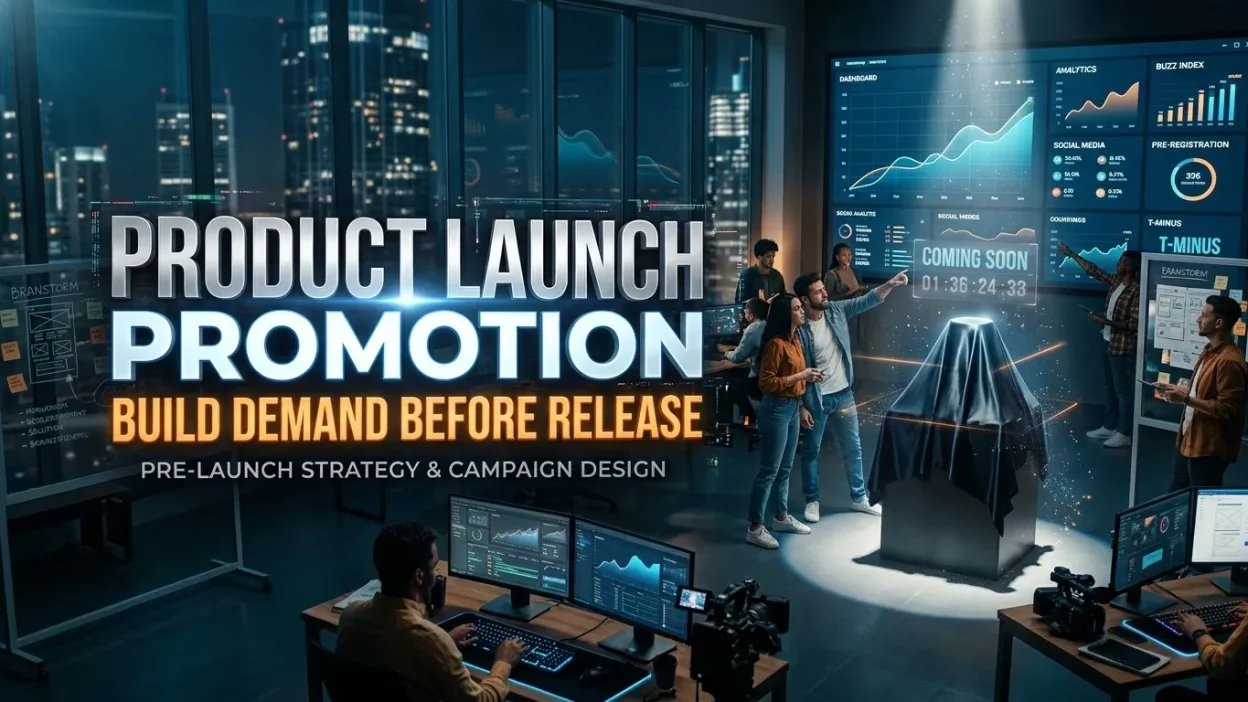
A successful Product Launch Promotion builds anticipation, validates customer demand, strengthens brand awareness, and creates purchase interest before a new product officially becomes available.
Launching a new product is one of the most exciting moments for a business, but it is also one of the most challenging. Companies invest significant time, money, research, and operational resources into developing products that customers will hopefully want to purchase. However, even an innovative product can struggle when potential buyers do not understand its value or have no reason to pay attention when it becomes available.
The problem often begins before launch day. Businesses spend months developing products but dedicate very little time to building awareness, communicating benefits, and understanding what potential customers expect. Consequently, the product becomes available without an established audience, meaningful anticipation, or sufficient purchase intent.
A well-planned Product Launch Promotion changes this situation by introducing the product to the market before its official release. Instead of waiting until inventory is available, businesses begin creating awareness, communicating the problem being solved, collecting customer feedback, and developing relationships with potential buyers.
Consider a company preparing to launch a new productivity application. It could publish a promotional advertisement on launch day and hope people download the application. Alternatively, it could introduce the problem, share development updates, demonstrate selected features, collect early registrations, and build an interested audience several weeks before release. The second approach creates more opportunities to understand customer expectations and prepare an engaged market.
The purpose of a Product Launch Promotion is not simply to generate attention. It is to convert awareness into genuine interest and prepare potential customers to make informed purchasing decisions when the product becomes available.
This process involves market research, audience segmentation, positioning, pre-launch content, email marketing, paid advertising, influencer partnerships, social proof, and performance measurement. Every activity should contribute to a clear commercial objective rather than creating attention without a meaningful next step.
This guide explains how businesses can plan a successful Product Launch Promotion, build demand before release, attract the right audience, develop effective promotional campaigns, and turn early interest into sustainable sales.
Understanding Product Launch Promotion and Why It Matters
A Product Launch Promotion is a coordinated marketing process designed to introduce a new product to its target market, create awareness, communicate value, and encourage purchasing interest before and after its official release.
Unlike ordinary advertising, launch promotion connects several marketing activities around a defined product-release timeline.
The strategy may include teaser campaigns, product demonstrations, landing pages, email sequences, early-access registrations, influencer collaborations, customer research, promotional offers, and launch-day announcements.
The purpose is to make sure potential customers understand the product before they are expected to make a purchasing decision.
Why Product Launch Marketing Should Begin Before Release
Many businesses assume that customers will automatically become interested once a product becomes available.
However, customers rarely purchase unfamiliar products without understanding what they offer and why they matter.
They may have several questions:
- What problem does this product solve?
- How is it different from existing alternatives?
- Why should I consider purchasing it?
- Is the company trustworthy?
- Does the product justify its price?
- Will it meet my expectations?
- Is there a reason to purchase now rather than later?
A planned Product Launch Promotion addresses these questions gradually.
During the early stages, businesses introduce the problem and establish relevance. As the launch approaches, they explain product capabilities and demonstrate value. Finally, they communicate availability, purchasing information, and supporting evidence.
This process reduces uncertainty and makes the purchasing decision easier.
The Business Value of Creating Demand Early
Pre-launch demand generation provides several commercial advantages.
Audience development: Businesses can build a group of potential customers before inventory or product access becomes available.
Market validation: Customer responses can reveal whether the product addresses a meaningful problem.
Improved positioning: Feedback can help businesses identify the most convincing features and benefits.
Sales preparation: Early registrations and enquiries can provide useful demand indicators.
Operational planning: Businesses can estimate potential interest and prepare inventory, customer service, or onboarding resources.
Marketing efficiency: Campaigns can be refined before the full promotional budget is deployed.
These benefits make Product Launch Promotion an important part of commercial planning rather than an activity that begins only when the product is ready for sale.
Establishing the Right Objectives Before Launch
A successful launch needs clear objectives.
Without measurable goals, promotional activities can become disconnected. A company might publish social media content, pay influencers, launch advertisements, and send emails without understanding whether these actions contribute to customer acquisition.
Before designing a Product Launch Promotion, determine what the business wants to achieve.
Define the Primary Business Objective
Different products require different launch priorities.
An e-commerce brand introducing a new skincare product may prioritize initial sales and repeat purchases.
A SaaS business launching a new subscription platform may focus on free-trial registrations, qualified demonstrations, and conversion into paid accounts.
A technology manufacturer may need qualified distributor enquiries and advance orders.
Consider the following objectives:
| Business objective | Suggested measurement | Strategic purpose |
|---|---|---|
| Build awareness | Reach and relevant website visits | Introduce the product |
| Generate interest | Product-page engagement | Evaluate audience attention |
| Capture potential buyers | Qualified registrations | Build a pre-launch audience |
| Validate demand | Survey responses and product enquiries | Understand market interest |
| Generate initial sales | Completed purchases | Measure commercial performance |
| Improve retention | Repeat purchases and active customers | Develop long-term value |
A strong Product Launch Promotion should connect these objectives rather than treating them as separate marketing activities.
Establish Realistic Launch Targets
Targets should reflect market size, product pricing, audience awareness, promotional resources, and historical performance.
For example, a business introducing an unfamiliar enterprise product may need a longer educational process than a retailer launching a new variation of an established product.
Set targets for awareness, qualified leads, sales, and profitability separately.
Avoid selecting arbitrary registration or sales numbers simply because they appear ambitious.
A realistic Product Launch Promotion begins with measurable expectations that the business can actually evaluate.
Determine the Launch Timeline
The launch timeline should account for product development, manufacturing, inventory, website preparation, creative production, and marketing execution.
A common planning structure includes:
- Research and validation.
- Early awareness.
- Audience building.
- Product education.
- Launch preparation.
- Official release.
- Post-launch optimization.
The duration of each stage depends on product complexity and customer purchasing behavior.
A simple consumer product may need a shorter preparation period, while enterprise software or high-value equipment may require several months of education and relationship building.
Identifying the Right Target Audience

Even a well-designed product can struggle when promotional messages reach people who have little reason to purchase it.
Audience identification should therefore happen before large-scale promotional activity begins.
A successful Product Launch Promotion requires a clear understanding of who is most likely to benefit from the product and what motivates their purchasing decisions.
Build an Ideal Customer Profile
An Ideal Customer Profile (ICP) describes the type of customer or organization that is most likely to benefit from a product.
For a consumer product, useful characteristics may include:
- Age range where relevant.
- Product preferences.
- Purchasing motivations.
- Lifestyle requirements.
- Budget expectations.
- Geographical availability.
- Existing product frustrations.
For B2B products, consider:
- Industry.
- Company size.
- Revenue range.
- Business model.
- Decision-maker responsibilities.
- Technology requirements.
- Purchasing capacity.
- Operational challenges.
The objective is not to target everyone who might theoretically purchase the product.
Instead, identify the audience most likely to understand its value and have a genuine reason to purchase.
Understand Customer Problems Before Promoting Features
People generally become interested in products because they address a problem, satisfy a preference, or provide a desired experience.
A business launching a time-management application should not focus exclusively on listing its technical features.
It should first understand why potential customers struggle with productivity.
Some may have difficulty organizing tasks. Others may struggle with team coordination or managing deadlines.
Different customer problems can influence which product benefits deserve attention.
A customer-centered Product Launch Promotion connects product capabilities with real-life situations rather than relying on technical descriptions alone.
Segment Different Audience Groups
Not every potential buyer should receive the same promotional message.
For example, a company launching an accounting application might identify three audience segments:
| Audience segment | Main challenge | Relevant product benefit |
|---|---|---|
| Freelancers | Managing invoices | Simplified invoicing |
| Small businesses | Organizing finances | Centralized financial management |
| Growing companies | Financial visibility | Reporting and operational insights |
This segmentation helps businesses create more relevant campaigns.
The same product can communicate different benefits depending on the audience’s priorities.
Understanding Market Demand Before Product Release
One of the biggest mistakes in product launches is assuming that product development automatically creates market demand.
A business may invest heavily in manufacturing or software development without validating whether customers actually want the proposed solution.
Market research reduces this uncertainty.
Conduct Competitor Research
Begin by identifying existing products that address similar customer problems.
Analyze their:
- Pricing.
- Core features.
- Product positioning.
- Customer reviews.
- Marketing messages.
- Distribution channels.
- Customer complaints.
- Competitive advantages.
The objective is not to copy competitors.
It is to understand what customers already expect and where existing solutions may fall short.
For instance, if competitors provide similar functionality but receive repeated complaints about complicated interfaces, ease of use might become an important positioning opportunity.
Analyze Customer Feedback
Customer feedback provides valuable insight into unmet expectations.
Review public product discussions, support questions, industry forums, and verified customer experiences.
Identify recurring concerns rather than focusing on isolated opinions.
A Product Launch Promotion becomes more effective when its messaging addresses questions customers already have.
Validate Interest Before Investing Heavily
Businesses can test demand through landing pages, product surveys, demonstrations, and early-access registrations.
For example, a company developing a new business software product might create a landing page explaining the intended solution and invite interested businesses to register for updates.
The number and quality of registrations can provide preliminary evidence of interest.
However, registrations should not be confused with guaranteed purchases.
A person who expresses curiosity may still decide against buying after learning the price or evaluating the complete product.
Use multiple research methods to establish a more reliable picture of potential demand.
Developing a Strong Product Positioning Strategy
Positioning explains why a product deserves attention in a competitive market.
A product can have several useful features, but customers need a clear reason to choose it over available alternatives.
Define the Unique Value Proposition
A Unique Value Proposition (UVP) communicates the most important benefit that differentiates a product.
It should explain:
- Who the product serves.
- Which problem it solves.
- What benefit customers receive.
- Why the offering deserves consideration.
For example, a business productivity tool might position itself as a simple project management solution for small teams that need better task visibility without complex enterprise software.
This is more meaningful than claiming that the product is innovative or revolutionary.
A Product Launch Promotion should communicate the UVP consistently across advertisements, websites, social media, email messages, and product demonstrations.
Focus on Benefits Rather Than Feature Lists
Features describe what a product contains.
Benefits explain why those features matter to customers.
| Product feature | Customer benefit |
|---|---|
| Automated reminders | Helps users remember important tasks |
| Cloud synchronization | Allows access across supported devices |
| Advanced reporting | Improves performance visibility |
| Multiple user accounts | Supports team collaboration |
| Custom settings | Adapts the experience to different needs |
A persuasive promotional strategy translates technical functionality into meaningful customer outcomes.
Build a Consistent Brand Message
Your product should have a consistent identity throughout the launch campaign.
Use the same core positioning, visual language, important product descriptions, and approved claims across communication channels.
Inconsistent messaging can create confusion.
For example, an advertisement promising simplicity should not direct customers to a product page filled with unexplained technical language.
A cohesive Product Launch Promotion makes the customer journey easier to understand.
Creating a Pre-Launch Marketing Strategy
Pre-launch activity is where businesses begin converting product awareness into meaningful interest.
The objective is to introduce the upcoming product without overwhelming potential customers with repetitive promotional messages.
Create a Teaser Campaign
A teaser campaign introduces elements of a forthcoming product before revealing every detail.
It may include product visuals, short videos, feature highlights, development updates, or problem-focused messages.
The goal is to create curiosity around something relevant to the target audience.
For example, a technology brand preparing to introduce a new wireless device might publish a short video showing how the product solves a common connectivity problem.
A teaser should create understandable interest rather than relying entirely on vague statements such as “Something big is coming.”
Build a Pre-Launch Landing Page
A landing page provides a central location for people interested in the upcoming product.
It should explain the product’s purpose and provide a clear next step.
Important elements include:
- Product name and introductory message.
- Main customer benefit.
- Relevant product visuals.
- Brief feature information.
- Expected release information where confirmed.
- Early-access registration or enquiry form.
- Privacy information.
- Clear call to action.
A strong landing page helps Product Launch Promotion campaigns convert attention into an identifiable business outcome.
Develop an Email Waiting List
Email registration can provide a direct communication channel with interested customers.
However, the registration process should explain what subscribers can expect.
For example, tell visitors whether they will receive product updates, launch announcements, educational information, or early-access invitations.
Avoid collecting unnecessary information.
An email address and an optional product-interest selection may be sufficient for many early-stage campaigns.
Use Early Access Strategically
Early access allows selected users to explore a product before general availability.
Depending on the business model, this may involve beta access, product demonstrations, pilot programs, or limited availability.
The main benefit is learning.
Early users can identify usability problems, unexpected requirements, and confusing product descriptions.
Their feedback may help improve the product before wider release.
Share Development Progress
Regular updates can help maintain interest between initial awareness and launch day.
Businesses can share:
- Development milestones.
- Product design decisions.
- Manufacturing updates.
- Feature demonstrations.
- Testing progress.
- Frequently asked questions.
A Product Launch Promotion should maintain a reasonable communication rhythm.
Publishing meaningful updates is more valuable than posting daily messages that introduce no new information.
Using Content Marketing to Build Demand
Content marketing helps potential customers understand the problem, evaluate different solutions, and become more familiar with your product category.
It is particularly valuable when customers need education before making a purchasing decision.
Publish Educational Blog Content
Create articles that address the questions customers are likely to ask before purchasing.
For example, a business launching a new home security device could publish content about common security challenges, device compatibility, installation considerations, and maintenance.
These articles attract people who are researching the problem rather than immediately searching for a particular brand.
Create Product Demonstration Videos
Videos help customers visualize how a product works.
A demonstration can show an important feature, explain a common use case, or compare different methods of solving a problem.
Keep demonstrations focused.
A long feature presentation may be less effective than a short explanation showing a specific customer benefit.
Develop Comparison Content
Potential customers often compare products before purchasing.
Comparison articles can explain how a new product differs from existing alternatives.
Focus on accurate information, relevant specifications, actual limitations, and practical benefits.
Avoid misleading competitor comparisons or unsupported superiority claims.
Use Educational Resources to Support Different Buying Stages
Not every person is ready to purchase when they first discover a product.
Some need basic information. Others want technical specifications, pricing details, demonstrations, or customer experiences.
A useful Product Launch Promotion distributes content across these stages.
| Buying stage | Suggested content | Purpose |
|---|---|---|
| Awareness | Educational articles | Explain the customer problem |
| Interest | Product teasers | Introduce the solution |
| Evaluation | Demonstrations and comparisons | Explain product value |
| Consideration | Reviews and FAQs | Reduce uncertainty |
| Purchase | Pricing and product pages | Support conversion |
Using Social Media to Generate Pre-Launch Interest
Social media provides opportunities to introduce products, communicate with potential customers, and create conversations around upcoming releases.
However, effective promotion requires more than repeatedly publishing product images.
Select the Right Social Platforms
Different platforms serve different audiences and content formats.
For example:
- Instagram supports visual storytelling and short product videos.
- Facebook can help businesses communicate with communities and existing customers.
- LinkedIn can be useful for B2B product introductions.
- YouTube supports demonstrations, reviews, and detailed explanations.
- TikTok can help brands introduce visually interesting consumer products.
- X can distribute product news, announcements, and industry conversations.
The right platform depends on audience behavior rather than popularity alone.
Create a Social Media Content Calendar
A content calendar helps maintain consistency throughout the launch period.
An example schedule might include:
| Timeline | Content idea | Marketing objective |
|---|---|---|
| Four weeks before launch | Problem-focused teaser | Build awareness |
| Three weeks before launch | Product introduction | Explain the solution |
| Two weeks before launch | Feature demonstration | Create consideration |
| One week before launch | FAQ and early-access update | Reduce uncertainty |
| Launch day | Official product announcement | Drive sales |
| After launch | Customer experiences | Strengthen confidence |
The calendar should remain flexible enough to incorporate customer feedback and unexpected market developments.
Encourage Authentic Community Participation
Customers may become interested when they can ask questions and participate in discussions.
Brands can organize product Q&A sessions, live demonstrations, feedback conversations, and educational discussions.
Avoid manufacturing popularity through fake comments or artificial engagement.
A trustworthy Product Launch Promotion should encourage genuine interest rather than create an unrealistic impression of demand.
Leveraging Influencers and Creator Partnerships

Influencers and creators can help businesses introduce new products to audiences that already have an established interest in a particular category.
However, audience size alone should not determine partnership suitability.
Choose Creators Based on Audience Relevance
Evaluate potential partners according to:
- Audience interests.
- Content quality.
- Industry relevance.
- Geographic audience distribution.
- Engagement authenticity.
- Brand suitability.
- Previous promotional work.
A creator with a smaller but highly relevant audience may generate better commercial results than a large account with limited product-category relevance.
Provide Creative Freedom
Creators generally understand their audiences better than brands do.
Give them accurate product information, usage instructions, approved claims, and important campaign requirements.
Allow them to present the product naturally within their content style.
Avoid demanding unrealistic promotional statements that may reduce audience trust.
Measure Influencer Performance
Track relevant indicators such as qualified website visits, referral traffic, product enquiries, conversions, and attributable revenue.
Use appropriate campaign links or promotional codes where suitable.
A Product Launch Promotion should measure the commercial contribution of creator partnerships rather than evaluating success through likes and views alone.
Using Customer Feedback and User-Generated Content
Customer experiences can play an important role in helping potential buyers evaluate an unfamiliar product.
However, pre-launch campaigns require care because the product may not yet have enough genuine customers to provide reviews.
Collect Feedback From Beta Users
Businesses offering early product access can invite participants to share their experiences.
Useful questions include:
- Was the product easy to use?
- Which feature provided the most value?
- What was confusing?
- Did the product solve the expected problem?
- What improvements would make the experience better?
Use feedback to improve the product and understand customer expectations.
Develop Authentic User-Generated Content
User-generated content (UGC) includes genuine customer-created videos, photos, demonstrations, and product experiences.
For a newly released product, businesses can invite early users to share their experiences voluntarily.
They should obtain appropriate permission before using customer content in advertisements or other promotional materials.
A campaign featuring relevant UGC Ads can help communicate how real users interact with a product, provided the content and claims are authentic and accurately presented.
Do not present paid creator content as an independent customer opinion.
Use Reviews to Build Confidence
Reviews help customers understand what others experienced after using a product.
For new products, businesses can collect verified feedback after the first customers have received and used the product.
A structured Customer Review Marketing approach can help brands turn genuine feedback into useful promotional evidence without manipulating ratings or concealing negative experiences.
Respond to Feedback Professionally
Not every early user will provide positive feedback.
Some may identify product limitations or problems that require additional attention.
Responding constructively can improve the product and demonstrate accountability.
A Product Launch Promotion should treat feedback as a source of learning rather than an opportunity to display only favorable opinions.
Paid Advertising Strategies for Building Pre-Launch Demand
Organic content and community engagement can create valuable awareness, but paid advertising may help businesses reach relevant audiences more quickly.
The campaign should be designed around a specific objective.
For some businesses, the objective may be early-access registration. For others, it could be product demonstrations, qualified leads, or launch-day purchases.
Prepare Paid Campaigns Before Launch
Start by defining the target audience, promotional message, creative assets, landing page, and conversion measurement.
Avoid launching advertisements before confirming that the registration or product enquiry process works correctly.
Use Search Advertising to Capture Existing Demand
Search advertising can connect businesses with people actively researching a product category or related problem.
It is useful when customers already understand their needs and are looking for possible solutions.
A launch campaign might use relevant commercial search themes to introduce the product to an audience researching the category.
Depending on the campaign objective, advertisers can explore Performance Max to reach audiences across Google’s available advertising inventory, while using suitable Search campaigns for more direct keyword-led demand capture.
Each campaign type should be evaluated according to its targeting, placement, and measurement requirements.
Expand Search Reach Carefully
Businesses targeting multiple geographical markets may benefit from evaluating additional search advertising platforms.
For example, Microsoft Advertising can provide another paid search channel for reaching relevant users beyond Google’s advertising ecosystem.
The decision should be based on audience availability, campaign economics, conversion tracking, and actual commercial performance.
Retarget Interested Visitors Responsibly
People who visit a product page may not be ready to purchase immediately.
However, retargeting depends on the advertising platform, applicable privacy requirements, and the visitor’s consent or other relevant legal basis.
Businesses should not assume that every website visitor can automatically be added to an advertising audience.
Where permitted, appropriately configured remarketing can help communicate launch updates and relevant information to interested audiences.
Creating an Effective Pre-Order and Early-Access Strategy
Pre-orders can provide useful information about demand while allowing customers to secure a product before general availability.
However, they also create expectations that businesses must be prepared to fulfill.
Decide Whether Pre-Orders Suit the Product
Pre-orders may be appropriate for products with predictable manufacturing, clear release dates, and reliable fulfillment arrangements.
They may be less suitable when the development schedule or final product specifications remain uncertain.
Before accepting advance payments, explain the expected delivery period, payment conditions, cancellation rights, and relevant product details.
Communicate Early-Access Benefits
Depending on the product and business model, early access may provide:
- An opportunity to test a new product.
- Advance product information.
- A demonstration session.
- Early product availability.
- Access to a pilot program.
- An opportunity to submit feedback.
Benefits should be realistic and genuinely available.
Avoid artificial scarcity or misleading countdowns.
Build a Reliable Registration Process
A registration form should request only the information needed to manage the early-access program.
Explain how the information will be used and what communications registrants can expect.
Confirm registrations through an appropriate process and provide a clear way to update preferences.
Estimate Demand Without Overcommitting
Pre-order numbers can provide useful forecasting information, but they do not eliminate fulfillment uncertainty.
Review production capacity, supplier availability, return expectations, and customer service resources.
A Product Launch Promotion should be supported by operational readiness rather than encouraging demand that the business cannot fulfill.
Planning the Official Launch Day
Launch day brings together the awareness, audience development, and communication activities completed before release.
The objective is to make the product easy to discover, understand, and purchase.
Coordinate Launch Messaging
Prepare consistent announcements across relevant channels.
These may include the website, email newsletter, social media profiles, creator partnerships, and paid advertising campaigns.
Ensure that product pricing, availability, specifications, and purchasing information remain consistent.
Prepare the Product Page
The launch page should clearly communicate:
- Product name.
- Main value proposition.
- Product images or demonstrations.
- Features and benefits.
- Pricing.
- Availability.
- Shipping or subscription details.
- Warranty and support information.
- Frequently asked questions.
- Purchase call to action.
The customer should not need to search through unrelated pages to understand the offer.
Test the Purchasing Process
Before launch, verify that:
- Payment systems function correctly.
- Inventory information is accurate.
- Mobile layouts work properly.
- Registration forms operate correctly.
- Important analytics events are recorded.
- Confirmation messages are delivered.
- Customer support channels are accessible.
A technically unreliable launch can waste the demand generated by weeks of preparation.
Maintain Communication During Launch
Monitor customer enquiries and provide accurate answers.
If unexpected stock issues, technical problems, or delivery delays occur, communicate them promptly.
A successful Product Launch Promotion includes the customer experience after the promotional message has been delivered.
Measuring Product Launch Promotion Performance
Performance measurement helps businesses determine whether their promotional efforts generate meaningful commercial results.
Without measurement, organizations may mistake attention for demand.
Track Important Launch Metrics
| Metric | What it measures | Business value |
|---|---|---|
| Reach | Number of people exposed | Awareness |
| Relevant website visits | Visits from suitable audiences | Interest |
| Registration rate | Visitors who register | Pre-launch demand |
| Cost per lead | Spending per qualified lead | Acquisition efficiency |
| Email engagement | Meaningful subscriber interaction | Communication effectiveness |
| Conversion rate | Visitors who purchase | Sales performance |
| Average order value | Average purchase value | Revenue quality |
| Customer acquisition cost | Cost of acquiring customers | Financial efficiency |
| Return on advertising spend | Revenue compared with advertising cost | Paid campaign efficiency |
| Refund rate | Purchases subsequently refunded | Customer satisfaction and product fit |
Not every metric needs equal attention.
Select measurements according to the product’s business model and primary commercial objective.
Measure Pre-Launch Demand Separately
Before the product becomes available, measure indicators such as qualified registrations, enquiries, demonstration requests, and customer feedback.
Do not report every registration as a future sale.
A realistic forecast should consider historical conversion rates and the quality of the audience.
Compare Marketing Channels
Evaluate how different channels contribute to demand and sales.
For example, social media may produce strong awareness, while search advertising attracts people with stronger existing purchase intent.
Email communication may produce effective conversions among people who already understand the product.
A Product Launch Promotion becomes easier to optimize when each channel is evaluated according to its role in the customer journey.
Common Product Launch Promotion Mistakes to Avoid
Even well-funded launches can struggle when businesses overlook fundamental marketing requirements.
Starting Promotion Too Late
Waiting until the product is available leaves little time to develop awareness and customer understanding.
Begin building interest while the product is being prepared.
Targeting an Overly Broad Audience
Attempting to reach everyone increases marketing waste.
Identify customers who have a genuine reason to use the product and develop communication around their requirements.
Focusing Only on Product Features
Customers care about how a product improves their situation.
Explain practical benefits rather than publishing technical specifications without context.
Ignoring Customer Feedback
Pre-launch feedback may reveal product weaknesses, confusing messaging, or unmet expectations.
Use the information to make meaningful improvements.
Making Unsupported Promises
Avoid exaggerated performance claims, fabricated testimonials, and unrealistic delivery commitments.
A product launch should create confidence through accurate information.
Using Every Marketing Channel Without a Strategy
More channels do not automatically produce better results.
Choose the platforms that match your audience and establish clear objectives for each.
Neglecting Post-Launch Communication
Marketing should not end when the product becomes available.
Customers may need tutorials, onboarding, troubleshooting, product education, and support.
A strong launch strategy continues after the initial release.
A Practical 30-Day Product Launch Promotion Framework
A focused 30-day framework can help smaller businesses coordinate their preparation and promotional activities.
The timeline is illustrative and should be adjusted for product complexity, market conditions, and operational readiness.
| Period | Main activities | Primary objective |
|---|---|---|
| Days 1–5 | Research audience, competitors, and product demand | Validate market opportunity |
| Days 6–10 | Finalize positioning, messaging, and landing page | Communicate product value |
| Days 11–15 | Publish teaser content and collect registrations | Build awareness |
| Days 16–20 | Share demonstrations and educational resources | Develop consideration |
| Days 21–25 | Activate suitable advertising and partner campaigns | Expand relevant reach |
| Days 26–29 | Review feedback, test purchasing systems, and prepare announcements | Ensure launch readiness |
| Day 30 | Release the product and coordinate promotional activities | Generate initial sales |
Establish Responsibilities
Assign clear responsibilities for:
- Marketing strategy.
- Creative production.
- Product information.
- Website development.
- Advertising management.
- Email communication.
- Customer support.
- Sales reporting.
A defined workflow prevents important activities from being overlooked.
Prepare a Launch-Day Contingency Plan
Identify possible problems before the product becomes available.
Consider website downtime, unexpected demand, inventory shortages, advertising disapprovals, payment failures, and customer service delays.
Define who is responsible for responding to each situation.
Operational preparedness protects both the brand’s reputation and the customer experience.
What Happens After Launch? Turning Initial Buyers Into Long-Term Customers

A product launch should create the beginning of a customer relationship, not simply a short period of sales activity.
The post-launch stage helps businesses learn whether the product fulfills expectations and whether customers are interested in continuing the relationship.
Collect Genuine Customer Feedback
Ask customers about product quality, usability, delivery, functionality, and overall satisfaction.
Use feedback to identify recurring problems and opportunities for improvement.
Respond professionally to negative experiences rather than attempting to hide criticism.
Improve Product Onboarding
For software, educational products, and complex physical products, onboarding can determine whether customers successfully receive the expected value.
Provide instructions, tutorials, support resources, and clear explanations.
An easy initial experience can improve satisfaction and reduce avoidable support requests.
Encourage Repeat Purchases
Depending on the product category, businesses can introduce complementary products, subscriptions, accessories, or relevant upgrades.
These offers should reflect actual customer requirements rather than relying on excessive promotional messages.
Build a Long-Term Customer Community
Customers who enjoy a product may become interested in product updates, educational content, new releases, and community activities.
Maintain communication according to their selected preferences.
Use their feedback to guide future product development.
An effective Product Launch Promotion creates the initial demand, while a thoughtful post-launch strategy helps preserve the value of that demand over time.
Conclusion
Product Launch Promotion is most effective when demand generation begins before the product becomes available. Businesses should understand their audiences, validate market interest, communicate a clear value proposition, and coordinate content, social media, advertising, and early-access activities. Accurate measurement and customer feedback help refine both promotional decisions and product positioning. However, creating demand is only part of the responsibility. Operational readiness, honest communication, reliable fulfillment, and post-launch support determine whether early interest becomes lasting customer value. A successful launch ultimately connects the right product with the right audience through a relevant and trustworthy experience.
Frequently Asked Questions (FAQ)
What is Product Launch Promotion?
Product Launch Promotion is a coordinated marketing strategy used to introduce a new product, generate awareness, build customer interest, and encourage purchases before and after its official release. It can include social media, email marketing, content, advertising, influencer partnerships, and pre-orders.
Why should businesses promote products before launch?
Pre-launch promotion helps businesses build an interested audience, validate demand, collect feedback, and prepare customers for the release. It also provides more time to refine messaging and improve the purchasing experience before launch day.
How long should a product launch campaign last?
The duration depends on product complexity, audience awareness, sales cycles, and marketing resources. A simple consumer product may require a few weeks of preparation, while enterprise technology or specialized equipment may require several months.
What is the best marketing channel for a product launch?
There is no universally best channel. Email marketing, social media, search advertising, content marketing, influencer partnerships, and public relations can serve different purposes. Select channels according to audience behavior, budget, and product type.
How can businesses generate pre-launch demand?
Businesses can publish teaser campaigns, create landing pages, collect early-access registrations, provide product demonstrations, share educational content, and invite relevant audiences to participate in product feedback activities.
Are pre-orders useful for a product launch?
Pre-orders can provide early demand information and allow customers to secure products before general availability. However, businesses must communicate delivery expectations, pricing, cancellation conditions, and fulfillment limitations clearly.
How can customer reviews support a new product launch?
Genuine customer reviews can provide evidence about product quality, usability, and customer satisfaction. Businesses should collect authentic feedback from people who have actually used the product and obtain permission before reusing their content in promotional materials.
How should businesses measure Product Launch Promotion success?
Measure relevant awareness, qualified registrations, website visits, conversion rates, customer acquisition costs, revenue, profitability, and customer retention. Evaluate both pre-launch demand and post-launch commercial results.
What is the difference between pre-launch and post-launch marketing?
Pre-launch marketing builds awareness, interest, and purchasing readiness before the product becomes available. Post-launch marketing focuses on converting interested audiences, supporting customers, collecting feedback, and encouraging repeat purchases.
What is the biggest mistake businesses make during product launches?
One major mistake is beginning promotion too late or assuming that product availability will automatically generate sales. Businesses should validate demand, understand customer needs, communicate meaningful benefits, and prepare the entire purchasing experience before release.