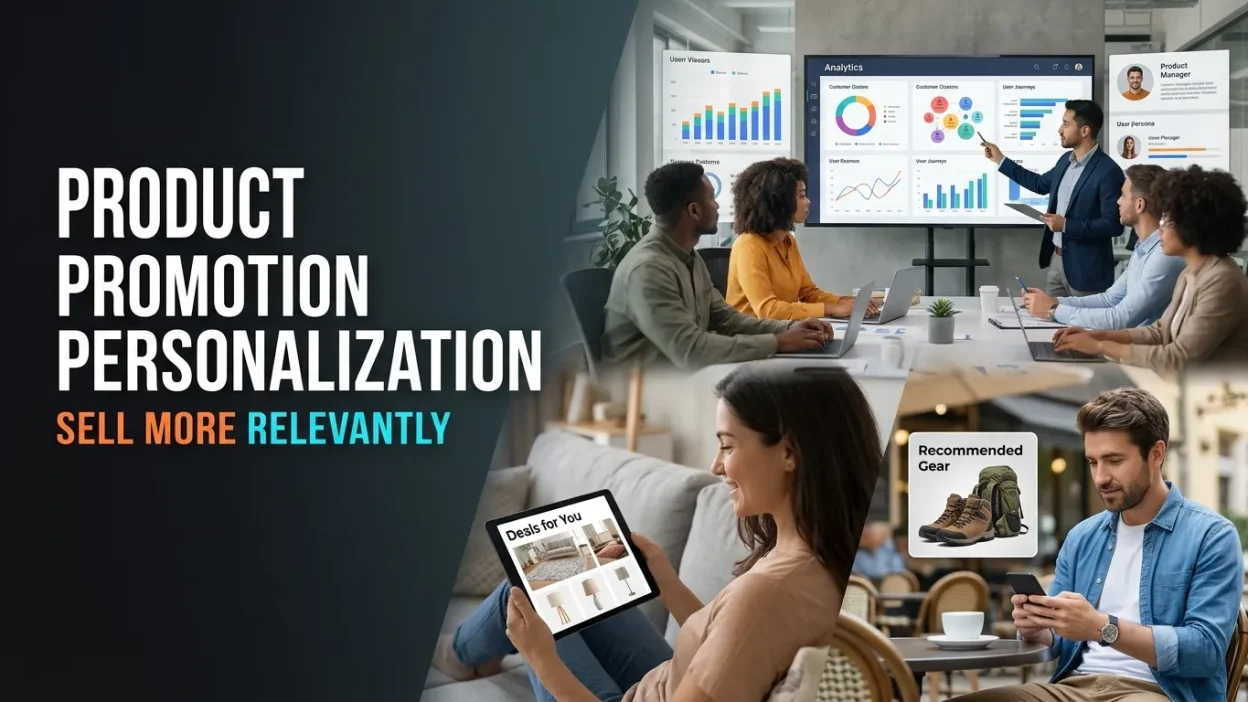
Product Promotion Personalization helps businesses match relevant products, offers, and messages to customer needs, improving discovery, purchase confidence, conversion quality, and long-term relationships across digital channels.
Customers encounter countless promotional messages every day. They see product advertisements on social media, browse ecommerce websites, receive promotional emails, watch product demonstrations, and discover recommendations through search engines. However, seeing a promotion does not necessarily mean someone is interested in purchasing the advertised product. People respond more positively when the products, messages, and offers they encounter relate to their actual needs, preferences, and purchasing situations.
This creates an important opportunity for modern businesses. Instead of presenting identical advertisements and promotional offers to everyone, brands can use customer information, purchasing behaviour, browsing activity, and product interests to create more relevant experiences. The objective is to help potential buyers discover products that genuinely match what they are looking for.
Product Promotion Personalization is the process of adapting product recommendations, promotional messages, offers, advertising content, and customer experiences according to individual or audience-level preferences. It helps businesses move beyond generic promotions and communicate product value in a way that feels more useful to each customer.
For example, an online fashion retailer may identify customers who regularly explore athletic clothing. Instead of sending those customers advertisements for every product category, the business can highlight sportswear collections, related accessories, and relevant offers. Similarly, an electronics retailer can recommend compatible accessories to customers who previously purchased a smartphone.
The value comes from relevance rather than simply increasing the number of promotional messages. When customers encounter products that match their interests, they can evaluate purchasing options more easily. Businesses may also improve advertising efficiency by reducing irrelevant impressions and focusing on audiences with stronger potential interest.
However, successful Product Promotion Personalization requires more than collecting customer data and automatically generating recommendations. Businesses must understand customer psychology, select appropriate promotional methods, maintain data quality, respect privacy preferences, and continuously measure campaign results.
This guide explains how to develop an effective personalization strategy, understand customer behaviour, create relevant product recommendations, improve promotional campaigns, and measure commercial performance. It also explores practical examples, automation opportunities, common mistakes, and implementation steps that help businesses sell more relevantly without overwhelming their audiences.
What Is Product Promotion Personalization?
Product Promotion Personalization is a marketing approach that adapts how products are presented and promoted according to customer preferences, behaviour, purchasing history, demographics, interests, and relevant contextual information.
Instead of showing every visitor the same product selection, businesses use available information to identify which products, benefits, and offers may be most relevant to different customer groups.
For example, two customers visiting the same ecommerce website may see different product recommendations.
One customer may frequently explore skincare products and receive recommendations for moisturisers, cleansers, and complementary products. Another may regularly purchase fitness equipment and see relevant training accessories or exercise products.
Both customers interact with the same brand, but the promotional experience reflects different purchasing interests.
Product Promotion Personalization can operate across multiple marketing channels, including websites, mobile applications, email campaigns, paid advertisements, social media platforms, and customer loyalty programmes.
How the Personalization Process Works
A typical personalization process follows several stages:
- Collect relevant customer information through appropriate and permitted sources.
- Identify customer interests, preferences, and purchasing behaviour.
- Organise customers into meaningful segments.
- Select products and promotional messages relevant to each segment.
- Deliver recommendations through suitable marketing channels.
- Measure engagement, conversions, and revenue.
- Improve promotional relevance using actual performance information.
For example, a customer who purchases a coffee machine may receive recommendations for compatible filters, coffee accessories, or maintenance products.
The business does not need to promote its entire inventory to that person. It can focus on products that naturally complement the original purchase.
Personalization Versus Traditional Product Promotion
Traditional promotion often uses the same offer, advertisement, and product selection for a broad audience.
Personalised promotion adapts the experience according to available customer information.
| Traditional Product Promotion | Personalised Product Promotion |
|---|---|
| Similar messages for everyone | Messages reflect customer interests |
| Broad product recommendations | Relevant product suggestions |
| General promotional offers | Segmented offers |
| Limited behavioural context | Uses appropriate customer activity |
| Broad audience targeting | More specific audience groups |
| General campaign evaluation | Customer and segment-level analysis |
Traditional promotion still has a place in brand awareness and mass-market campaigns. However, personalised communication can become more useful when businesses understand what different customers actually want.
Why Relevance Matters More Than Promotional Volume
Customers do not necessarily become more interested because a brand sends more advertisements.
Repeatedly showing irrelevant products can create frustration, reduce engagement, and weaken brand perception.
Product Promotion Personalization helps businesses focus on the quality of communication rather than simply increasing the number of impressions.
The goal is to create a stronger connection between what the business offers and what the customer is most likely to value.
Why Businesses Need Personalised Product Promotions
Customer expectations have changed as digital shopping experiences have become more convenient.
People increasingly expect businesses to understand their interests, provide useful recommendations, and make product discovery easier.
A brand that repeatedly presents irrelevant offers may struggle to maintain attention, even when its products are competitive.
Improve Product Discovery
Large product catalogues can make purchasing decisions difficult.
Customers may need to browse dozens or hundreds of products before finding something suitable.
Relevant recommendations can simplify this process by highlighting products connected to the customer’s interests.
For example, an online furniture retailer may identify visitors exploring compact apartment furniture. The website can prioritise space-saving desks, storage solutions, and multifunctional furniture.
Product Promotion Personalization makes product discovery more focused and reduces the effort required to identify relevant purchasing options.
Increase Purchase Confidence
Customers often hesitate when they are unsure which product will satisfy their requirements.
They may compare different models, read specifications, examine reviews, and investigate whether a product is suitable for their situation.
A personalised promotion can help by presenting relevant options together with useful explanations.
For instance, a customer interested in beginner photography equipment may benefit from recommendations organised around ease of use, compatibility, and budget.
This approach supports informed decisions rather than simply pushing the most expensive product.
Reduce Irrelevant Advertising
Advertising budgets can be wasted when campaigns repeatedly reach people who have little interest in the promoted products.
A personalised strategy allows marketers to use available customer signals to refine audience selection and promotional content.
Businesses can prioritise product categories that match customer interests and reduce unnecessary exposure to unrelated offers.
However, segmentation quality matters. Incorrect assumptions can still produce irrelevant promotions.
Improve Conversion Opportunities
When customers encounter a product that matches their needs, they may become more willing to explore its features and consider purchasing.
Relevant messaging can also reduce uncertainty by highlighting the benefits that matter most to a particular audience.
Product Promotion Personalization can support better conversion opportunities when it is combined with strong product information, transparent pricing, and a convenient purchasing experience.
Strengthen Customer Relationships
Customers may develop stronger relationships with brands that consistently provide useful recommendations.
A business that remembers preferences appropriately, respects communication choices, and provides relevant suggestions can create a more comfortable shopping experience.
Personalization should make customers feel understood rather than monitored.
This distinction is essential for maintaining trust.
Understand Customer Psychology Before Personalising Promotions
A successful personalization strategy begins with understanding why people purchase.
Customer behaviour is influenced by emotional needs, practical requirements, perceived risk, price sensitivity, social influence, and previous experiences.
Businesses should consider these motivations when creating promotional campaigns.
The Relevance Principle
People naturally pay more attention to information that relates to their current needs.
A customer researching running shoes is more likely to notice an advertisement for suitable footwear than an unrelated kitchen appliance.
This is the foundation of Product Promotion Personalization.
Businesses should use relevant customer signals to determine which products deserve attention.
The Choice Overload Problem
Too many options can make decision-making difficult.
When customers encounter an enormous range of products without useful guidance, they may postpone purchasing.
Personalised recommendations can reduce the number of irrelevant options and help visitors explore a smaller, more suitable selection.
For example, a retailer can recommend three products based on the customer’s budget and intended use rather than displaying an overwhelming catalogue.
The objective is not to remove choice but to make useful choices easier to evaluate.
The Trust Principle
Customers need confidence that recommendations are genuinely useful.
If a business continually promotes expensive items regardless of customer requirements, people may eventually question its recommendations.
Product Promotion Personalization should prioritise product suitability, honest descriptions, and transparent offers.
A recommendation that acknowledges limitations can be more trustworthy than one that presents every product as perfect.
The Reciprocity Principle
People may appreciate brands that provide useful information before asking for another purchase.
A customer who receives helpful product guidance, maintenance instructions, or educational content may become more comfortable interacting with the brand again.
This creates an opportunity to introduce relevant promotions naturally.
The Social Proof Principle
Customer experiences can influence purchasing confidence.
Reviews, ratings, case studies, product demonstrations, and authentic customer stories help potential buyers understand how other people evaluate a product.
Use genuine evidence and provide appropriate context.
Product Promotion Personalization can become more persuasive when suitable customer proof accompanies relevant recommendations.
The Timing Principle
An offer presented at the wrong time may receive little attention.
Someone who purchased a product yesterday may not need another immediate sales message. A customer who has been researching a replacement product for several weeks may be more receptive to an appropriate offer.
Consider buying cycles, product usage, previous activity, and customer preferences when scheduling promotional communication.
Collect the Right Customer Data for Personalization
Personalization depends on the quality and relevance of the information businesses use.
However, collecting more data does not automatically produce better marketing results.
Organisations should identify which information is genuinely useful and ensure that collection and processing follow applicable privacy requirements.
First-Party Customer Data
First-party data is information a business collects directly through its own customer interactions and digital properties.
Examples include:
- Purchase history.
- Product category interests.
- Website browsing activity.
- Customer account preferences.
- Email engagement.
- Loyalty programme participation.
- Customer support interactions.
- Product reviews.
- Wishlist activity.
This information can help businesses understand their existing customer relationships.
For example, a retailer may use purchase history to identify customers who regularly purchase particular product categories.
Zero-Party Data
Zero-party data is information customers intentionally share with a business.
Examples include preferred product categories, style preferences, budget ranges, product requirements, and communication preferences.
Businesses can collect this information through preference centres, surveys, quizzes, and registration forms.
Customers should understand why information is requested and how it will improve their experience.
Behavioural Data
Behavioural information can provide insights into how visitors interact with a website or application.
It may include:
- Products viewed.
- Categories explored.
- Searches performed.
- Items added to a wishlist.
- Shopping cart activity.
- Previous conversions.
- Campaign interactions.
Product Promotion Personalization can use suitable behavioural information to recommend relevant products or trigger appropriate messages.
However, browsing activity does not always represent purchase intent. Someone may explore a product for research purposes without intending to buy it.
Transactional Data
Transactional information provides evidence of actual purchasing behaviour.
Useful attributes include product quantities, average order value, purchase frequency, preferred payment methods, and order recency.
Businesses can use these details to identify replenishment opportunities, complementary products, and suitable customer segments.
Data Quality and Privacy
Poor customer information can produce incorrect recommendations.
A customer may have changed preferences, purchased a gift for someone else, or stopped using a particular product.
Businesses should maintain accurate records and use reasonable retention periods.
They should also respect consent, privacy rights, cookie choices, and applicable data protection requirements.
The objective of Product Promotion Personalization is to improve relevance through responsible information use, not to collect information without a clear purpose.
Build Customer Segments That Support Relevant Product Promotions
Customer segmentation converts customer information into useful marketing groups.
Instead of creating completely individual campaigns for every customer, businesses can identify patterns among people with similar interests or behaviour.
Segment by Demographics
Demographic segmentation can use relevant characteristics such as age range, location, language, or household situation when lawfully collected and appropriate.
For example, a business selling winter clothing may adapt product recommendations according to the climate of the customer’s location.
However, demographic assumptions should not replace actual customer preferences.
Two people with similar demographic characteristics may have completely different product requirements.
Segment by Purchase Behaviour
Purchasing behaviour provides useful information about what customers already value.
Possible groups include:
| Customer segment | Behaviour | Suitable promotion |
|---|---|---|
| First-time buyers | Completed an initial purchase | Product education and complementary items |
| Repeat customers | Purchased multiple times | Loyalty benefits and new products |
| High-value customers | Higher historical spending | Exclusive products and relevant premium offers |
| Discount-sensitive customers | Frequently use promotional offers | Profitable bundles |
| Inactive customers | No recent activity | Re-engagement campaigns |
| Category-focused shoppers | Repeated interest in one category | Relevant product recommendations |
Product Promotion Personalization becomes easier when campaigns are organised according to meaningful behavioural segments.
Segment by Customer Intent
Customer intent describes what someone is trying to achieve.
A visitor may be researching product information, comparing alternatives, looking for a specific price, or preparing to purchase.
Different intentions require different promotional approaches.
An educational guide may support someone in the research stage, while a comparison chart may help a customer evaluating alternatives.
A product offer may become more useful when a visitor has demonstrated stronger buying intent.
Segment by Customer Lifecycle
The customer lifecycle provides another useful segmentation approach.
Customers may be:
- Newly acquired.
- Actively purchasing.
- Regular customers.
- Loyal advocates.
- At risk of becoming inactive.
- Fully inactive.
A first-time customer may need introductory guidance, whereas a long-term customer may prefer early access or advanced product recommendations.
Avoid treating all customers as though they are at the same relationship stage.
Create Personalised Product Recommendations
Product recommendations help customers discover items that match their interests, purchasing patterns, or current needs.
They can appear on ecommerce websites, mobile applications, product pages, checkout screens, and marketing emails.
Related Product Recommendations
Related products share similarities with an item the customer is currently viewing.
For example, a shopper exploring wireless headphones may receive recommendations for other headphones with similar specifications.
This helps customers compare suitable options without starting another search.
Complementary Product Recommendations
Complementary recommendations suggest products that work alongside an item the customer already purchased or intends to purchase.
Examples include:
- Phone cases for smartphones.
- Lenses for compatible cameras.
- Storage accessories for laptops.
- Replacement filters for water purifiers.
- Protective equipment for sporting goods.
These recommendations can increase order value when they genuinely support the customer’s needs.
Alternative Product Recommendations
Sometimes the most appropriate recommendation is an alternative rather than an additional item.
A customer may be viewing a premium product that exceeds their budget.
Presenting a suitable lower-priced option can help the customer make a comfortable decision.
Product Promotion Personalization should not always push customers toward higher spending.
Replenishment Recommendations
Some products are used regularly and may need replacement.
Examples include skincare products, household essentials, pet supplies, and certain consumables.
Businesses can use purchase timing and product information to send appropriate replenishment reminders.
Avoid assuming that every customer consumes products at exactly the same rate.
New Product Recommendations
Existing customers may appreciate discovering new products that relate to their previous interests.
For example, a retailer can introduce a new collection to customers who have previously purchased related items.
The recommendation should explain why the product may be relevant rather than relying exclusively on the word “new.”
Personalise Promotional Offers Without Damaging Profitability
Promotional offers can encourage purchasing, but excessive discounting may weaken profit margins and train customers to wait for sales.
A business should determine which customers need a financial incentive and which may respond to other benefits.
Personalised Discount Offers
A discount may be suitable for customers who are comparing similar products or waiting for a better purchase opportunity.
Businesses can segment offers according to purchase history, margin, and relevant customer behaviour.
For example, a retailer might provide a suitable offer to inactive customers rather than discounting products for people who were already planning to purchase.
Product Bundles
Bundles combine complementary products into one purchasing offer.
A photography retailer may create a camera and accessory bundle, while a skincare business may combine products designed for a particular routine.
Bundles can improve convenience and encourage relevant additional purchases.
The total price should remain transparent.
Loyalty-Based Promotions
Loyal customers may appreciate benefits that recognise their relationship with the business.
These could include early access, additional loyalty points, exclusive products, or member-only offers.
The value should reflect the customer’s preferences rather than automatically increasing the discount.
Time-Sensitive Promotions
A genuine limited-time offer can encourage action when customers have a relevant purchasing need.
However, false countdowns and artificial scarcity can damage trust.
Clearly explain the actual offer conditions and expiry date.
Product Promotion Personalization should create relevant opportunities without manipulating customers into unnecessary purchases.
Personalise Promotions Across Different Marketing Channels
Customers interact with businesses across several platforms.
A product recommendation seen on a website may be followed by an email, a social media advertisement, or an application notification.
A consistent strategy can connect these interactions.
Ecommerce Website Personalization
Websites can display relevant product recommendations based on suitable customer information.
Examples include recently viewed items, complementary products, preferred categories, and recommendations based on previous purchases.
Keep these recommendations useful and avoid displaying products that are unavailable or unsuitable.
Email Marketing Personalization
Email allows businesses to deliver relevant recommendations directly to customers who have appropriate marketing permissions.
Campaigns can be segmented using purchase history, category preferences, and engagement.
For example, a customer who previously purchased gardening equipment may receive useful seasonal recommendations related to plant care or outdoor maintenance.
Mobile Application Personalization
Mobile applications can provide relevant product suggestions through home screens, account areas, and suitable notifications.
However, notifications should remain limited and useful.
Allow customers to manage notification preferences and avoid sending promotional messages at inappropriate times.
Social Media Personalization
Social media platforms offer advertising and content opportunities that help brands reach relevant audiences.
A practical Social Media Marketing strategy can connect product promotion with audience interests, campaign objectives, and content planning.
Businesses should use suitable audience information and avoid assuming that every follower has the same product needs.
Seasonal Campaign Personalization
Customer interest often changes according to seasons, occasions, weather, and purchasing cycles.
A fashion retailer may promote different products during summer and winter, while a home improvement business may adjust recommendations according to seasonal household projects.
A structured Seasonal Digital Marketing approach can help businesses coordinate personalised offers with actual customer demand.
Product Promotion Through Customer Content
Customer experiences can help potential buyers understand how products work in real situations.
Authentic Video Testimonials can demonstrate product value through genuine customer experiences.
Businesses should obtain permission, preserve the customer’s original meaning, and avoid presenting exceptional results as typical outcomes without supporting evidence.
Use User-Generated Content in Promotions
Customer-created demonstrations, product reviews, and practical experiences can make advertisements more relatable.
UGC Ads can introduce products through content that reflects genuine customer use.
Product Promotion Personalization can improve these campaigns by matching the content and featured products with relevant audience interests.
Use AI and Automation to Scale Personalised Promotions
Personalisation becomes more difficult when businesses manage large customer databases and extensive product catalogues.
AI and automation can help process information, identify patterns, and deliver recommendations at scale.
However, automated output must remain accurate and relevant.
AI-Powered Product Recommendations
Recommendation systems can analyse available product and customer information to identify potential matches.
Depending on the implementation, these systems may use collaborative filtering, content-based filtering, or hybrid recommendation methods.
Collaborative filtering identifies patterns among users with similar behaviour.
Content-based methods use product attributes and customer interests to recommend relevant items.
Hybrid systems combine different approaches.
Businesses should evaluate recommendation quality using actual customer engagement and conversion data rather than assuming AI-generated suggestions are automatically useful.
Automated Customer Segmentation
AI-supported systems can help identify groups of customers with similar purchasing behaviour.
For example, an organisation may discover a segment of customers who frequently purchase premium products but rarely respond to discounts.
The business can test a different promotional approach for this group.
Product Promotion Personalization should use segments that are understandable and actionable rather than creating unnecessary complexity.
Predictive Product Recommendations
Predictive systems attempt to estimate which products or categories may be relevant to a customer in the future.
They may consider purchase history, product relationships, activity patterns, and other permitted information.
Predictions should be treated as probabilities rather than guaranteed purchasing intentions.
Automated Email and Campaign Workflows
Marketing automation platforms can trigger campaigns according to defined activities.
Examples include:
- Welcome communication after registration.
- Product suggestions after purchasing.
- Complementary recommendations after delivery.
- Replenishment reminders.
- Relevant loyalty notifications.
- Re-engagement messages for inactive customers.
Set clear conditions and frequency limits.
Automation should pause or adjust when customers change their preferences, complete a purchase, or opt out of marketing.
Maintain Human Oversight
AI-generated descriptions may contain inaccurate product details or recommendations that do not make commercial sense.
Marketing teams should verify product availability, pricing, eligibility, and claims before important campaigns are delivered.
The strongest approach combines automation with human judgement.
Improve Product Promotion Through Search Visibility and Useful Content
Product promotion does not depend exclusively on paid advertisements.
Customers also discover products through search engines, educational content, comparisons, recommendations, and AI-assisted search experiences.
Understand Zero-Click Search Behaviour
Customers may discover product information directly from search results without immediately visiting a website.
Understanding Zero-Click Searches helps businesses recognise why accurate product descriptions, useful answers, and brand visibility matter beyond website traffic alone.
A shopper may learn about a product through a search summary and later visit the retailer directly.
Build Topic Coverage Around Product Categories
Businesses should develop useful content that answers customer questions surrounding their product categories.
For example, a home appliance retailer can publish buying guides, product comparisons, maintenance instructions, and troubleshooting resources.
A well-planned Topical Authority Strategy can help connect related content and establish a more useful information structure.
Match Search Intent With Product Information
A customer researching a product needs different information from someone ready to purchase.
Informational content should explain features, use cases, and selection criteria.
Commercial pages should help customers compare alternatives, understand pricing, and evaluate product suitability.
Transactional pages should make availability, delivery, payment, and purchasing steps clear.
Product Promotion Personalization becomes more effective when promotional content matches the customer’s actual research stage.
Measure the Performance of Product Personalization
A successful personalization strategy should generate measurable business value.
Businesses should not rely only on clicks, impressions, or email engagement to determine whether personalised promotions are working.
Product Recommendation Click-Through Rate
This metric measures how frequently customers click recommended products.
Formula:
Recommendation CTR = (Recommendation Clicks ÷ Recommendation Impressions) × 100
It can help businesses understand whether recommendations attract attention.
However, a click does not necessarily represent purchase intent.
Personalised Campaign Conversion Rate
This measures the percentage of campaign recipients or visitors who complete a defined purchasing action.
Formula:
Conversion Rate = (Completed Purchases ÷ Eligible Campaign Visits or Recipients) × 100
The denominator should remain consistent when comparing different campaigns.
Average Order Value
Average order value measures the average revenue generated per completed transaction.
Formula:
Average Order Value = Total Order Revenue ÷ Number of Completed Orders
Personalised bundles and complementary recommendations may influence this metric.
However, a higher average order value should be evaluated alongside margin and customer satisfaction.
Revenue Per Customer
This metric helps businesses understand how much revenue individual customers generate during a defined period.
It can help compare customer groups exposed to different promotional experiences.
Repeat Purchase Rate
Repeat purchase rate measures the percentage of customers who make more than one purchase during a defined period.
Product Promotion Personalization can support repeat purchasing when recommendations remain relevant after the original transaction.
Customer Lifetime Value
Customer lifetime value estimates the total value expected from a customer relationship.
It helps businesses understand whether personalised promotional activities contribute to longer-term commercial performance.
Return on Advertising Spend
ROAS compares advertising-attributed revenue with advertising expenditure.
Formula:
ROAS = Advertising-Attributed Revenue ÷ Advertising Spend
For example, a campaign generating $10,000 in attributed revenue from $2,000 in advertising spend has a reported ROAS of 5.
This does not automatically mean the campaign is profitable. Product costs, fulfilment, discounts, returns, and other expenses must also be considered.
Measure Incremental Performance
One of the biggest measurement challenges is determining whether personalisation actually created additional purchases.
A customer may have purchased even without receiving the recommendation.
Businesses can use appropriate A/B tests, holdout groups, and controlled experiments to compare personalised experiences with standard campaigns.
This helps distinguish incremental results from purchases that would have happened anyway.
Common Product Personalization Mistakes Businesses Should Avoid
A personalised campaign can perform poorly when customer data is inaccurate, recommendations are irrelevant, or promotional communication becomes excessive.
Recommending Unrelated Products
Customers may lose confidence when recommendations do not match their interests.
Review recommendation rules and use accurate product relationships.
Overusing Customer Information
Using unnecessary personal information can create discomfort.
Collect only information that has a clear business purpose and follow applicable privacy and consent requirements.
Sending Too Many Promotional Messages
Even relevant offers can become irritating when delivered too frequently.
Set reasonable communication limits and allow customers to control their preferences.
Ignoring Product Availability
Recommending unavailable products creates frustration.
Connect recommendation systems with accurate inventory information.
Focusing Only on Discounts
A discount may encourage an immediate purchase but weaken margins or train customers to wait for another promotion.
Use education, product suitability, exclusivity, and convenience alongside promotional pricing.
Assuming AI Recommendations Are Always Correct
Automated systems can identify patterns incorrectly or make unsuitable predictions.
Review recommendation quality and introduce human oversight where necessary.
Ignoring Mobile Experiences
Many customers discover and purchase products through smartphones.
Make sure personalised recommendations, product pages, and checkout experiences work effectively on smaller screens.
Measuring Only Engagement
High clicks and impressions do not guarantee revenue.
Track conversions, margins, repeat purchasing, and customer retention.
A Practical 90-Day Product Personalization Implementation Roadmap
A phased implementation approach allows businesses to build a reliable personalization strategy without changing every marketing system simultaneously.
| Period | Priority | Activities | Expected outcome |
|---|---|---|---|
| Days 1–15 | Customer data audit | Review purchase history, browsing behaviour, and preferences | Reliable customer data |
| Days 16–30 | Segmentation | Create groups based on interests, behaviour, and lifecycle | Actionable customer segments |
| Days 31–45 | Campaign development | Build recommendation blocks, emails, and promotional offers | Personalised campaign assets |
| Days 46–60 | Automation | Connect recommendation and campaign workflows | Scalable delivery |
| Days 61–75 | Testing | Compare personalised and standard campaigns | Performance insights |
| Days 76–90 | Optimisation | Improve segments, recommendations, and offers | More efficient promotional strategy |
Days 1–15: Audit Existing Customer Information
Identify which customer information is available and whether it can be used appropriately.
Review data quality, purchase records, product interests, and existing segmentation.
Identify gaps that may affect recommendation accuracy.
Days 16–30: Build Meaningful Segments
Create practical customer segments.
Start with first-time buyers, repeat customers, category-focused shoppers, and inactive customers.
Avoid creating too many segments before the business understands which groups produce meaningful differences.
Days 31–45: Create Personalised Campaigns
Develop product recommendations, segmented emails, and suitable promotional offers.
Make sure each campaign has a clear customer objective and measurable outcome.
Days 46–60: Introduce Automation
Connect customer data with appropriate marketing workflows.
Test product availability, pricing information, delivery conditions, and communication preferences.
Days 61–75: Run Controlled Tests
Compare personalised recommendations with existing promotional campaigns.
Evaluate clicks, conversions, average order value, and customer response.
Use suitable control groups to understand incremental impact.
Days 76–90: Improve Performance
Review campaign results and identify the strongest customer segments and promotional approaches.
Remove ineffective recommendations and improve the messaging where relevance is weak.
Product Promotion Personalization should become a continuous marketing improvement process rather than a one-time campaign setup.
Conclusion
Product Promotion Personalization helps businesses connect the right products with the right customers through relevant recommendations, tailored offers, and useful communication. Its effectiveness depends on accurate customer information, meaningful segmentation, responsible data practices, and continuous performance measurement. Start by understanding purchasing behaviour, creating actionable customer groups, and introducing relevant recommendations across appropriate channels. Then test campaign performance and improve the experience using real customer feedback. Rather than sending more promotional messages, businesses should focus on delivering greater relevance. A thoughtful personalization strategy can improve product discovery, strengthen customer confidence, encourage repeat purchases, and support sustainable revenue growth.
Frequently Asked Questions (FAQ)
What Is Product Promotion Personalization?
Product Promotion Personalization is a marketing approach that adapts product recommendations, offers, advertisements, and promotional messages according to customer preferences, purchase history, interests, and relevant behaviour.
Why Is Personalization Important in Product Promotion?
It helps businesses present more relevant products to customers, reduce irrelevant advertising, simplify product discovery, and create purchasing experiences that better reflect individual needs.
How Can Businesses Personalise Product Recommendations?
Businesses can use relevant purchase history, product interests, browsing activity, customer preferences, and product relationships to recommend suitable items. Recommendations should be tested and updated when customer needs change.
What Types of Data Are Useful for Product Promotion Personalization?
Useful information can include first-party purchase data, zero-party preferences, browsing activity, product category interests, previous transactions, and customer engagement. Data collection should follow applicable privacy and consent requirements.
Can Small Businesses Use Product Promotion Personalization?
Yes. Small businesses can begin with simple customer segments, personalised emails, complementary product recommendations, and purchase-based offers. More advanced automation can be introduced as their data and marketing requirements grow.
How Does AI Improve Product Personalization?
AI can analyse customer and product information, identify behavioural patterns, support product recommendations, and automate campaign delivery. Businesses should maintain human oversight and evaluate the accuracy and usefulness of automated suggestions.
Does Personalised Product Promotion Increase Sales?
It can improve purchasing opportunities by making product recommendations and offers more relevant. However, results depend on product suitability, pricing, customer demand, campaign quality, and the overall buying experience.
What Is the Difference Between Product Personalization and Customer Segmentation?
Customer segmentation groups people according to shared characteristics or behaviour. Product personalization uses relevant information to adapt products, recommendations, offers, or messages for individuals or specific segments.
Which KPIs Should Businesses Track for Personalised Product Promotions?
Important metrics include recommendation click-through rate, campaign conversion rate, average order value, revenue per customer, repeat purchase rate, customer lifetime value, and incremental campaign performance.
How Can Businesses Start a Product Promotion Personalization Strategy?
Start by reviewing available customer data, identifying meaningful customer segments, selecting relevant products, and creating personalised campaigns. Test the results, maintain appropriate privacy controls, and improve recommendations using actual customer behaviour and performance information.