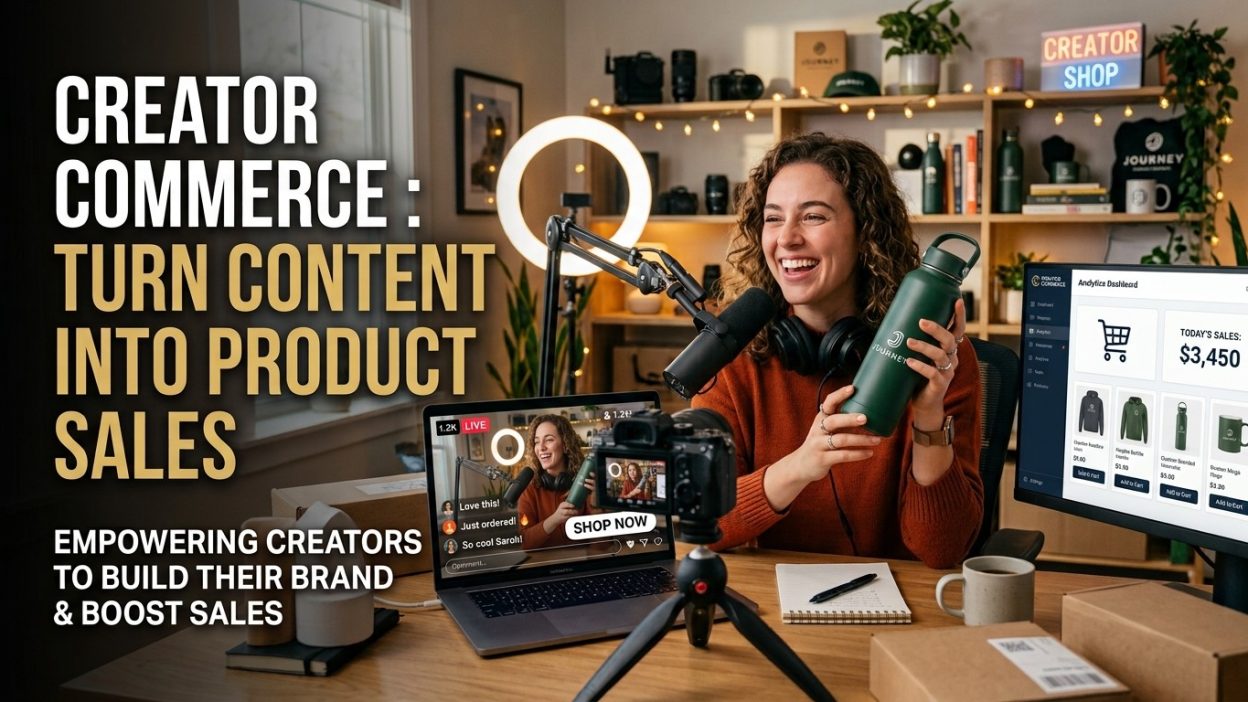
Creator Commerce connects trusted content with product discovery, recommendation, checkout, attribution, and retention to turn audience attention into measurable and sustainable commerce growth.
Content has become one of the most powerful ways for consumers to discover products, understand their benefits, compare alternatives, and make purchasing decisions. At the same time, creators have developed direct relationships with audiences that traditional advertising often struggles to reproduce. Creator Commerce brings these two forces together by connecting content, trust, product discovery, and transactions within a more connected customer journey.
The old model was relatively simple: a brand created an advertisement, purchased distribution, and sent people toward a product page. The modern customer journey is more fragmented. A person might discover a product through a short video, watch a detailed review later, search for additional information, compare products through creator recommendations, read community comments, and finally purchase through a creator’s link or storefront.
This evolution changes what brands need from creators. The creator is no longer only an awareness channel. A creator can become an educator, reviewer, recommender, community leader, affiliate, product demonstrator, and commerce partner. Creator Commerce therefore requires marketers to think beyond impressions and measure how content influences the complete commercial journey.
The opportunity is enormous, but success does not happen automatically. Large audiences do not guarantee large sales. Viral content can produce weak commercial results. An attractive storefront can still fail when product positioning is unclear. A powerful recommendation can lose the sale when checkout is complicated.
Effective Creator Commerce solves these problems by building a connected system where the right creator reaches the right audience with the right product story at the right stage of intent.
What Is Creator Commerce?
Creator Commerce is a business model and marketing strategy that allows content creators to influence product discovery, consideration, purchase, and sometimes post-purchase advocacy through content and creator-led distribution.
At its simplest, the model looks like this:
Creator Content → Audience Attention → Product Interest → Recommendation → Click → Purchase → Repeat Purchase
Traditional influencer marketing often focuses on exposure. Creator Commerce places stronger emphasis on transaction and measurable business outcomes.
A creator may recommend a product in a video, demonstrate it in a tutorial, showcase it inside a routine, link directly to it, sell through a storefront, offer a personalized discount, or earn a commission when an audience member purchases.
The defining characteristic is the connection between influence and commerce.
Creator Commerce can exist on social platforms, websites, live-streaming environments, marketplaces, newsletters, communities, blogs, podcasts, messaging channels, and creator-owned storefronts. The technology may change, but the underlying principle remains the same: trusted content helps move consumers closer to a purchasing decision.
Why Creator Commerce Is Growing
Consumer behavior is increasingly shaped by people rather than brands alone.
People seek recommendations from personalities they already follow because creators often make product information easier to understand. A creator can show a product in context, explain how it works, discuss limitations, compare alternatives, and answer questions from an audience.
That creates a more human purchasing journey.
Creator Commerce also addresses a major problem in modern advertising: attention scarcity.
Consumers are exposed to enormous volumes of promotional content. Many ads are ignored because they look and feel like advertisements. Creator-led content can sometimes reduce this resistance by integrating product information into formats the audience already wants to consume.
The key word is “sometimes.”
Creator content only becomes commercially powerful when the product feels relevant and the creator’s recommendation feels credible.
The Difference Between Influencer Marketing and Creator Commerce
The two concepts overlap, but their objectives can be different.
| Influencer Marketing | Creator Commerce |
|---|---|
| Often focused on awareness | Strongly connected to transactions |
| Exposure can be the main KPI | Revenue and customer value matter heavily |
| Short campaigns are common | Ongoing relationships are valuable |
| Brand messaging may dominate | Creator context often matters more |
| Reach is highly visible | Conversion and lifetime value receive more attention |
| Post-click journey may be secondary | Product journey is central |
Creator Commerce does not replace influencer marketing. It extends it.
A creator can still generate awareness, but the commercial infrastructure makes it easier to turn that awareness into measurable customer action.
The Psychology Behind Creator Commerce
People do not make purchasing decisions purely through rational analysis.
Emotion, familiarity, trust, social proof, perceived similarity, convenience, urgency, identity, and risk all influence decisions.
Creator Commerce works partly because creators can reduce several psychological barriers at the same time.
Familiarity Reduces Uncertainty
Repeated exposure makes the creator familiar.
Familiarity can make recommendations feel easier to process.
Demonstration Reduces Risk
Seeing a product being used helps audiences visualize their own experience.
Social Proof Creates Confidence
When respected creators and other customers use a product, uncertainty can decline.
Identification Increases Relevance
Audiences may think, “That person’s situation is similar to mine.”
Authority Simplifies Decisions
Experts can help users understand complicated products quickly.
Personal Experience Adds Context
Creators can explain what a product actually feels like to use rather than simply repeating specifications.
These psychological factors make Creator Commerce especially useful for products that require education or trust.
The Creator Is a Distribution Layer
A creator’s audience is not simply a collection of followers.
It is a distribution layer built on attention, familiarity, community, and content habits.
This changes how brands should evaluate partnerships.
A creator with 70,000 highly engaged followers in a specialized category may provide more commercial value than a creator with 700,000 broad followers.
The question is not:
“How many people can this creator reach?”
A better question is:
“How many relevant people are likely to care about this product when this creator recommends it?”
That shift from reach to relevance is fundamental to Creator Commerce.
Choosing the Right Creator
Creator selection should consider both audience characteristics and creator behavior.
Evaluate:
- Audience relevance
- Audience location
- Content quality
- Engagement quality
- Historical brand partnerships
- Product-category expertise
- Communication style
- Community activity
- Commercial credibility
- Platform suitability
A useful scoring model could look like this:
| Factor | Weight |
|---|---|
| Audience relevance | 25% |
| Content quality | 20% |
| Trust and credibility | 15% |
| Engagement quality | 15% |
| Platform fit | 10% |
| Commercial history | 10% |
| Cost efficiency | 5% |
The exact weights can change by product and market.
A highly technical product may prioritize expertise.
A fashion product may prioritize aesthetic fit.
A household product may prioritize demonstration ability.
Creator Commerce becomes stronger when creator selection is treated as a strategic decision instead of simply buying audience size.
Audience-Product Fit
The strongest creator partnership often feels inevitable.
When followers see the recommendation, they immediately understand why the creator is discussing that product.
For example, a home organization creator promoting storage products makes intuitive sense.
A fitness creator recommending training equipment makes sense.
A software educator demonstrating productivity tools makes sense.
The creator does not need to invent an artificial reason for discussing the product.
That natural context makes the promotional message easier to accept.
Trust Is the Real Currency
Creators can generate clicks through curiosity, but trust is what makes recommendations commercially valuable.
Audience trust can be weakened when creators:
- Promote unrelated products
- Recommend everything positively
- Hide commercial relationships
- Exaggerate claims
- Misrepresent personal experience
- Promote products they obviously do not use
Brands should therefore avoid treating creators as interchangeable media placements.
Creator Commerce works best when the commercial relationship is compatible with the creator’s existing identity.
The Product Story
A product needs a story that can live naturally inside content.
The strongest story often answers four questions:
What problem exists?
Why is it frustrating?
What does the product change?
Why is that change valuable?
Creators can then express the story through their own experiences.
For example, a kitchen creator might explain how a particular tool saves preparation time.
A productivity creator might demonstrate how a software product removes repetitive work.
A beauty creator might document a routine and explain the improvement.
The product becomes part of a useful story instead of appearing as an isolated sales pitch.
Demonstration-Based Selling
Demonstration is one of the most powerful formats in Creator Commerce.
Instead of saying a product is fast, show the speed.
Instead of saying a tool is easy to use, demonstrate the setup.
Instead of claiming a product produces better results, show a realistic comparison.
Demonstration reduces the amount of imagination the customer needs to perform.
The viewer can see:
Before
Action
After
This creates evidence.
Evidence often carries more persuasive weight than generic promotional language.
Tutorials as Commerce Content
Tutorial content is particularly valuable because it delivers immediate utility.
The audience came to learn something.
The product appears because it helps solve the problem being explained.
This creates alignment between education and commerce.
For example:
“How to organize your weekly meals”
could naturally introduce a meal-planning product.
“How to create professional product photos”
could naturally demonstrate a photography tool.
“How to manage freelance projects”
could naturally introduce project-management software.
The commercial message feels less intrusive because the product is integrated into the lesson.
Reviews and Buying Guides
Consumers often seek creator content after becoming aware of a product.
At this stage, they want answers.
They want to know:
- Is it worth the price?
- Is it easy to use?
- What are the downsides?
- Who should buy it?
- Who should avoid it?
- What alternatives exist?
- Is there a cheaper option?
Creator reviews can address these questions directly.
Balanced reviews can actually increase sales because honesty creates credibility.
A creator who says, “This is excellent for beginners, but advanced users may need another option,” can appear more trustworthy than someone who claims every product is perfect.
Comparison Content
Comparison content is especially useful for audiences close to purchase.
Examples include:
Budget vs premium
Old vs new
Brand A vs Brand B
Basic vs professional
Manual vs automated
The format naturally supports decision-making.
Creator Commerce can benefit from comparison content because the audience already has purchasing intent.
At this stage, information quality often matters more than raw entertainment.
Content Formats That Support Commerce
Different formats can serve different stages.
| Format | Strongest Use |
|---|---|
| Short-form video | Awareness |
| Tutorial | Education |
| Review | Evaluation |
| Comparison | Decision support |
| Live stream | Interaction and conversion |
| Newsletter | Deeper recommendation |
| Blog | Search-driven discovery |
| Podcast | Authority and trust |
| Community post | Discussion and social proof |
| Product showcase | Commercial action |
A mature Creator Commerce strategy does not force every creator into one content format.
It matches format to audience behavior.
The Role of Short-Form Video
Short-form video can generate rapid product discovery because it captures attention quickly.
The hook is critical.
Effective hooks often involve:
- A problem
- A surprising observation
- A common mistake
- A transformation
- A comparison
- A result
- A strong opinion
The content should then move quickly toward context and demonstration.
A creator who spends the first fifteen seconds discussing unrelated topics risks losing the commercial opportunity.
The Role of Long-Form Content
Long-form content gives creators space to build deeper trust.
This can include:
- Detailed reviews
- Buying guides
- Tutorials
- Product experiments
- Case studies
- Interviews
- Educational series
Long-form content is particularly useful for expensive, complex, unfamiliar, or technical products.
Creator Commerce does not always require immediate conversion.
Sometimes the creator’s job is to move the customer from uncertainty to confidence.
Live Commerce
Live content can compress the distance between content and transaction.
During a live session, the creator can:
- Demonstrate products
- Answer questions
- Compare options
- Explain features
- Address objections
- Introduce limited offers
- Respond to audience feedback
The interactive nature of live content can create a stronger buying environment.
However, poor execution can feel overly aggressive.
The best live commerce sessions provide genuine value before pushing the transaction.
Building a Creator Storefront
Creator storefronts can organize recommendations into a single destination.
A creator might categorize products by:
- Favorite tools
- Beginner essentials
- Best-value choices
- Premium picks
- Daily routine
- Travel
- Home
- Work
- Fitness
This makes recommendations easier to explore.
It can also improve conversion by reducing search friction.
Instead of asking followers to remember a product mentioned several weeks ago, the creator gives them one organized destination.
Affiliate Commerce
Affiliate models are commonly connected with Creator Commerce because they directly align creator compensation with customer action.
The creator can receive a commission based on sales.
Brands can track:
- Clicks
- Orders
- Revenue
- Conversion rate
- Average order value
- Commission cost
- Repeat purchases
Affiliate compensation can be particularly useful when brands want performance-based economics.
However, commissions should not become the only measure of partnership value.
Creators can also contribute awareness, content assets, customer insight, and brand credibility.
Discount Codes
Personalized codes can make creator campaigns easier to track.
A creator might offer:
CREATOR10
or another unique promotion identifier.
Codes provide useful attribution when link tracking is imperfect.
They also give the audience a concrete reason to act.
However, brands should avoid making every creator campaign dependent on discounts.
Constant price reductions can weaken perceived value.
Sometimes an exclusive bundle, bonus, free trial, early access, or limited feature is more appropriate.
The Landing Page Experience
Creator content can generate powerful intent, but the post-click experience determines whether that intent becomes revenue.
The landing page should answer:
What is this?
Why do I need it?
Why should I trust it?
How much does it cost?
What happens after I buy?
Message consistency matters.
If the creator highlights one benefit while the landing page focuses on something completely different, confusion can increase.
A strong Creator Commerce journey preserves the creator’s central message all the way to checkout.
Reducing Purchase Friction
Friction can exist at multiple levels.
Information Friction
The user cannot understand the product.
Trust Friction
The user doubts quality or legitimacy.
Price Friction
The perceived value does not justify the cost.
Process Friction
Checkout is difficult.
Choice Friction
Too many options create confusion.
Technical Friction
The website or payment experience fails.
Brands should identify which type exists instead of simply increasing traffic.
More traffic does not solve a broken buying journey.
Social Proof After the Click
The creator’s recommendation creates initial confidence, but the product page should reinforce it.
Useful signals can include:
- Customer reviews
- Ratings
- Testimonials
- Usage statistics
- Expert commentary
- Demonstration videos
- Return policies
- Security indicators
- Frequently asked questions
The exact combination depends on the product.
The purpose is simple:
Reduce uncertainty.
Pricing Psychology
Price is not evaluated in isolation.
Consumers ask:
Compared with what?
How long will it last?
How much value will I receive?
Can I justify the purchase?
A creator can help frame price through context.
Instead of simply saying “This costs $100,” the creator can explain why the product is worth $100 and who is likely to benefit.
That creates value framing.
The brand should ensure the claim remains truthful and supportable.
Scarcity and Urgency
Limited-time offers can increase action because they reduce indefinite postponement.
However, false scarcity damages trust.
Real scarcity might involve:
- Genuine launch pricing
- Limited inventory
- Seasonal availability
- Time-limited bonus
- Real event deadline
Artificial countdown timers that reset repeatedly can create skepticism.
Creator Commerce should optimize conversion without destroying credibility.
Building the Right Call to Action
A CTA should tell the audience what to do next.
Examples:
Explore the collection
Try the free version
Use the creator code
See the full comparison
Shop the recommended bundle
The CTA should match the user’s current intent.
A viewer who has just discovered the product may prefer “Learn more.”
A viewer who has watched a detailed comparison may be ready for “Shop now.”
Intent determines the correct CTA.
Attribution
Attribution is critical because creator-led customer journeys can involve multiple touchpoints.
A user may:
- See a creator video.
- Search the product later.
- Read reviews.
- Return through organic traffic.
- Purchase directly.
The creator influenced the purchase even though the last click came from another channel.
This is one reason Creator Commerce measurement can be complex.
Useful tracking methods include:
- Affiliate links
- Unique discount codes
- Dedicated landing pages
- UTM parameters
- Creator-specific storefronts
- Platform analytics
- Post-purchase surveys
Brands should ideally combine multiple signals rather than depending on one attribution method.
Last-Click Attribution Can Undervalue Creators
Last-click reporting gives credit to the final measurable interaction.
That can be misleading when creators primarily influence early or middle stages of the funnel.
Consider a customer who watches a creator review, waits three days, searches the product on Google, and purchases.
A pure last-click model may credit search with 100% of the revenue.
The creator influenced demand but receives no attribution.
More sophisticated measurement considers assisted conversions and multi-touch influence where data quality allows.
Measuring Creator Commerce Performance
A useful measurement framework can cover the entire funnel.
| Funnel Stage | Metrics |
|---|---|
| Awareness | Reach, impressions, views |
| Engagement | Likes, comments, saves, shares |
| Intent | Profile visits, clicks, product-page views |
| Conversion | Orders, purchases, subscriptions |
| Economics | CAC, CPA, ROAS |
| Customer Value | AOV, repeat purchase, LTV |
| Advocacy | Reviews, referrals, UGC |
The most important KPI depends on the business model.
An awareness campaign may prioritize reach.
An affiliate campaign should emphasize revenue and conversion.
A subscription product should consider retention and lifetime value.
Customer Acquisition Cost
Creator Commerce should eventually be evaluated through customer acquisition economics.
A simplified formula is:
CAC = Total Creator Campaign Cost ÷ Number of New Customers
Suppose a company spends $12,000 on creators and acquires 600 new customers.
CAC is:
$12,000 ÷ 600 = $20
The number becomes meaningful only when compared with customer value.
If each customer produces $60 in contribution margin, the economics may be attractive.
If each produces $10, the strategy needs improvement.
Return on Ad Spend
When creator content is amplified through paid advertising, ROAS can help evaluate the paid component.
ROAS = Revenue Attributed to Advertising ÷ Advertising Cost
Creator content can sometimes provide useful creative material for paid campaigns because it can look more native than traditional promotional assets.
But brands must secure appropriate usage rights before using creator content commercially.
Lifetime Value
Customer lifetime value becomes particularly important for products with repeat purchases.
Imagine a creator generates 300 first-time customers.
Each produces only $25 in initial revenue.
However, many return multiple times over the next year.
The economic value can become significantly larger than the first purchase suggests.
This is why creator partnerships should not always be judged immediately after the first sale.
A good Creator Commerce strategy considers the complete customer relationship.
Retention After Creator Acquisition
Customer retention can be influenced by the quality of the initial recommendation.
When creators accurately explain who the product is for and how it should be used, customers may have more realistic expectations.
That can improve post-purchase satisfaction.
When creators make exaggerated claims, the opposite can happen.
Customers may purchase quickly and become disappointed quickly.
For businesses that rely heavily on apps, Creator Commerce should therefore connect with lifecycle systems such as Mobile App Marketing And Retention to support onboarding, engagement, repeat usage, and reactivation after creator-driven acquisition.
Customer Reviews as Commerce Content
Customers increasingly become part of the content ecosystem themselves.
A satisfied customer can create:
- Unboxing videos
- Tutorials
- Reviews
- Demonstrations
- Comparisons
- Before-and-after posts
- Social recommendations
This creates a flywheel:
Creator Recommendation → Customer Purchase → Customer Experience → Customer Content → New Discovery
The strongest brands encourage this flywheel without making customer participation feel forced.
User-Generated Content
User-generated content provides another layer of social proof.
Unlike a paid creator, a customer may have no direct commercial incentive beyond their own experience.
That can make authentic customer content especially persuasive.
However, brands should obtain appropriate permission before republishing customer content and should avoid presenting paid or incentivized content as completely independent.
Turning Creators Into Long-Term Partners
Short-term campaigns can generate useful results, but long-term relationships often create deeper commercial value.
A creator who repeatedly works with a product becomes more knowledgeable about it.
They can:
- Answer common questions
- Explain advanced use cases
- Introduce new products
- Share honest feedback
- Create recurring content
- Build community challenges
- Support launches
Over time, the creator becomes more than a promotional channel.
They become a commercial partner.
Building an Ambassador Program
An ambassador program can formalize long-term Creator Commerce relationships.
Potential components include:
- Custom commission
- Exclusive products
- Early access
- Creator codes
- Performance bonuses
- Community access
- Product feedback opportunities
- Content resources
Ambassador programs work best when participation feels valuable to both sides.
Creator Feedback as Product Research
Creators can reveal what customers understand and what they do not understand.
Suppose a creator receives hundreds of questions about a product’s compatibility.
That is useful product information.
If multiple creators struggle to explain the same feature, the product may have a communication problem.
Creator Commerce can therefore produce market intelligence in addition to sales.
Turning Comments Into Insights
Comment sections are often overlooked.
Yet comments can reveal:
- Purchase objections
- Price concerns
- Feature requests
- Confusion
- Competitor comparisons
- Product interest
- Audience language
Brands can categorize comments and use the findings to improve:
Product pages
FAQs
Advertising
Creator briefs
Customer support
Product development
This creates a valuable feedback system.
Search Behavior and Creator Discovery
Creator content can trigger search activity beyond social platforms.
A consumer might see a creator discussing a product and then search:
Product name
Product reviews
Best alternatives
How the product works
Is the product worth it?
Brands should prepare their digital ecosystem to capture this demand.
For mobile applications, marketplace visibility can become particularly relevant when creator-driven interest leads users toward an app listing, where App Store Optimization can help convert branded and category-based discovery into installs.
Creator Commerce and Product Education
Some products are difficult to sell through short promotional claims.
Examples include:
- Software
- Professional equipment
- Technical products
- Health and wellness technology
- Financial tools
- Educational products
- Business services
These products benefit from explanation.
A creator can break complexity into understandable pieces.
That makes Creator Commerce especially powerful for education-heavy purchase journeys.
Building Content Around Customer Objections
A sophisticated campaign does not only answer:
“Why buy this?”
It also answers:
“Why might I hesitate?”
Common objections involve:
- Price
- Quality
- Complexity
- Compatibility
- Results
- Durability
- Security
- Learning curve
Creators can address these concerns directly.
A video titled “Who should actually buy this product?” may generate stronger commercial trust than an overly promotional announcement.
Product Bundles
Brands can collaborate with creators to create bundles based on audience needs.
For example:
Beginner Bundle
Creator Starter Kit
Home Essentials
Professional Package
Bundles can simplify choice.
This is valuable because too many individual products can create decision fatigue.
A creator can curate the options and explain why each item belongs in the bundle.
Exclusive Creator Products
Some brands take Creator Product Promotion Creator Product Promotion further by developing products or collections in partnership with creators.
This can increase differentiation.
The creator can participate in:
- Product ideation
- Design
- Naming
- Testing
- Launch
- Community feedback
The resulting product may have stronger audience relevance because the creator understands the community.
Co-Creation
Co-creation moves the relationship from promotion toward participation.
Instead of asking:
“Can you sell our product?”
the brand asks:
“Can we build something your audience genuinely needs?”
This can create stronger alignment because the creator contributes audience insight.
It also gives the campaign a more authentic story.
Seasonal Creator Commerce
Creator Commerce can be particularly effective during moments when consumer intent naturally increases.
Examples include:
- Holiday gifting
- Back-to-school
- New Year
- Summer travel
- Wedding seasons
- Major product launches
- Shopping events
Seasonal content should focus on the customer’s problem.
For example, rather than saying “Holiday promotion,” a creator could explain how to choose gifts for a particular type of person.
That makes the content useful first and commercial second.
Product Launch Strategy
A coordinated creator launch can happen in stages.
Phase 1: Seeding
Selected creators receive the product before launch.
Phase 2: Education
Creators publish tutorials, reviews, and demonstrations.
Phase 3: Launch
Multiple creators publish around the same period.
Phase 4: Social Proof
Customer reactions and creator feedback strengthen confidence.
Phase 5: Retargeting
The brand re-engages high-intent visitors through appropriate channels.
This sequence helps create sustained momentum rather than one short attention spike.
The Importance of Timing
A creator campaign can fail because it arrives when the audience is not ready.
Timing can be influenced by:
- Season
- Product availability
- Launch stage
- Audience behavior
- Competitor activity
- Promotional calendar
- Creator posting patterns
The right content at the wrong moment may still produce weak sales.
Building a Creator Brief
A useful brief should provide clarity without destroying creator authenticity.
Include:
Campaign Objective
What business outcome matters?
Target Audience
Who should respond?
Product Truth
What must be accurately communicated?
Key Benefits
What genuinely matters to customers?
CTA
What should viewers do?
Offer
Is there a code, bundle, trial, or special access?
Requirements
What disclosures and brand guidelines apply?
The creator should still have room to communicate naturally.
Creative Freedom Versus Brand Control
Too much control can make content sound like an advertisement.
Too little control can produce inaccurate claims or inconsistent messaging.
The best balance is:
Strategic constraints + creative freedom
The brand controls truth, legal requirements, positioning, and objectives.
The creator controls voice, format, storytelling style, and audience communication.
This balance can significantly improve Creator Commerce performance.
Authenticity in Sponsored Content
Audiences generally understand that creators make money from brand partnerships.
The issue is not sponsorship itself.
The issue is misleading communication.
Clear disclosure, honest reviews, accurate claims, and genuine product familiarity support long-term trust.
Creators should not claim personal experiences they did not have.
Brands should not pressure creators to make unsupported promises.
Trust is an asset that takes time to build and seconds to damage.
Micro-Creator Strategies
Smaller creators can be highly valuable when they have strong audience alignment.
Their communities may be more specialized.
Their content may generate deeper conversations.
Their recommendations may feel more personal.
Micro-creators can be especially useful for:
- Niche products
- Local campaigns
- Specialized industries
- Emerging brands
- Test campaigns
- Community building
The objective is not necessarily to replace large creators.
A portfolio approach may combine large reach with niche credibility.
Creator Portfolio Strategy
Instead of depending on one creator, brands can build a diversified network.
For example:
2 large creators
5 mid-sized creators
15 niche creators
This creates multiple audience entry points.
It can also produce more content variations and reduce dependency on one personality.
Portfolio-based Creator Commerce allows the brand to compare different creator segments and identify which combinations produce the strongest customer economics.
Testing Creator Content
Testing can reveal which ideas generate both engagement and commercial action.
Variables might include:
- Hook
- Content length
- Demonstration
- Offer
- CTA
- Product angle
- Story structure
- Thumbnail
- Product placement
One creator may succeed with tutorials.
Another may succeed with comparisons.
A third may perform best with personal storytelling.
Testing should discover these differences rather than forcing everyone into one template.
Scaling Winning Creators
When a creator consistently produces profitable customers, brands can increase investment.
Scaling may involve:
- More posts
- Longer partnerships
- Additional products
- Paid amplification
- Affiliate incentives
- Ambassador status
- Exclusive campaigns
But scaling should remain disciplined.
Performance can decline when audiences experience excessive promotional frequency.
Avoiding Audience Fatigue
Repeated sponsorships can reduce attention.
Audiences may begin ignoring posts when every piece of content becomes commercial.
A healthy Creator Commerce calendar should balance:
Education
Entertainment
Community
Personal content
Product content
The Micro-Influencer Product Promotion should feel like one useful part of the creator’s ecosystem, not the entire ecosystem.
Creator Whitelisting and Paid Amplification
With appropriate authorization, brands can sometimes amplify creator content through paid distribution.
This creates a hybrid model:
Creator credibility + paid reach
The brand can use high-performing creator content as advertising creative.
This can extend the content’s life beyond the creator’s existing audience.
Again, commercial usage rights must be clearly agreed upon.
Commerce Across Multiple Platforms
Creators often operate across several platforms.
A single creator may publish:
- Short videos
- Long videos
- Stories
- Posts
- Newsletter content
- Podcasts
- Blogs
- Community messages
The product story should remain consistent while the format changes.
Each platform may require a different creative approach.
The commerce experience should also be optimized for each platform’s user behavior.
Creator Commerce and Email
Email can extend the life of creator-driven demand.
For example, someone may discover a product through a creator and then subscribe to the brand’s email list.
The brand can continue educating the prospect with:
- Product guides
- Tutorials
- Customer stories
- Comparison content
- Offers
- FAQs
This helps convert creator-generated attention into an owned customer relationship.
Building an Owned Audience
Creators have audiences.
Brands need owned relationships too.
A purchase should ideally create an opportunity for the brand to build a direct customer connection through appropriate channels.
This can include:
- Customer accounts
- Loyalty programs
- Community
- SMS where appropriate
- App experiences
Creator Commerce is strongest when rented attention eventually contributes to durable customer relationships.
Repeat Purchase Strategy
The first purchase is only one part of commerce.
Brands should understand:
Why did the customer buy?
When will they need the product again?
What complementary products might be useful?
What experience would make them recommend the brand?
Creator partnerships can continue after the initial purchase through tutorials, usage tips, new product education, and community content.
Cross-Selling and Upselling
Once the customer trusts the brand, relevant complementary products may increase order value.
However, cross-selling should be contextual.
A creator can demonstrate how two products work together rather than simply announcing that both are available.
This turns upselling into education.
The Creator Commerce Flywheel
A sustainable system can be represented as:
Discovery
Creator introduces the product.
↓
Trust
Audience believes the recommendation is relevant.
↓
Education
Creator explains how the product works.
↓
Conversion
Audience clicks or purchases.
↓
Experience
Customer uses the product.
↓
Advocacy
Customer shares feedback.
↓
New Discovery
Other consumers discover the product.
The more effectively this flywheel operates, the less the brand depends solely on repeated paid acquisition.
Common Creator Commerce Mistakes
Choosing Reach Over Relevance
Large audiences can be commercially weak when product fit is poor.
Giving Creators Generic Scripts
Rigid scripts can eliminate authenticity.
Focusing Only on Views
Attention is not the same as purchase intent.
Ignoring the Landing Page
Great creator content cannot rescue a poor checkout experience.
Overusing Discounts
Discount dependency can damage perceived value.
Measuring Only Last Click
Influence may occur earlier in the journey.
Ignoring Lifetime Value
First-order revenue may understate customer value.
Promoting Too Frequently
Audience fatigue can reduce trust.
Failing to Test
One campaign does not prove a strategy.
Ignoring Customer Feedback
Comments often reveal the exact reason people do or do not purchase.
Avoiding these problems makes Creator Commerce more sustainable.
A Practical Creator Commerce Funnel
A practical funnel can be structured into seven stages.
Stage 1: Discover
Use creator content to introduce the problem or product.
Stage 2: Recognize
Connect the product with a customer need.
Stage 3: Understand
Explain the product through tutorials, demonstrations, or reviews.
Stage 4: Trust
Use proof, transparency, and real experiences.
Stage 5: Act
Create a clear CTA and low-friction buying process.
Stage 6: Experience
Deliver the promised product value.
Stage 7: Advocate
Turn satisfied customers into reviews, referrals, and content creators.
This funnel helps brands identify exactly where performance breaks.
A 90-Day Creator Commerce Strategy
A focused 90-day strategy can be divided into three phases.
Days 1–30: Research and Test
Identify the target customer.
Analyze successful creators.
Review competitor campaigns.
Develop product stories.
Build attribution.
Recruit a small pilot group.
Launch controlled campaigns.
The objective is to learn.
Days 31–60: Optimize
Compare creators.
Analyze content performance.
Test offers.
Improve landing pages.
Refine CTAs.
Study comments.
Identify high-value customers.
The objective is to find repeatable patterns.
Days 61–90: Scale
Increase investment in proven creators.
Develop longer partnerships.
Repurpose winning content.
Launch ambassador relationships.
Expand creator storefronts.
Integrate creator activity with broader marketing channels.
The objective is predictable growth.
Building a Creator Commerce Dashboard
A useful dashboard should answer five questions.
How much attention did we generate?
How much intent did we create?
How many customers did we acquire?
What did those customers spend?
What is their long-term value?
Useful dashboard columns might include:
| Creator | Reach | Clicks | Orders | Revenue | CAC | AOV | LTV |
|---|---|---|---|---|---|---|---|
| Creator A | 250K | 8,400 | 420 | $21K | $18 | $50 | $112 |
| Creator B | 110K | 6,300 | 510 | $27K | $13 | $53 | $127 |
| Creator C | 400K | 4,100 | 180 | $9K | $29 | $50 | $76 |
The numbers in such a dashboard should be interpreted according to attribution quality and customer behavior.
The example demonstrates an important principle: the creator with the biggest reach does not necessarily generate the best economics.
Forecasting Creator Commerce Growth
Once sufficient historical data exists, brands can begin estimating expected results.
Potential variables include:
- Audience size
- Historical engagement
- Click-through rate
- Conversion rate
- Average order value
- Repeat purchase rate
- Creator fee
- Commission
- Content production cost
A simple model can estimate:
Expected Revenue = Expected Clicks × Conversion Rate × Average Order Value
This should be treated as a planning model, not a guarantee.
Real performance can vary significantly.
Profitability Versus Revenue
High revenue does not automatically mean high profitability.
Creator Commerce costs may include:
- Creator fees
- Commissions
- Product samples
- Shipping
- Management
- Production
- Discounts
- Platform fees
- Paid amplification
The correct question is:
How much profitable customer value did this campaign create relative to total cost?
That is the commercial foundation of the strategy.
Integrating Creator Commerce With Other Marketing Channels
Creator-led selling does not need to operate separately.
Creators can feed demand into:
- Search
- Retargeting
- Content marketing
- Organic social
- Affiliate marketing
- App acquisition
- Customer communities
For example, a creator campaign can generate branded search demand, which later converts through another channel.
This is why multi-channel measurement is important.
Creator Commerce and Brand Building
Performance and brand building do not have to compete.
A creator can drive immediate sales while simultaneously strengthening brand familiarity.
Repeated exposure can make the product more recognizable.
Recognition lowers future cognitive effort.
A customer who already knows the brand may require less explanation next time.
Thus, today’s creator campaign can influence tomorrow’s direct traffic and organic demand.
Building a Sustainable Content Engine
The most successful brands do not treat each creator post as an isolated event.
They build a content engine.
One creator campaign can create:
Original video → Short clips → Paid ads → Product-page assets → Email content → Social posts → FAQ ideas → Search content
With appropriate permissions, this multiplies the value of the original collaboration.
The result is not just one promotional post.
It is a reusable content asset.
The Role of AI in Creator Commerce
Artificial intelligence can support creator operations by helping with:
- Creator discovery
- Audience analysis
- Content ideation
- Performance analysis
- Comment classification
- Customer sentiment analysis
- Product recommendation
- Campaign reporting
- Creative testing
But AI should not replace the human relationship between creator and audience.
Audience trust comes from authenticity and context.
Automation can increase efficiency.
It cannot automatically manufacture credibility.
Privacy and Responsible Data Use
Creator Commerce often involves tracking clicks, purchases, and customer interactions.
Brands should use data responsibly.
Customer information should be handled according to applicable privacy requirements and platform rules.
Tracking should serve a legitimate business purpose.
Creators should not be encouraged to make misleading claims merely because a certain statement converts better.
Sustainable commerce depends on maintaining customer trust.
The Future of Creator Commerce
The future of Creator Commerce is likely to become increasingly connected to social shopping, recommendation engines, live commerce, affiliate infrastructure, personalized discovery, community ecosystems, and direct creator storefronts.
Creators may increasingly function across the complete funnel:
Discoverer
Educator
Reviewer
Recommender
Seller
Community leader
Product collaborator
This means brands will need to evaluate creator partnerships using broader commercial measures.
The best question will not simply be:
“How many views did we get?”
It will become:
“How effectively did this creator move relevant customers from attention to value?”
That is a much more sophisticated way to understand commerce through content.
Final Creator Commerce Framework
A sustainable Creator Commerce program can be remembered through eight principles.
Relevance
Choose creators whose audiences genuinely need the product.
Trust
Protect the creator’s credibility.
Context
Make the product fit naturally into content.
Demonstration
Show real value.
Convenience
Make purchasing simple.
Measurement
Track the full customer journey.
Retention
Focus on what happens after the first sale.
Relationship
Turn successful collaborations into long-term partnerships.
When these principles work together, content stops being merely a source of attention.
It becomes a commercial system.
Final Checklist
Before launching a Creator Commerce campaign, confirm that:
- The target customer is clearly defined.
- The creator’s audience matches the product.
- The creator has credible category relevance.
- The product story is simple.
- The content format matches buyer intent.
- Demonstration opportunities exist.
- The CTA is clear.
- The offer is compelling without damaging value perception.
- The landing page continues the creator’s message.
- Checkout is easy.
- Attribution is configured.
- Creator compensation is commercially sustainable.
- Disclosure requirements are handled.
- Customer feedback is monitored.
- Retention is measured.
- Lifetime value is considered.
- High-performing creators have a path toward long-term partnership.
- Winning content can be repurposed appropriately.
These fundamentals create a stronger foundation for scalable commerce through creators.
Conclusion
Creator Commerce represents a major evolution in how products are discovered, evaluated, and purchased. Instead of separating content from commerce, it connects trusted creator communication directly with product education, recommendation, transaction, and long-term customer relationships. Success depends on more than audience size. Brands need relevant creators, authentic stories, clear demonstrations, low-friction buying experiences, reliable attribution, and strong post-purchase value. The most effective programs also learn from comments, customer behavior, and creator feedback while turning successful collaborations into lasting partnerships. As creators increasingly influence both discovery and purchasing decisions, businesses that build structured, measurable, and trust-centered commerce systems around creator relationships can transform content from an awareness asset into a durable revenue engine.
Frequently Asked Questions (FAQ)
1. What is Creator Commerce?
Creator Commerce is a model where creators help audiences discover, evaluate, and purchase products through content, recommendations, affiliate links, storefronts, live shopping, or creator-led selling experiences.
2. How is Creator Commerce different from influencer marketing?
Influencer marketing often emphasizes awareness and reach, while Creator Commerce connects creator influence more directly with product discovery, transactions, revenue, attribution, and customer lifetime value.
3. Do creators need a large following to generate sales?
No. Audience relevance, trust, engagement quality, content quality, and product fit can be more commercially important than follower count.
4. How do creators make money through commerce?
Creators can earn through affiliate commissions, sponsored campaigns, performance bonuses, product collaborations, storefronts, subscriptions, exclusive products, or other commercial arrangements.
5. What products work best with Creator Commerce?
Products that can be demonstrated, explained, reviewed, compared, or naturally integrated into a creator’s content often perform well, including beauty, fashion, technology, software, fitness, lifestyle, education, and consumer goods.
6. How should brands measure Creator Commerce?
Brands can measure reach, engagement, clicks, conversion, orders, revenue, customer acquisition cost, average order value, repeat purchases, lifetime value, and assisted conversions.
7. Are discounts necessary for Creator Commerce?
No. Discounts can help create urgency, but exclusive bundles, bonuses, free trials, early access, or curated recommendations can also provide strong reasons to purchase.
8. Can creator content be reused in paid advertising?
Yes, when the brand has the appropriate commercial rights and permissions. Usage terms should clearly define where, how long, and in what format creator content may be used.
9. Why is attribution difficult in Creator Commerce?
Customers may discover a product through a creator but purchase later through search, direct traffic, email, or another channel. Last-click attribution can therefore underestimate the creator’s actual influence.
10. What is the biggest mistake in Creator Commerce?
One of the biggest mistakes is treating creators as simple advertising placements. Effective creator commerce depends on audience relevance, authentic communication, product fit, strong buying experiences, accurate measurement, and long-term customer value.