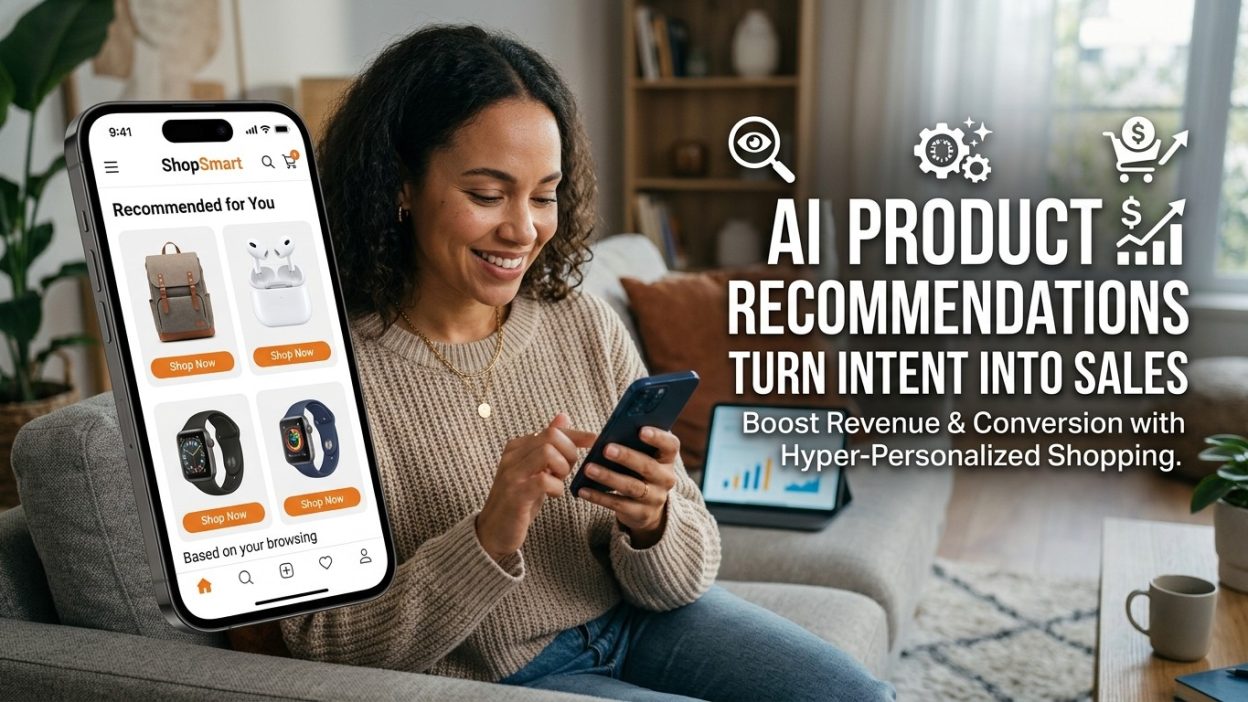
AI-powered shopping is transforming product discovery by interpreting shopper intent, connecting preferences with products, and helping brands deliver more relevant recommendations that accelerate
Modern shoppers are surrounded by choices. An ecommerce store can contain hundreds, thousands, or even millions of products, yet customers rarely want to browse everything. They want the right product for their situation, budget, preferences, and immediate need.
That is where AI Product Recommendations become strategically important.
Traditional recommendation engines often depend on fixed rules such as “customers who bought this also bought that” or “popular products in this category.” Those methods can still be useful, but artificial intelligence creates a more contextual approach. Instead of simply looking at historical purchase patterns, modern systems can analyze behavioral signals, product attributes, search intent, conversational queries, contextual information, and real-time interactions to determine which products are most relevant.
The result is a shift from product discovery to intent fulfillment.
A shopper may search for a lightweight laptop suitable for university, ask for skincare for sensitive skin, look for a gift for someone who loves outdoor activities, or want running shoes suitable for rainy conditions. AI can interpret these layered requirements and narrow thousands of possibilities into a smaller, more useful selection.
For ecommerce businesses, this has major commercial implications. Better recommendations can reduce decision fatigue, increase engagement, improve product discovery, raise average order value, and potentially improve conversion rates because shoppers spend less time searching and more time evaluating relevant options.
However, AI Product Recommendations are not simply about installing an AI-powered recommendation widget. The real challenge is connecting customer intent, high-quality product data, behavioral signals, contextual information, and merchandising strategy into one coherent system.
This guide explains how AI Product Recommendations work, why intent matters, what data powers them, how recommendation logic can improve the customer journey, how marketers can connect recommendations with promotions and seasonal demand, and how businesses can build a practical strategy focused on revenue rather than novelty.
What Are AI Product Recommendations?
AI Product Recommendations are personalized product suggestions generated or enhanced by artificial intelligence using customer behavior, product information, contextual signals, and inferred shopping intent.
The objective is simple: show the shopper products that are most relevant to what they are trying to accomplish.
A traditional recommendation might say:
“Customers who bought this product also purchased these items.”
An AI-driven recommendation can potentially reason more broadly:
“You are looking for a lightweight hiking jacket suitable for wet weather, warm enough for cool evenings, and compact enough for travel.”
The second scenario requires the system to understand multiple dimensions of intent.
These dimensions can include:
- The category the customer is shopping for
- Price sensitivity
- Preferred features
- Previous interactions
- Current session behavior
- Search queries
- Product attributes
- Geographic context
- Seasonal factors
- Device behavior
- Purchase history
- Content engagement
- Inventory conditions
- Promotional eligibility
AI Product Recommendations can use these signals to rank products dynamically instead of applying one static recommendation rule to every shopper.
The important distinction is that personalization is not the same as random variation. A recommendation becomes valuable when it helps the customer move closer to a decision.
Why Product Recommendations Matter for Ecommerce
Choice is valuable until choice becomes overwhelming.
When shoppers encounter too many options, the cognitive burden increases. They may open multiple tabs, compare dozens of products, postpone the purchase, or abandon the website entirely.
Recommendation systems reduce that burden by turning a large catalog into a more manageable selection.
AI Product Recommendations can influence several stages of the customer journey.
At the discovery stage, recommendations can introduce products the shopper may not have found independently.
During consideration, they can compare products based on preferences.
At checkout, they can identify relevant accessories or complementary products.
After purchase, they can support replenishment, upgrades, or related purchases.
This creates a continuous recommendation ecosystem rather than a single “recommended products” section.
The Commercial Logic
A recommendation has value when it improves the probability of an economically meaningful action.
That action could be:
- Clicking a product
- Adding an item to the cart
- Completing a purchase
- Purchasing a higher-value option
- Increasing basket size
- Returning to the store
- Reordering a consumable
- Discovering a new product category
AI Product Recommendations therefore should not be evaluated only by click-through rate. A recommendation receiving many clicks but producing low conversion or high returns may be less valuable than a recommendation with fewer clicks and stronger downstream performance.
How AI Understands Shopper Intent

Intent is the foundation of intelligent recommendation.
A customer saying “show me a blue backpack” communicates one level of intent. A customer saying “I need a durable carry-on backpack for a two-week business trip with a laptop compartment” communicates much more.
AI systems can process these different levels of information and translate natural language into product requirements.
Explicit Intent
Explicit intent is information directly provided by the shopper.
Examples include:
“Under $100.”
“Size medium.”
“Waterproof.”
“Suitable for beginners.”
“Works with Android.”
“Available in black.”
These signals are comparatively easy to interpret because the shopper has clearly stated a requirement.
Implicit Intent
Implicit intent comes from behavior rather than direct statements.
A shopper who repeatedly views trail shoes, reads articles about hiking, filters for waterproof products, and spends time comparing outdoor gear is revealing a likely interest even without typing a detailed query.
AI Product Recommendations can combine those behavioral signals to infer intent.
Contextual Intent
Context adds another layer.
The same customer may have completely different needs depending on time, location, season, weather, event type, or shopping occasion.
Someone browsing jackets in a tropical climate may be preparing for international travel.
Someone searching for cooling products during a heatwave may have very different intent from someone browsing the same category in winter.
Context-aware recommendations can therefore be more useful than historical personalization alone.
The Data Behind AI Product Recommendations
AI is only as useful as the information it can access.
A recommendation engine needs reliable product and customer signals to make meaningful decisions.
Product Data
Product information typically includes:
- Product title
- Category
- Description
- Brand
- Price
- Availability
- Product identifiers
- Attributes
- Images
- Variants
- Specifications
- Compatibility
- Materials
- Dimensions
- Ratings
- Reviews
- Use cases
The more accurately products are described, the easier it becomes to match customer requirements with the right inventory.
This is why Product Feeds for AI can become an important foundation for recommendation strategies. A recommendation engine cannot reliably identify the best product for a specific need if the underlying catalog lacks structured information about that product.
Customer Data
Customer-level signals may include:
- Previous purchases
- Browsing history
- Search behavior
- Wishlist activity
- Cart activity
- Product comparisons
- Category engagement
- Purchase frequency
- Preferred price ranges
- Previous responses to recommendations
However, businesses need to handle customer data responsibly. Personalization should create useful experiences without becoming intrusive.
Session Data
Session behavior can reveal immediate intent.
For example, if a shopper searches for wireless headphones, filters for noise cancellation, compares three models, and repeatedly visits one product, their current intent is more relevant to the session than an older purchase from six months ago.
AI Product Recommendations can prioritize recent signals when immediate intent appears stronger than historical patterns.
AI Product Recommendations vs. Rule-Based Recommendations
Rule-based systems rely on predefined instructions.
For example:
“If the shopper is viewing running shoes, recommend socks.”
That approach is straightforward and predictable, but it can become difficult to manage at scale.
AI-driven systems can identify patterns that are difficult to encode manually.
Consider a shopper who frequently purchases premium outdoor products but has recently started searching for lightweight travel equipment. A rigid rule might continue recommending high-end hiking equipment. An AI system may recognize that the shopper’s current goal has shifted toward portability and travel.
The difference can be summarized as follows:
| Factor | Rule-Based System | AI-Driven System |
|---|---|---|
| Logic | Predefined rules | Learned or dynamic patterns |
| Adaptability | Limited | High |
| Context | Usually limited | Can be extensive |
| Personalization | Segment-based | Individualized |
| Intent interpretation | Basic | More sophisticated |
| Maintenance | Manual rule updates | Model and data optimization |
| Scale | Can become complex | Better suited to large catalogs |
Rule-based merchandising still has an important role. Merchants may intentionally prioritize inventory, promote strategic products, or suppress products that are unavailable.
The strongest approach can combine business rules with AI.
Turning Search Intent Into Product Intent
Search queries contain clues.
A customer searching for “cheap laptop” communicates price sensitivity.
A customer searching for “best laptop for video editing” communicates performance requirements.
A customer searching for “laptop for college and travel” communicates multiple contextual priorities.
AI Product Recommendations can map these expressions to product attributes.
For example:
“Lightweight laptop” → weight
“Long battery laptop” → battery performance
“Laptop for gaming” → GPU, CPU, display, cooling
“Laptop for travel” → portability, durability, battery, dimensions
This attribute mapping helps transform vague natural language into actionable product filtering and ranking.
AI Product Recommendations and Semantic Understanding
Semantic understanding is especially useful when shoppers use words that do not exactly match a merchant’s catalog terminology.
A customer may search for “rainproof jacket,” while a store lists “water-resistant outerwear.”
A keyword-only system might struggle with the difference.
An AI system can potentially recognize the conceptual relationship between the expressions.
This matters because customers do not always speak the language used by product databases.
They use everyday language, category language, social language, personal language, and sometimes incomplete phrases.
Better semantic understanding reduces the distance between customer language and catalog language.
Personalization Without Over-Personalization
Personalization can improve relevance, but too much personalization can become uncomfortable.
A shopper does not necessarily want every interaction to expose everything a business knows about them.
For example, a customer may have purchased a gift for someone else. Recommending products based on that purchase indefinitely could create inaccurate assumptions.
AI Product Recommendations should therefore balance long-term customer history with current intent.
A useful hierarchy may look like:
Current session intent → recent behavior → stable preferences → historical behavior.
The closer a signal is to the customer’s immediate objective, the more useful it may be for the current interaction.
Recommendation Placement Across the Customer Journey
Recommendation placement influences how customers perceive suggestions.
Homepage
Homepage recommendations can support discovery.
Examples include:
“Popular for you”
“Recently viewed”
“Because you liked…”
“Trending in your favorite category”
Category Pages
Recommendations can help shoppers narrow broad product collections.
For example, instead of showing hundreds of backpacks equally, the system can highlight products based on the customer’s observed preferences.
Product Pages
Product pages are ideal for complementary or alternative recommendations.
Examples include:
“Similar products”
“Better value options”
“Premium alternatives”
“Complete the set”
“Frequently purchased together”
Cart
Cart recommendations should remain closely connected to the purchase.
Unrelated suggestions can distract shoppers.
A customer buying a camera may appreciate a compatible memory card or battery, but a random home appliance recommendation could dilute attention.
Post-Purchase
Post-purchase recommendations can support replenishment, accessories, upgrades, and related categories.
The correct timing is important. Selling a replacement product immediately after a purchase may be inappropriate unless the product is consumable.
Using AI to Improve Product Discovery
AI Product Recommendations can solve a discovery problem that traditional navigation struggles with.
Large ecommerce catalogs often force shoppers through a hierarchy:
Category → Subcategory → Filter → Subfilter → Product.
This structure is useful, but it assumes the shopper already understands how the merchant organizes the catalog.
AI enables a more conversational path.
A shopper can explain what they want in their own words and receive a curated set of products.
This shifts the experience from:
“Find the product yourself.”
to:
“Tell us what you are trying to accomplish.”
That is a major change in ecommerce UX.
AI Product Recommendations and Product Promotion
Recommendation and promotion should support one another without becoming indistinguishable.
A recommendation should primarily answer:
“What is relevant to this customer?”
A promotion answers:
“What products does the business want to push?”
Combining the two requires discipline.
AI Product Recommendations can identify which products best satisfy customer intent, while an AI Product Promotion strategy can determine whether selected products should receive additional visibility because of inventory, margins, strategic objectives, or campaign priorities.
The customer should still receive relevant choices.
Overriding relevance too aggressively in favor of promotion can reduce trust.
Contextual Recommendations and Weather
Certain product categories are highly sensitive to external conditions.
Rain affects demand for umbrellas, waterproof footwear, jackets, and outdoor protection.
Heat affects demand for fans, cooling equipment, hydration products, and warm-weather apparel.
Cold conditions can increase demand for heating products and winter clothing.
Weather-Based Marketing can therefore become a useful input for contextual recommendation strategies.
Imagine a customer who regularly shops for outdoor equipment and suddenly visits the store during heavy rainfall. The recommendation system could prioritize waterproof products or relevant accessories, provided those products genuinely match the shopper’s needs.
The value comes from combining context with intent, rather than using weather as a blunt promotional trigger.
Seasonal Intelligence and Recommendations
Customer intent changes throughout the year.
Holiday periods create gift-focused shopping.
Back-to-school periods create education-related demand.
Travel seasons affect luggage, clothing, accessories, and equipment.
Winter can increase demand for heating products and cold-weather apparel.
A recommendation strategy that ignores seasonality can miss valuable context.
Seasonal Demand Forecasting can help businesses anticipate which product groups are likely to experience increased demand. These insights can then inform inventory planning, product ranking, merchandising, and recommendation strategies.
The AI system should still prioritize customer relevance. Seasonal demand is a contextual signal, not a justification for recommending irrelevant products.
The Role of Product Attributes
Attributes are the vocabulary of product intelligence.
A recommendation engine needs to understand what differentiates one product from another.
For apparel:
- Fabric
- Fit
- Color
- Size
- Waterproofing
- Insulation
For electronics:
- Processor
- Memory
- Storage
- Display
- Connectivity
- Compatibility
For furniture:
- Dimensions
- Material
- Style
- Capacity
- Assembly requirements
- Color
AI Product Recommendations become much more precise when these attributes are structured consistently.
A product database that simply says “premium chair” gives little information.
A catalog describing “ergonomic office chair, adjustable lumbar support, mesh back, 135-degree recline, height-adjustable armrests” gives substantially more usable information.
Improving Recommendation Quality With Better Catalog Data
Many recommendation problems are actually catalog problems.
If the same product appears under inconsistent categories, attributes are missing, variants are disconnected, or descriptions are vague, the recommendation engine receives poor signals.
This is why data quality should be treated as part of AI optimization.
Audit the catalog for:
| Data Problem | Potential Recommendation Impact |
|---|---|
| Missing attributes | Weak matching |
| Incorrect category | Irrelevant suggestions |
| Duplicate products | Repetitive recommendations |
| Incorrect availability | Poor customer experience |
| Inconsistent variants | Wrong options |
| Weak descriptions | Limited semantic matching |
| Incorrect compatibility | Customer dissatisfaction |
| Outdated prices | Reduced trust |
Clean data can improve the foundation before the AI layer is even optimized.
Product Similarity and Product Complementarity
Not all recommendations serve the same purpose.
Similarity
Similarity-based recommendations answer:
“What else is like this?”
A shopper viewing one camera might receive other cameras with similar specifications.
Complementarity
Complementary recommendations answer:
“What works with this?”
A customer purchasing a camera might need a memory card, case, lens, or extra battery.
Substitution
Substitution recommendations answer:
“What should I choose instead?”
This can be useful when an item is out of stock, exceeds the budget, or lacks a required feature.
AI Product Recommendations can combine these recommendation types depending on context.
Using Price Sensitivity Intelligently

Price is rarely a simple preference.
A customer may be:
- Budget constrained
- Value focused
- Premium oriented
- Willing to spend more for convenience
- Comparing products within a narrow price band
- Looking for a specific discount
AI can infer price sensitivity from behavioral patterns, but businesses should avoid assuming that the cheapest product is always the best recommendation.
A better approach is to understand value.
Someone looking for a professional camera may prefer a higher-priced model if it satisfies critical performance requirements.
The recommendation should optimize for fit, not simply price.
Recommendation Diversity Matters
A recommendation system that repeatedly shows nearly identical products can become frustrating.
Imagine receiving ten recommendations that differ only slightly in color.
That is technically personalized but practically unhelpful.
AI Product Recommendations should consider diversity as well as relevance.
A strong recommendation set might contain:
One best-match product
One lower-priced alternative
One premium alternative
One highly rated alternative
One complementary option
This gives the shopper multiple decision pathways without overwhelming them.
Avoiding Recommendation Fatigue
More recommendations do not automatically mean better recommendations.
Too many recommendation modules can clutter an ecommerce page.
Too many notifications can irritate customers.
Too many product suggestions can create decision paralysis.
Businesses should identify the moments where recommendations provide genuine value.
A useful test is:
“Does this recommendation help the shopper make a decision right now?”
If not, the recommendation may be unnecessary.
AI Recommendations in Conversational Commerce
Conversational commerce is one of the strongest applications of AI-driven product discovery.
A customer can ask:
“I need a travel backpack for a five-day trip, under $150, with a laptop compartment.”
The system can interpret the request and identify products satisfying the relevant criteria.
The experience feels less like browsing a database and more like speaking with a knowledgeable sales associate.
The quality of that interaction depends heavily on product data.
If the system does not know whether a backpack has a laptop compartment, it cannot confidently recommend it based on that requirement.
AI Product Recommendations and Customer Trust
Recommendation quality influences trust.
If suggestions are consistently useful, shoppers may assume the platform understands their needs.
If recommendations are obviously irrelevant, trust declines.
Accuracy therefore matters more than sophistication.
An impressive AI interface cannot compensate for inaccurate inventory, misleading descriptions, broken product pages, or recommendations that ignore stated preferences.
Trust is built through repeated successful interactions.
Explainable Recommendations
Customers may respond better when they understand why something was recommended.
Examples include:
“Recommended because you viewed similar products.”
“Popular among customers buying this model.”
“Matches your preference for lightweight products.”
“Works with the device in your cart.”
AI Product Recommendations can become easier to trust when the reason behind the recommendation is transparent without exposing complicated technical details.
The explanation should be concise and useful.
Recommendation Systems and Merchandising Control
Retailers still need control.
An AI system should not automatically recommend:
- Discontinued products
- Products with zero inventory
- Products that violate campaign rules
- Products outside geographic availability
- Products with incorrect pricing
- Products unsuitable for specific customer contexts
Business rules can act as guardrails around AI ranking.
This hybrid model is often more practical than allowing a model to operate without commercial constraints.
Handling Cold Start Problems
A major recommendation challenge is the cold start problem.
What should the system recommend when:
A new customer has no history?
A new product has no engagement data?
A new category has limited behavioral signals?
AI Product Recommendations can address cold-start situations by using product metadata, popularity, contextual signals, category relationships, and current session behavior.
For new products, rich product attributes become particularly important because there may not yet be enough historical interactions to learn from.
For new customers, current-session intent can be more useful than nonexistent purchase history.
A Practical AI Recommendation Framework
Businesses can build a recommendation framework around five major stages.
Stage 1: Capture Intent
Collect search queries, page interactions, filters, cart actions, purchase history, and declared preferences.
Stage 2: Understand Products
Structure titles, descriptions, categories, attributes, compatibility, variants, price, and availability.
Stage 3: Generate Candidates
Identify a broad set of potentially relevant products.
Stage 4: Rank Products
Score candidates based on relevance, intent, context, business constraints, and customer preferences.
Stage 5: Learn
Measure outcomes and use performance data to improve future recommendations.
This creates a continuous learning loop.
Metrics That Actually Matter
Businesses should avoid evaluating recommendations using one metric.
A comprehensive measurement framework can include:
| Metric | What It Reveals |
|---|---|
| Recommendation CTR | Initial engagement |
| Add-to-cart rate | Product interest |
| Conversion rate | Commercial effectiveness |
| Revenue per session | Business impact |
| Average order value | Basket impact |
| Recommendation-attributed revenue | Direct contribution |
| Return rate | Recommendation quality |
| Product discovery depth | Catalog exploration |
| Repeat purchase rate | Long-term value |
Revenue attribution should be handled carefully because customers often interact with several recommendations before purchase.
Testing AI Product Recommendations
Recommendation systems should be continuously tested.
Useful testing methods include:
A/B testing
Multivariate testing
Holdout groups
Category-specific experiments
Segment-level experiments
Placement testing
Different recommendation strategies should be compared against meaningful business outcomes.
For example:
Model A may generate more clicks.
Model B may generate fewer clicks but higher revenue.
Model B could be the better business solution.
Segmenting Recommendation Strategy
Different customers can require different recommendation logic.
A first-time visitor might need broad discovery.
A returning customer may benefit from personalized suggestions.
A high-value customer may respond well to premium products or early access.
A customer with a narrow purchase history may need category expansion.
AI can help dynamically identify these patterns rather than relying entirely on fixed segments.
Recommendations for B2B Ecommerce
B2B recommendation systems can be more complex.
Business buyers may care about:
- Contract pricing
- Bulk quantities
- Compatibility
- Procurement standards
- Reorder cycles
- Product availability
- Delivery requirements
- Previous organizational purchases
AI Product Recommendations can support repeat ordering, cross-selling, substitution, and procurement discovery.
For example, a business ordering printer supplies may receive recommendations based on expected replenishment cycles and device compatibility rather than generic popularity.
Recommendations for Subscription Businesses
Subscription brands can use AI to determine:
- Replenishment timing
- Product preferences
- Upgrade opportunities
- Cross-category recommendations
- Subscription adjustments
A consumable product can generate recommendations around likely future needs.
The system should avoid recommending a refill too early simply because historical behavior indicates frequent purchases.
Current inventory and purchase timing matter.
AI Recommendations and Inventory Management
Inventory should influence recommendation logic.
A product that is almost unavailable may not be ideal for a high-volume recommendation campaign.
Conversely, products with excess inventory may receive strategic visibility if they are genuinely relevant.
This creates an important intersection between merchandising and AI.
The objective should be:
Relevant product + healthy availability + suitable commercial priority.
Not simply:
Product with excess inventory = recommendation.
Using Promotions Without Damaging Relevance
Discounts can influence ranking, but discount depth alone should not determine product relevance.
Suppose a customer is looking for running shoes with excellent cushioning. A heavily discounted minimalist shoe may be cheaper, but it does not satisfy the requirement.
AI Product Recommendations should preserve intent alignment first.
Promotions can then act as secondary ranking signals.
This creates a healthier experience where customers see commercially attractive products that still fit their needs.
Recommendation Personalization Across Channels

Customers interact with brands across multiple touchpoints.
Website
Mobile app
Search
Advertising
Customer support
Social commerce
AI assistants
A consistent recommendation strategy across channels can improve continuity.
For example, a shopper who demonstrates interest in a product on a website may later receive a relevant follow-up recommendation through another permitted marketing channel.
Cross-channel personalization should still respect privacy expectations and consent requirements.
Building a High-Quality Product Recommendation Dataset
The recommendation dataset should contain more than transactions.
A richer dataset can incorporate:
Product views
Search queries
Category visits
Filters
Wishlist additions
Cart additions
Purchases
Returns
Ratings
Reviews
Product comparisons
Time spent
Clicks
Inventory status
Promotional exposure
This allows the model to distinguish between interest, consideration, purchase, and post-purchase satisfaction.
Negative Signals Matter Too
AI Product Recommendations should understand what customers reject.
If a shopper repeatedly filters out products above a certain price, that is informative.
If someone views a product multiple times but never clicks “add to cart,” the system may need to reconsider its assumptions.
Returns are also meaningful.
A product generating high return rates after recommendation exposure may indicate a mismatch between product presentation and customer expectations.
Negative signals can improve recommendation quality when interpreted carefully.
Ethical and Privacy Considerations
AI personalization requires responsible data practices.
Businesses should collect only necessary information, communicate relevant privacy practices, protect customer data, and comply with applicable laws and platform policies.
Avoid making highly sensitive assumptions about customers.
Recommendation systems should primarily improve shopping relevance rather than manipulate vulnerable users.
Trust should remain a design principle.
Common AI Recommendation Mistakes
Mistake 1: Focusing on Technology Before Data
A sophisticated model cannot fix poor product information.
Improve the catalog foundation first.
Mistake 2: Optimizing Clicks Instead of Revenue
High engagement can be misleading.
Track downstream outcomes.
Mistake 3: Ignoring Context
A recommendation that was relevant yesterday may not be relevant today.
Use current intent and situational signals.
Mistake 4: Recommending Too Many Products
More options can increase decision fatigue.
Curate recommendations.
Mistake 5: Allowing AI Unlimited Control
Business constraints still matter.
Use guardrails.
Mistake 6: Forgetting Product Availability
An unavailable recommendation creates immediate frustration.
Synchronize inventory.
Mistake 7: Ignoring New Products
New products need recommendation opportunities even before they accumulate behavioral data.
Use product attributes and category relationships.
How to Optimize Product Pages for Better Recommendations
Product pages should expose clear, structured information.
Include:
A descriptive title
Specific product attributes
Clear specifications
Relevant use cases
Accurate pricing
Current availability
Strong imagery
Variant information
Compatibility information
FAQs where useful
Customer reviews
This information gives both shoppers and recommendation systems more context.
AI Product Recommendations and Content Strategy
Content can strengthen recommendation systems by expanding contextual understanding.
A merchant selling hiking products could publish content about:
Choosing hiking boots
Rainy-weather hiking
Layering systems
Trail safety
Backpacking equipment
These content topics reveal relationships between products and use cases.
When content and product information align, the entire commerce ecosystem becomes more semantically connected.
The Role of Customer Reviews
Reviews contain rich natural-language information.
Customers may describe products in ways merchants did not anticipate.
For example:
“Perfect for long flights because it fits under the seat.”
That statement adds a use case.
Another shopper may write:
“The shoes remain comfortable after walking all day.”
That provides contextual evidence about comfort and usage duration.
AI systems can potentially use these patterns to understand how customers experience products.
However, review data needs careful processing because individual opinions are not absolute product facts.
AI Product Recommendations for High-Consideration Products
Some products require extensive research.
Examples include:
Cars
Laptops
Cameras
Appliances
Professional equipment
Furniture
For these categories, recommendation systems should not simply optimize for immediate purchase.
They can support education and comparison.
A useful journey might be:
Understand needs → shortlist products → compare alternatives → evaluate specifications → read reviews → purchase.
AI Product Recommendations can guide customers through that sequence.
Building a Recommendation Strategy From Scratch
Businesses can begin with a phased approach.
Phase One: Catalog Foundation
Clean product data, identifiers, categories, variants, descriptions, prices, and availability.
Phase Two: Basic Personalization
Introduce recently viewed products, similar products, complementary products, and popular products.
Phase Three: Behavioral Intelligence
Incorporate browsing, searches, cart behavior, and purchase history.
Phase Four: Contextual Intelligence
Add seasonality, geographic relevance, device context, current session behavior, and other appropriate signals.
Phase Five: Conversational Recommendations
Allow customers to describe their needs naturally and receive curated product options.
Phase Six: Continuous Optimization
Use testing and commercial performance to improve ranking.
This phased process reduces the risk of investing heavily in AI before the underlying catalog is ready.
How to Create More Human-Like Recommendations
The best recommendation experience should feel helpful rather than mechanical.
Instead of:
“Recommended Item #4”
Use useful framing such as:
“Best match for lightweight travel”
“Lower-cost alternative”
“Premium option with longer battery life”
“Compatible with your current selection”
The recommendation should communicate why the product belongs in the customer’s consideration set.
The Psychology Behind Recommendation-Driven Sales
Recommendations work partly because they reduce uncertainty.
A shopper often asks:
“Am I choosing the right product?”
The more complex the purchase, the stronger that uncertainty can become.
A well-designed recommendation can act as decision support.
It narrows the field.
It highlights differences.
It makes alternatives easier to compare.
It can reassure the customer that their specific requirements were considered.
However, recommendations should support the decision, not disguise persuasion as objectivity.
The Future of AI Product Recommendations

The next generation of ecommerce will likely become increasingly intent-driven.
Instead of browsing categories manually, shoppers may tell an AI what they need.
Instead of comparing fifty products, they may receive a shortlist.
Instead of reading dozens of specification pages, they may receive a concise comparison.
Instead of repeatedly applying filters, they may describe the desired outcome in natural language.
AI Product Recommendations sit at the intersection of these developments.
But the technology alone will not create the advantage.
The businesses that benefit most will likely be the ones with strong product data, clear merchandising strategy, reliable inventory, thoughtful personalization, and a disciplined approach to experimentation.
A Practical Checklist for AI Product Recommendations
Before launching or improving a recommendation strategy, review this checklist.
| Area | Key Question |
|---|---|
| Intent | Can the system understand what customers want? |
| Product data | Are product attributes complete? |
| Availability | Are inventory signals current? |
| Personalization | Are recommendations relevant to the individual? |
| Context | Can recommendations respond to current circumstances? |
| Diversity | Are suggestions sufficiently varied? |
| Pricing | Are budget preferences considered appropriately? |
| Business rules | Are commercial guardrails applied? |
| Placement | Are recommendations shown at useful moments? |
| Measurement | Are revenue and conversion tracked? |
| Privacy | Is customer data handled responsibly? |
| Testing | Are recommendation strategies continuously evaluated? |
Final Strategic Framework
An effective recommendation ecosystem can be understood as a chain:
Customer intent
↓
Behavioral signals
↓
Product understanding
↓
Candidate generation
↓
AI ranking
↓
Business rules
↓
Recommendation presentation
↓
Customer action
↓
Performance feedback
↓
Model and catalog improvement
Each layer contributes to the outcome.
Weak product data can damage strong AI.
Weak intent interpretation can produce irrelevant candidates.
Poor ranking can hide good products.
Poor placement can reduce engagement.
Weak measurement can prevent improvement.
That is why recommendation strategy should be treated as an end-to-end system rather than a single technology implementation.
Frequently Asked Questions (FAQ)
1. What are AI Product Recommendations?
AI Product Recommendations are product suggestions generated or personalized using artificial intelligence, customer behavior, product attributes, contextual signals, and inferred shopping intent. Their purpose is to help shoppers discover more relevant products and make purchasing decisions more efficiently.
2. How are AI Product Recommendations different from traditional recommendations?
Traditional recommendation engines often rely on predefined rules or historical purchase relationships. AI Product Recommendations can incorporate broader signals such as natural-language intent, current session activity, product attributes, context, and behavioral patterns to create more dynamic recommendations.
3. Can AI Product Recommendations increase ecommerce sales?
They can contribute to higher engagement, product discovery, basket size, and conversion when recommendations are genuinely relevant. However, performance depends on catalog quality, customer data, implementation, placement, pricing, inventory accuracy, and continuous optimization.
4. What data is needed for AI Product Recommendations?
Useful inputs can include product titles, descriptions, categories, specifications, variants, prices, availability, customer searches, browsing behavior, cart activity, purchase history, product reviews, and current session context.
5. Do small ecommerce stores need AI Product Recommendations?
Small stores can benefit, particularly when customers face many products or when products have meaningful relationships. Smaller catalogs can begin with simpler recommendation strategies and gradually introduce more advanced AI capabilities as data volume increases.
6. Can AI Product Recommendations work with new products?
Yes. New products create a cold-start challenge because they lack historical behavior. Product attributes, category relationships, product similarity, contextual signals, and controlled merchandising rules can help generate recommendations before enough interaction data accumulates.
7. How can businesses make AI Product Recommendations more accurate?
Start by improving product data. Maintain accurate attributes, categories, identifiers, variants, prices, availability, descriptions, and compatibility information. Then combine current shopper intent with behavioral and contextual signals and continuously test recommendation performance.
8. Should promotions influence AI recommendations?
Promotions can influence ranking, but relevance should remain a core priority. A discounted product that does not satisfy the customer’s needs should generally not outrank a more suitable product simply because it has a larger discount.
9. How do seasonal and weather signals affect recommendations?
Seasonal and environmental context can help identify products that become more relevant under particular circumstances. These signals work best when combined with actual customer intent instead of being used as standalone triggers.
10. What is the most important principle for AI Product Recommendations?
The most important principle is relevance. Recommendations should help customers accomplish their current objective with less effort, greater confidence, and better product understanding. Technology should serve that outcome rather than replace it.