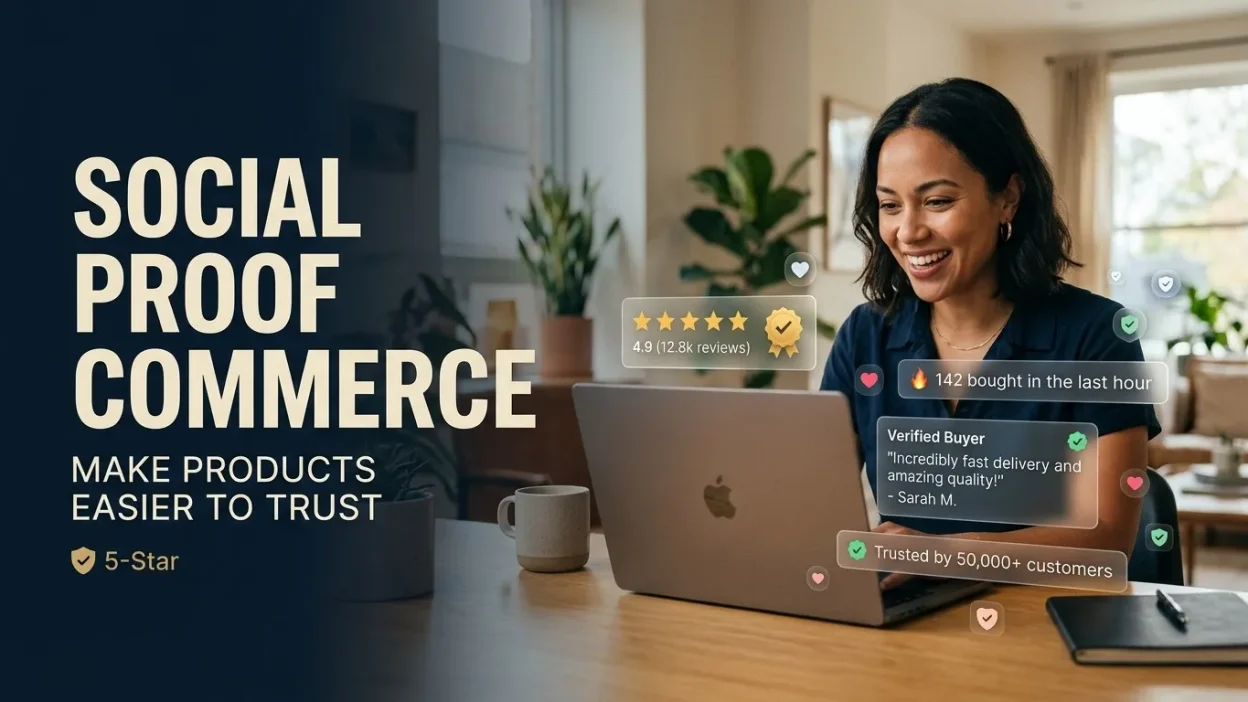
Social Proof Commerce helps businesses build buyer confidence through authentic reviews, customer experiences, product demonstrations, and trustworthy recommendations that reduce uncertainty and encourage informed purchasing decisions.
Social Proof Commerce is the practice of using genuine customer experiences, reviews, ratings, testimonials, creator recommendations, and other credible evidence to help people feel more confident about purchasing products or services. It combines the psychology of social proof Commerce with the online shopping experience, allowing potential buyers to evaluate a product through the experiences and opinions of others.
Online shoppers face a fundamental problem: they often cannot physically inspect a product before buying it. They cannot always judge its quality, test its performance, or know whether the seller will deliver what was promised. Product descriptions and promotional photographs provide information, but customers may still wonder whether the claims reflect reality.
Social Proof Commerce helps address this uncertainty by providing evidence beyond the seller’s own promises. A detailed customer review can explain how a product performs after several weeks of use. A demonstration can show how it works in a real situation. A collection of verified ratings can help shoppers identify recurring strengths and weaknesses.
The objective is not simply to display as many positive reviews as possible. Effective social proof gives customers relevant, believable information that helps them make decisions. Honest feedback, realistic demonstrations, transparent policies, and useful answers can make a business easier to trust.
For e-commerce businesses, this approach can support several stages of the buying journey, from initial product discovery to final purchase evaluation and post-purchase confidence.
Why Social Proof Influences Buying Decisions
People rarely make every purchasing decision by evaluating product specifications in isolation. They also consider experiences, recommendations, perceived risks, and evidence that other people have made similar decisions.
Understanding these psychological factors helps businesses use social proof Commerce responsibly.
People Look for Evidence When Decisions Feel Uncertain
Imagine a shopper comparing two unfamiliar online stores selling similar products. Both stores promise good quality, attractive prices, and reliable service. One provides only promotional descriptions, while the other offers detailed customer feedback, realistic product photographs, and clear answers to common questions.
The second store gives the shopper more information with which to evaluate the offer. That additional evidence does not automatically prove that the business is better, but it makes the decision easier to assess.
Social Proof Commerce works particularly well when customers face uncertainty about product quality, compatibility, durability, delivery, or seller reliability.
People Learn From Other People’s Experiences
Customer experiences can provide practical information that a business description may overlook.
A buyer reviewing a backpack might explain whether its compartments are useful for daily commuting. Someone reviewing a kitchen appliance might describe how easy it is to clean. A customer evaluating clothing might discuss sizing, fabric feel, and fit.
These details help prospective buyers visualize how a product could fit into their own lives.
The most useful social proof is therefore specific. A vague statement such as “Amazing product!” communicates enthusiasm but provides little evidence about performance or suitability.
Trust Reduces Perceived Purchasing Risk
Online shoppers may worry about receiving an item that looks different from its photographs, discovering hidden costs, or struggling to obtain support after payment.
Authentic customer experiences can help address some of these concerns, especially when combined with clear policies and accurate product information.
Social Proof Commerce should not be expected to eliminate every risk. Instead, it should help customers understand what previous buyers experienced and what they can reasonably expect.
Businesses must still deliver reliable products and service. Reviews cannot permanently compensate for poor fulfillment, misleading descriptions, or unresolved complaints.
Familiarity Can Make a Brand Feel More Credible
When shoppers repeatedly encounter consistent product information, authentic customer experiences, and professional responses, they may develop greater familiarity with the brand.
That familiarity can make the business feel easier to evaluate, particularly when customers are comparing unfamiliar sellers.
However, repeated exposure alone is not proof of reliability. Businesses should support familiarity with transparent information and verifiable customer experiences rather than manufactured popularity.
The Main Types of Social Proof Commerce
Different forms of social proof answer different customer questions. A review may explain satisfaction, while a product demonstration may show how an item works. Businesses should select evidence according to the uncertainty they need to reduce.
Customer Reviews and Ratings
Customer reviews are among the most familiar forms of social proof Commerce in online shopping. They allow buyers to describe their experiences in their own words, including what they liked, what disappointed them, and who might benefit from the product.
Star ratings provide a quick overview, while written reviews offer context. A shopper might use the rating to shortlist products and then read detailed comments before choosing one.
Social Proof Commerce becomes more useful when businesses make legitimate reviews accessible, present them accurately, and avoid manipulating their distribution.
A balanced collection of feedback can be more informative than a page containing only brief, uniformly positive statements.
Customer Testimonials
Testimonials are selected customer statements that highlight a particular experience or outcome. They can be useful on product pages, landing pages, and other places where shoppers need additional confidence.
A strong testimonial explains a relevant problem, the customer’s experience with the product, or a specific benefit they observed.
Businesses should obtain permission before publishing identifiable customer statements and should preserve their original meaning. Editing for readability should never turn a qualified opinion into a guarantee.
User-Generated Content
User-generated content includes customer photographs, videos, styling ideas, product demonstrations, and other material created by actual users.
For example, customers might share photographs of a product in their homes or demonstrate how they use it during daily activities. This content can provide a more realistic perspective than carefully staged promotional imagery.
Social Proof Commerce benefits from user-generated content when the material is authentic, relevant, and presented with appropriate permission.
Businesses should not imply that every customer will achieve the same result shown in a particular photograph or video.
Creator and Influencer Recommendations
Creators can introduce products to audiences that already value their content or expertise. A relevant demonstration may explain product features in a way that feels more natural than a conventional advertisement.
However, creator popularity is not equivalent to product expertise, and a large audience does not guarantee strong purchasing intent.
Choose partnerships based on audience relevance, content quality, credibility, and campaign objectives. Disclose paid relationships, gifted products, and other material connections as required by applicable rules.
Expert Opinions and Professional Endorsements
Expert commentary can help shoppers understand products that require specialized knowledge. Depending on the category, relevant evidence might come from qualified professionals, independent reviewers, or recognized industry specialists.
The credibility of an endorsement depends on the person’s actual qualifications, the relevance of their experience, and the evidence supporting their claims.
Businesses should not present a general creator as a qualified expert or suggest that a professional endorsement proves more than it actually does.
Community Discussions and Customer Questions
Public discussions can reveal how products perform in everyday situations. Questions and answers can also clarify compatibility, setup, maintenance, and other practical details.
These interactions help prospective buyers evaluate whether a product suits their circumstances.
Social Proof Commerce can incorporate useful community knowledge without pretending that every comment represents the wider customer base. Businesses should moderate abusive or irrelevant material fairly while preserving legitimate criticism.
How to Choose the Right Social Proof for Your Products

Not every product needs the same kind of customer evidence. The most effective approach depends on the product’s price, complexity, perceived risk, and the questions buyers commonly ask.
Match Evidence to Customer Concerns
A low-cost accessory may need clear photographs, straightforward ratings, and a few helpful reviews. An expensive electronic device may require detailed demonstrations, compatibility information, verified purchase feedback, and transparent warranty terms.
Social Proof Commerce should respond to the actual concerns that influence the decision. Adding hundreds of short reviews will not necessarily help if customers mainly want to know whether a product works with a device they already own.
Start by listing the questions shoppers ask before purchasing. Then identify which questions can be answered through customer experiences and which require official product information.
Consider the Customer’s Buying Stage
Different forms of evidence become useful at different points in the journey.
|
Buying stage |
Customer’s concern |
Useful social proof |
|---|---|---|
|
Discovery |
Is this product relevant to me? |
Creator demonstrations, community recommendations |
|
Consideration |
Does it work as described? |
Detailed reviews, product videos |
|
Comparison |
Is it suitable for my needs? |
Feature-specific reviews, customer questions |
|
Purchase |
Can I trust this seller? |
Verified purchase feedback, clear policies |
|
Post-purchase |
Did I make a sensible choice? |
Setup guides, customer tips, support resources |
Social Proof Commerce should support the shopper’s current decision rather than displaying identical evidence everywhere.
Prioritize Relevance Over Volume
A smaller number of detailed, relevant reviews can answer more questions than a large collection of generic comments.
For example, a customer buying professional equipment may care about reliability during frequent use. Feedback from someone who used the product for a similar purpose could be more helpful than dozens of reviews discussing packaging alone.
The goal is not to make the page look busy. It is to make the evidence useful to the intended buyer.
Build a Trustworthy Review Collection Process
A dependable review process starts after the customer has had a reasonable opportunity to experience the product. It should make feedback convenient while respecting the customer’s freedom to express an honest opinion.
Ask Customers at the Right Time
Request feedback when customers have enough experience to provide meaningful information. The ideal timing depends on the product.
A delivery experience can be reviewed shortly after fulfillment, while products that require extended use may need a longer interval.
Social Proof Commerce works best when requests are connected to real purchases and do not pressure customers into providing positive feedback.
Keep the request short and explain what kind of feedback would be useful. Asking about fit, ease of use, setup, or durability can encourage specific comments without directing customers toward a predetermined conclusion.
Make Reviewing Simple
Customers are less likely to provide feedback when the process requires unnecessary effort.
Use a straightforward review form, provide clear instructions, and avoid requesting information that is irrelevant to the review. If customers must create another account or complete a long questionnaire, participation may decrease.
A simple process can ask customers to rate their experience and optionally describe the most important thing another shopper should know.
Social Proof Commerce should reduce friction for honest feedback, not create obstacles that favor only the most enthusiastic customers.
Never Buy Positive Opinions
Paying people specifically for positive reviews undermines the credibility of the evidence. So does asking staff to impersonate customers, publishing fabricated testimonials, or removing legitimate criticism simply because it is unfavorable.
If incentives are offered for feedback, they should not depend on whether the review is positive, and the arrangement should be disclosed where required. Businesses must also follow the review policies of their platforms and applicable consumer-protection rules.
Social Proof Commerce depends on credibility. Manipulated reviews may create short-term appearances of popularity but expose a business to reputational, platform, and legal risks.
Verify Reviews Where Possible
A business may use purchase-linked review requests, order records, or platform verification features to establish whether a review relates to a genuine transaction.
Verification methods vary, and a verified purchase does not automatically mean that every claim in a review is accurate. It does, however, provide useful context about the reviewer’s relationship with the product.
Explain review labels clearly. Do not describe a review as independently verified unless the process genuinely supports that statement.
Preserve Negative and Mixed Feedback Fairly
A product page containing only praise may leave shoppers wondering whether important information is missing.
Legitimate criticism can reveal practical limitations, such as sizing differences, learning curves, or compatibility restrictions. Businesses should respond professionally and correct inaccurate claims through appropriate processes rather than manipulating the overall impression.
Social Proof Commerce is more credible when shoppers can see that the business treats feedback fairly and uses it to improve.
Display Social Proof on Product Pages
Collecting reviews is only part of the work. Customers must be able to find and understand the information when they need it.
Place Important Evidence Near Relevant Decisions
Star ratings near a product title can provide an initial signal. Detailed reviews near product specifications can answer more specific questions. Testimonials near a purchase prompt may help reinforce confidence once the shopper has evaluated the offer.
Social Proof Commerce should place evidence where it supports the decision without obstructing the product information.
Avoid covering every section with badges, pop-ups, and notifications. Excessive promotional elements can make a store feel less trustworthy rather than more persuasive.
Make Reviews Easy to Navigate
Customers should be able to browse reviews without excessive scrolling or confusion.
Where practical, offer filters for relevant characteristics such as rating, product variant, or topic. Sorting options can help shoppers locate detailed feedback, recent experiences, or critical observations.
Do not design filters to conceal unfavorable opinions or misrepresent the overall feedback. The purpose is to help customers find relevant information efficiently.
Show Specific Product Experiences
General praise is useful but often incomplete. A review that explains how a product performs during daily use gives shoppers more information.
For instance, a customer reviewing a travel bag might discuss its capacity, comfort, and durability after several trips. Someone evaluating a desk lamp might explain its brightness settings and ease of adjustment.
Social Proof Commerce gains practical value when feedback describes the context behind an opinion.
Keep Product Details Consistent
Customer reviews should complement accurate product descriptions rather than compensate for missing information.
If customers repeatedly ask about dimensions, material, compatibility, or care instructions, improve the official description. If multiple reviews identify the same limitation, investigate whether the product page needs clearer expectations.
Customer feedback can become a source of insight for merchandising, product development, and customer support.
Use Visual Social Proof to Make Products More Understandable
Visual evidence helps customers evaluate appearance and use. It can be particularly helpful for products whose value is difficult to communicate through specifications alone.
Encourage Customer Photos and Videos
Invite customers to share their genuine experiences after purchase. Explain where the content may be used and obtain appropriate permission before reposting it.
Visual contributions can show how products look in ordinary environments, how components fit together, or how an item compares with the customer’s expectations.
Social Proof Commerce should preserve the context of user-generated content. Do not crop or edit a photograph in a way that materially changes what it appears to demonstrate.
Create Useful Demonstration Content
A product demonstration can answer questions that a written review cannot fully resolve.
A customer might show how quickly a storage product can be assembled, how an accessory attaches to another item, or how a garment moves during normal activity.
Businesses can also create their own demonstrations, clearly distinguishing brand-produced content from independent customer experiences.
The aim is to provide useful evidence, not to make every demonstration look like a spontaneous customer endorsement.
Explain What Visual Evidence Does Not Prove
A photograph may show that a product looks attractive, but it does not establish its long-term durability. A short demonstration may show a feature working, but it cannot necessarily prove reliability over several years.
Social Proof Commerce should help shoppers interpret evidence within its proper limits. Combining visual content with specifications, policies, and detailed feedback creates a more complete picture.
Connect Social Proof Commerce With Product Discovery
People often discover products while looking for answers to a specific need. A helpful demonstration can address that need before the shopper starts comparing sellers.
For example, a brand could use a short tutorial to explain how a product solves a common problem and then provide customer experiences that add context.
This approach complements Micro-Moment Marketing, which focuses on responding to immediate customer needs at important decision-making moments. The content becomes more useful when it provides the answer a shopper is actively seeking.
Use Social Proof in Marketing Campaigns

Social proof can support customer acquisition when it is incorporated into a wider marketing strategy. The strongest campaigns use authentic evidence to answer relevant questions rather than treating reviews as decorative elements.
Use Customer Evidence in Paid Advertising
A business can use approved customer testimonials, genuine product demonstrations, or creator content in advertising when the relevant permissions and platform requirements are satisfied.
Social Proof Commerce in advertising should make the product’s value easier to evaluate. A customer describing a specific use case may be more informative than an advertisement displaying an unexplained five-star graphic.
Ensure that claims remain accurate, that the content reflects genuine experiences, and that paid relationships are disclosed appropriately. Advertising rules may impose additional requirements for particular product categories.
Adapt Evidence to the Customer Journey
A person encountering a brand for the first time may benefit from a simple demonstration or a relevant customer story. Someone already comparing products may need detailed reviews, product specifications, or an explanation of the return policy.
Social Proof Commerce should reflect these different information needs.
Businesses can review their campaign data to understand which content attracts qualified visitors and which pages help those visitors continue toward purchase. However, a high click-through rate alone does not prove that a particular testimonial caused additional sales.
Build a Consistent Brand Experience
Customer evidence should not contradict the message on the product page, in an advertisement, or in customer support.
If an advertisement promotes a particular benefit, the product description should explain it accurately. If a review mentions an important limitation, the business should consider whether that limitation needs to be addressed in the official information.
Consistency makes it easier for customers to evaluate the offer and reduces unpleasant surprises after purchase.
Support Organic Product Promotion
Social proof can also help businesses create useful organic content. Frequently asked questions, common review themes, and customer demonstrations can inspire posts that educate potential buyers.
For broader campaign planning, businesses can explore Online Product Promotion Techniques to understand how different promotional activities can work together.
Social Proof Commerce should remain connected to the actual product experience, regardless of whether the customer encounters the evidence through a paid advertisement, a search result, or an organic social post.
Respond to Customer Feedback and Questions
The way a business handles feedback can influence trust just as much as the feedback itself.
Respond to Positive Reviews With Specificity
A short thank-you is appropriate, but a thoughtful response can demonstrate that the business has paid attention to the customer’s experience.
If a customer mentions that a product was easy to assemble, the business can acknowledge that detail without turning the reply into an exaggerated sales pitch.
Social Proof Commerce becomes more credible when responses sound human, remain relevant, and avoid copying the same promotional message under every review.
Handle Negative Reviews Professionally
When customers raise legitimate concerns, acknowledge the issue and explain the next step. If the problem requires order details, invite the customer to continue through an appropriate private support channel.
Avoid arguing publicly, disclosing private information, or promising a resolution that the business cannot deliver.
Social Proof Commerce can benefit from professional responses because prospective buyers may evaluate how the company behaves when something goes wrong.
Identify Repeated Problems
One complaint may reflect an isolated experience, while repeated similar complaints may reveal a product or operational issue.
Track recurring themes such as late deliveries, confusing instructions, sizing concerns, damaged packaging, or difficulty contacting support. Use the findings to improve the underlying experience.
A business that responds to patterns rather than treating every review as an isolated public-relations issue can build stronger customer relationships over time.
Make Customer Communication Helpful
Sometimes a shopper needs an answer before making a purchase. Clear responses about availability, product suitability, delivery, or returns can remove uncertainty.
Social Proof Commerce can work alongside Conversational Marketing by helping businesses answer questions through useful, timely conversations rather than leaving potential customers to guess.
Automated responses may help with routine questions, but they should not invent answers or make unsupported promises. Provide a clear route to human assistance when a question requires judgment or account-specific information.
Measure the Business Impact of Social Proof Commerce
Businesses should evaluate whether their social proof activities help customers make better decisions and support commercial objectives.
Track Relevant Performance Indicators
Useful indicators may include product-page conversion rate, review submission rate, the proportion of visitors who interact with review sections, return rates, customer acquisition cost, and average order value.
The appropriate measures depend on the product and the purpose of the campaign.
Social Proof Commerce should not be judged by the number of reviews alone. A large review collection may provide little value if it contains repetitive comments that do not answer customer questions.
Compare Similar Product Pages
Where practical, compare products or pages with similar audiences, prices, and traffic sources. Look for differences in customer behavior after relevant changes are introduced.
A simple before-and-after comparison can be informative, but it cannot automatically prove that social proof caused the difference. Seasonality, promotions, traffic quality, and product availability may also affect results.
Test One Meaningful Change at a Time
Businesses can test the placement of reviews, the presentation of customer photographs, or the visibility of a relevant testimonial.
Define the primary metric before the test begins and avoid changing many unrelated elements simultaneously. Use a suitable sample size and test duration where possible.
Social Proof Commerce should be improved through evidence rather than assumptions about which design looks most persuasive.
Consider Profitability and Customer Satisfaction
Higher conversion rates are not the only sign of success. Misleading expectations may increase immediate sales while also increasing returns, complaints, and negative feedback.
Review post-purchase outcomes alongside conversion data. A sustainable strategy helps customers choose products that genuinely meet their needs.
Common Social Proof Commerce Mistakes to Avoid
Poorly managed social proof can undermine the trust it is intended to create. Businesses should recognize the difference between credible evidence and tactics that merely imitate popularity.
Publishing Fake Reviews
Fabricated reviews mislead customers and may violate platform policies or applicable law. Do not invent customer experiences, create fake accounts, or present employees as independent buyers.
Hiding Legitimate Criticism
Removing authentic negative reviews solely to improve a product’s appearance creates an unbalanced picture. Address the underlying issue and follow the applicable rules for handling abusive, irrelevant, or demonstrably fraudulent content.
Using Vague Testimonials
Statements such as “Excellent service” provide limited information without context. Encourage honest, specific feedback while allowing customers to express their opinions freely.
Displaying Unsupported Popularity Claims
Claims such as “Everyone loves this product” or “The most trusted brand” should not be used without adequate evidence. Be especially careful with live purchase notifications and scarcity messages, which must reflect real activity or inventory.
Overloading the Page With Badges
Too many review widgets, trust symbols, pop-ups, and promotional labels can distract visitors and make the store feel cluttered.
Present the most relevant information clearly. Social Proof Commerce should make evaluation easier, not compete with the product itself for attention.
Ignoring Customer Privacy
Customer names, photographs, order details, and private messages should not be published without the appropriate permission or legal basis. Collect only the information needed for the stated purpose and follow applicable privacy requirements.
Treating Every Customer as Identical
Different buyers care about different things. A professional buyer may prioritize durability, while a first-time customer may care more about setup and ease of use.
Organize relevant feedback so people can find information that applies to their own situation. Avoid implying that a single customer experience predicts every buyer’s outcome.
Create a Sustainable Social Proof Commerce Strategy

A strong strategy is built on a dependable product experience, a straightforward feedback process, and transparent communication.
Begin by identifying the questions that stop customers from purchasing. Collect honest feedback, make useful reviews easy to find, and create demonstrations that show how products work in realistic situations.
Next, connect this evidence with product descriptions, marketing campaigns, and customer support. Review recurring complaints and use them to improve product quality, delivery, and the information available before checkout.
Social Proof Commerce should also fit into the wider customer journey. For example, businesses using automated customer updates can explore RCS Marketing Automation as one approach to coordinating richer customer communication where supported. Messaging should remain relevant, permission-aware, and consistent with the actual service provided.
Finally, measure results and make changes based on reliable evidence. A trustworthy approach does not depend on manufactured popularity. It helps people understand what they are buying, what other customers experienced, and whether the product is suitable for them.
Conclusion
Social Proof Commerce helps businesses make online products easier to evaluate through authentic reviews, customer demonstrations, transparent feedback, and credible recommendations. Its effectiveness depends on relevance, honesty, and how well the evidence answers buyer concerns. Businesses should collect genuine experiences, display useful information near purchasing decisions, respond professionally to criticism, and measure outcomes beyond review counts. Combining social proof with accurate product descriptions, responsive support, and a smooth checkout experience can reduce uncertainty and strengthen customer confidence. Rather than manufacturing popularity, successful businesses use real customer experiences to help shoppers make informed decisions and build lasting trust.
Frequently Asked Questions (FAQ)
What is Social Proof Commerce?
Social Proof Commerce uses authentic customer reviews, ratings, testimonials, demonstrations, and recommendations to help shoppers evaluate products and make informed purchasing decisions.
Why is Social Proof Commerce important for e-commerce?
Online shoppers cannot always inspect products before buying. Genuine customer experiences provide additional context about quality, usability, and service, helping shoppers assess whether a product suits their needs.
What are the most effective forms of social proof Commerce?
Useful forms include detailed customer reviews, verified purchase feedback, customer photographs, product demonstrations, relevant creator recommendations, expert commentary, and helpful community discussions.
How can businesses collect more customer reviews?
Businesses can send polite review requests after customers have had enough time to experience a product. Keep the process simple, avoid pressuring customers, and welcome honest feedback regardless of sentiment.
Does Social Proof Commerce increase conversion rates?
It can help reduce purchase uncertainty and improve decision-making, potentially supporting conversions. However, results depend on product quality, audience relevance, pricing, website usability, and the credibility of the evidence.
Should businesses display negative reviews?
Yes, legitimate negative feedback can help shoppers understand a product’s limitations. Businesses should respond professionally, correct genuine problems, and follow applicable platform policies when moderating reviews.
How can a business identify fake reviews?
Warning signs may include repetitive wording, suspicious review patterns, unverifiable claims, or activity inconsistent with normal customer behavior. These signals are not conclusive by themselves, so investigations should be fair and evidence-based.
Where should social proof Commerce appear on a product page?
Ratings may appear near the product title, detailed reviews near product information, and relevant testimonials near purchasing decisions. Placement should help shoppers find answers without cluttering the page.
How can businesses measure Social Proof Commerce performance?
Track relevant metrics such as review submission rates, product-page conversions, customer acquisition costs, return rates, and customer satisfaction. Compare results carefully and account for other factors that may influence performance.
What is the biggest mistake in Social Proof Commerce?
The biggest mistake is sacrificing credibility to create an appearance of popularity. Fake reviews, misleading testimonials, and unsupported claims undermine trust. Authentic evidence, transparent communication, and reliable products create a stronger foundation for long-term growth.