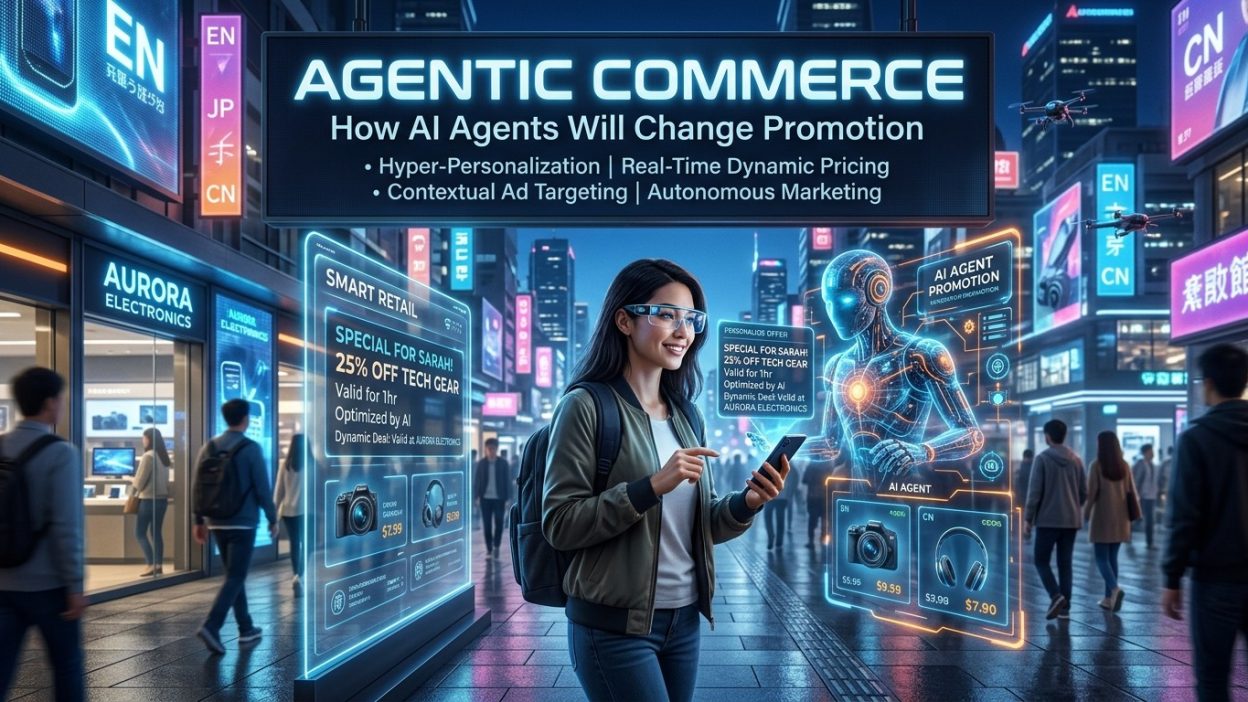
Agentic Commerce is transforming promotion from passive advertising into intelligent buying assistance, where AI agents can discover, compare, personalize, negotiate, and execute commerce decisions.
For decades, digital promotion followed a relatively predictable sequence. A brand created an advertisement, selected an audience, purchased exposure, generated a click, and attempted to convert that visitor on a website or marketplace. Marketing teams optimized impressions, clicks, conversion rates, customer acquisition costs, and return on ad spend.
Agentic Commerce introduces a fundamentally different possibility.
Instead of only persuading a human to take the next step, an AI agent can potentially perform parts of that decision-making process on the customer’s behalf. The shopper can express an objective such as finding the best laptop under a budget, selecting a gift within a particular style, locating a replacement part, or finding the cheapest suitable option. The agent can then investigate options, compare trade-offs, filter results, and potentially complete a transaction.
Agentic Commerce therefore changes the meaning of promotion. The question is no longer simply, “How do we get attention?” It becomes, “How do we make our product the most useful choice when an AI is helping someone decide?”
That difference is enormous.
OpenAI has already expanded its shopping experience around conversational product discovery, with product feeds, richer visual comparisons, and the Agentic Commerce Protocol connecting merchants and users. Google is also developing agentic shopping through its Universal Commerce Protocol and Universal Cart.
Agentic Commerce is consequently moving from an abstract technology concept toward a practical layer of ecommerce.
For marketers, this means the promotional playbook needs to evolve before the customer journey completely changes.
What Is Agentic Commerce?
Agentic Commerce describes commerce interactions in which AI agents can perform tasks on behalf of shoppers, merchants, or both. Rather than requiring a person to manually complete every research and purchasing step, an agent can interpret an objective, retrieve information, compare options, and take authorized actions.
Agentic Commerce is therefore more than conversational shopping.
A chatbot may answer, “Which headphones are best?”
An agentic system could potentially interpret a more complex instruction:
“Find me wireless headphones under $250 that are comfortable for long flights, have strong noise cancellation, work well with Android, and can arrive before Friday.”
The difference lies in autonomy.
Agentic Commerce can involve multiple steps executed according to an objective rather than one isolated response. The agent may gather product information, remove unsuitable items, compare relevant specifications, check availability, investigate merchant options, and help the customer move toward checkout.
OpenAI describes its Agentic Commerce Protocol as an open standard designed to allow AI agents, people, and businesses to work together to complete purchases. Its current shopping infrastructure supports product discovery and, for eligible merchants and products, checkout experiences inside ChatGPT.
That evolution matters because promotion becomes part of the agent’s decision environment.
A traditional advertisement tries to win attention.
An AI-oriented promotion needs to communicate relevance, value, proof, availability, and fit.
Agentic Commerce makes product information strategically important because an AI system cannot make a useful recommendation from vague product messaging.
If a retailer says “premium comfort,” an agent has limited usable information.
If the retailer states “memory foam seat, 18-inch width, adjustable lumbar support, and 12-year frame warranty,” the value proposition becomes much easier to interpret.
Why Promotion Will Change
Agentic Commerce changes promotion because the traditional funnel was designed around human attention.
Advertising assumes the customer will notice something, become interested, click, research, compare, and eventually buy.
An AI agent can compress those stages.
Agentic Commerce may allow a shopper to state a complete goal at the beginning of the journey and ask the system to manage much of the research.
That creates three major promotional changes.
First, discovery becomes more conversational.
Second, comparison becomes more automated.
Third, action can happen closer to discovery.
Instead of showing a banner that says “20% off running shoes,” the future promotional environment could ask an AI shopping agent to identify relevant running shoes and then consider which available offer provides the best overall value.
That changes what “good advertising” means.
Agentic Commerce favors products that are easy to evaluate.
A persuasive slogan may still help establish emotional appeal, but product attributes, reviews, pricing, delivery, compatibility, warranty terms, and merchant reliability become increasingly important.
Google’s 2026 commerce initiatives illustrate this direction. Its Universal Cart can track shopping activity across Google surfaces, identify price drops, provide price-history insights, flag product incompatibilities, and help shoppers make decisions.
The implication for promotion is simple:
A campaign cannot be optimized independently from the product data behind it.
From Audience Targeting to Intent Matching
Traditional advertising is heavily audience-oriented.
Marketers ask:
Who should see this ad?
Where do they live?
How old are they?
What interests do they have?
What behavior indicates purchase intent?
Agentic Commerce moves the emphasis toward objective and context.
The key question becomes:
What is this customer trying to accomplish?
That difference creates a major opportunity.
Agentic Commerce can match products to detailed intent rather than relying only on broad audience segments.
Imagine two customers searching for the same category.
Customer A wants the cheapest option that performs adequately.
Customer B wants the most durable premium version.
A traditional product campaign may target both people with similar messaging.
An agentic system can treat their objectives differently.
The first customer may value total cost.
The second may value longevity, warranty, material quality, and performance.
Agentic Commerce therefore encourages brands to map their products to specific buyer situations.
This makes intent architecture more important than simple demographic targeting.
The Rise of Constraint-Based Shopping
Human shoppers naturally use constraints.
They say:
“I need something under $100.”
“It has to arrive tomorrow.”
“It cannot contain a specific material.”
“It needs to fit a small apartment.”
“It must work with my existing device.”
“It should be appropriate for a beginner.”
Agentic Commerce can interpret multiple constraints simultaneously.
That means product promotion needs to communicate those constraints clearly.
A vague product page forces the shopper to investigate.
A detailed product page gives an agent usable evidence.
OpenAI’s shopping research experience is explicitly designed around user preferences and constraints, with product comparisons involving details such as price, features, reviews, and other information.
Agentic Commerce is therefore pushing marketers toward an attribute-first mindset.
Product Data Becomes Promotional Infrastructure
One of the most important consequences of Agentic Commerce is that product data becomes part of marketing infrastructure.
In conventional ecommerce, product information is often treated as merchandising content.
But an agent needs structured facts.
A product should have clear:
| Data element | Promotional importance |
|---|---|
| Product name | Establishes identity |
| Category | Defines context |
| Features | Explains functionality |
| Dimensions | Helps determine fit |
| Materials | Supports quality comparisons |
| Compatibility | Reduces purchase risk |
| Price | Supports budget decisions |
| Inventory | Determines practical availability |
| Reviews | Provides social evidence |
| Images | Supports visual evaluation |
| Shipping | Influences urgency |
| Returns | Reduces perceived risk |
| Warranty | Supports trust |
| Merchant information | Establishes seller credibility |
Agentic Commerce depends on this foundation because an agent cannot reliably recommend what it cannot understand.
OpenAI currently supports merchant product feeds through the Agentic Commerce Protocol, and merchants can provide product information so catalogs and promotions are represented more accurately in ChatGPT. OpenAI also notes that Shopify product data is integrated into ChatGPT through Shopify Catalog.
That means promotion teams increasingly need to collaborate with ecommerce, merchandising, engineering, and operations.
Data Freshness Matters
Imagine an agent recommends a product priced at $89, but the actual price is $119.
The shopper feels misled.
Imagine the agent recommends an item that has been out of stock for a week.
The customer loses confidence.
Imagine the product description says “fits all models,” but the compatibility information shows exceptions.
The agent may make a poor recommendation.
Agentic Commerce therefore rewards accurate and current information.
Marketing teams must care about catalog synchronization, feed quality, inventory accuracy, and product metadata just as seriously as they care about campaign creative.
How AI Agents Will Change Promotional Strategy
The promotional strategy of the future can be divided into four layers:
Discovery.
Consideration.
Decision.
Action.
Agentic Commerce affects every stage.
Discovery
At discovery, the customer describes what they want.
The agent translates intent into product requirements.
A brand needs strong relevance signals and complete information.
Consideration
The agent compares products.
This is where features, reviews, price, reputation, compatibility, and differentiation matter.
Agentic Commerce makes comparison visibility increasingly important.
A brand cannot assume that owning the highest-budget campaign means winning consideration.
Decision
The shopper asks for clarification.
Which one lasts longer?
Which has a better warranty?
Which fits smaller spaces?
Which is easier to maintain?
Which is best for beginners?
Agentic Commerce creates opportunities for brands that have already answered these questions clearly across their content ecosystem.
Action
The shopper buys.
This stage can increasingly involve agent-assisted checkout and merchant integrations.
OpenAI’s Instant Checkout connects ChatGPT with merchants while merchants remain responsible for order processing, fulfillment, returns, and customer support.
The promotional journey therefore becomes tightly connected with the transactional journey.
Promotion Will Become More Personalized
Personalization has existed in digital marketing for years, but it often means inserting someone’s name into an email or displaying ads based on browsing history.
Agentic Commerce can make personalization much more contextual.
Suppose a customer asks:
“I am furnishing a new apartment. I want a compact dining table that seats four, costs less than $500, and works with a minimalist interior.”
That request contains immediate context.
An AI agent can evaluate multiple products against the stated goal.
Agentic Commerce makes this context valuable.
The product that wins may not have the most famous brand.
It may simply have the strongest fit.
That creates a major change in promotional thinking.
Brands should stop asking only:
“How can we promote our product to everyone?”
They should also ask:
“What specific customer problems does this product solve better than alternatives?”
The answer should be reflected throughout the product catalog, website, content, reviews, merchandising, and promotional materials.
AI Product Recommendations Will Reshape Merchandising
AI Product Recommendations can become more sophisticated because agents can consider several variables simultaneously.
Traditional recommendation engines often rely on behavior such as:
People who bought X also bought Y.
Agentic systems can reason through needs.
A shopper may not want the “most popular” product.
They may want the best product for their situation.
That distinction has significant promotional implications.
Agentic Commerce can reward niche strengths.
A product might lose a broad popularity contest but win a specific intent category.
For example:
Best compact option.
Best for frequent travelers.
Best for beginners.
Best under a specific budget.
Best for professionals.
Best for small rooms.
Best for durability.
Best for compatibility.
This means brands need to understand their product’s strongest decision contexts.
Promotions Need Context
Discounting has traditionally been one of the strongest tools available to marketers.
But Agentic Commerce makes discounting more nuanced.
A lower price is not always the best offer.
A shopper may prefer free shipping.
Another may value an extended warranty.
Another may prefer a bundle.
Another may prioritize loyalty rewards.
Google has already introduced AI-oriented shopping experiences involving personalized commercial offers and loyalty or bundle-oriented value propositions.
Agentic Commerce can therefore shift promotional optimization from “biggest discount” toward “best value for this objective.”
WebAR Shopping and Agentic Discovery
Visual products create a unique challenge.
A customer may understand the specifications of a sofa but still wonder whether it will look right in the room.
They may understand a pair of glasses but question how the frame will appear on their face.
They may understand product dimensions but still struggle to imagine scale.
WebAR Shopping can address part of this uncertainty by allowing shoppers to visualize products in realistic environments.
Agentic Commerce can complement that experience.
The agent can narrow the catalog based on size, price, style, and functionality.
The AR experience can then help the customer evaluate a shortlisted choice visually.
This produces a powerful sequence:
Need → AI discovery → comparison → visualization → confidence → purchase.
The technologies solve different forms of uncertainty.
Agentic Commerce addresses informational and decision complexity.
AR addresses visual and spatial uncertainty.
Why Reduced Uncertainty Matters
Every purchase involves perceived risk.
The higher the uncertainty, the more effort the shopper needs before committing.
This is particularly important for:
Furniture.
Home décor.
Eyewear.
Fashion.
Automotive accessories.
Large appliances.
Electronics.
Cosmetics.
Agentic Commerce can reduce research effort, while immersive experiences can reduce visualization uncertainty.
The combination can make promotional experiences more persuasive without relying on aggressive messaging.
AR Marketing Trends and the New Promotional Mix
Emerging AR Marketing Trends suggest that visual commerce is becoming more interactive and utility-driven.
Consumers increasingly expect brands to demonstrate how products function rather than simply describe them.
Agentic Commerce amplifies this principle because an AI agent can identify why a specific product is relevant before a visual tool demonstrates it.
Consider a furniture shopper.
The agent could identify a three-seat sofa that fits the customer’s dimensions and budget.
The AR experience could let the customer place it in the room.
The brand does not need to interrupt the journey with a generic promotional message.
The experience itself becomes promotion.
Agentic Commerce therefore pushes brands toward useful experiences rather than attention-only advertising.
The End of the Single Promotion
One of the most important strategic changes will be the decline of the “one message for everyone” approach.
A brand may have one product, but an AI agent can present it differently depending on the customer’s objective.
Agentic Commerce can turn a product into multiple value narratives.
For a student:
Affordable and practical.
For a professional:
Reliable and efficient.
For a traveler:
Lightweight and durable.
For a family:
Safe and easy to maintain.
For an enthusiast:
Advanced performance.
The underlying product remains the same.
The context changes.
This is not merely dynamic creative.
It is dynamic value interpretation.
Brands should therefore create modular product information that supports multiple legitimate positioning angles.
The Importance of Trust
Promotion has always involved persuasion.
But when AI agents influence transactions, trust becomes even more critical.
A shopper is effectively asking the agent:
“Can you help me make a good decision?”
The brand benefits when the product information is reliable.
Agentic Commerce can increase the cost of inaccurate marketing because misleading information can affect downstream recommendations.
That makes unsupported claims dangerous.
“Industry-leading.”
“Best in class.”
“Ultimate.”
“Perfect.”
These phrases may sound impressive, but they provide limited decision value.
By contrast:
“Three-year warranty.”
“Supports devices using USB-C.”
“Machine washable.”
“Fits mattresses up to 14 inches.”
“Weight: 2.4 kg.”
These details are concrete.
Agentic Commerce rewards brands that convert promotional language into verifiable product facts.
Reviews Become Promotional Evidence
Reviews already influence shoppers, but AI-assisted purchasing can make them more useful because they provide customer-generated evidence.
A product’s promotional message may claim comfort.
Reviews can reveal whether customers consistently agree.
A brand may emphasize durability.
Customer experiences can reinforce or challenge the claim.
OpenAI’s current shopping guidance explains that review information may be summarized from publicly available reviews, while noting that reviews and ratings are not independently verified by OpenAI.
Agentic Commerce therefore creates incentives for brands to monitor review patterns rather than treating reviews as a separate reputation-management function.
Look for recurring themes.
What do customers repeatedly praise?
What do they dislike?
Which questions appear again and again?
Which features create surprise?
Which limitations create disappointment?
Those insights can directly improve product promotion.
Promotion Will Become More Conversational
Traditional ad copy is designed to capture attention quickly.
Agentic Commerce introduces longer interactions.
The customer can ask:
“Why this one?”
“Is it worth paying $50 more?”
“What makes it better?”
“Do people complain about the battery?”
“Can I use it outdoors?”
“Is there a smaller version?”
“What alternatives are available?”
Brands therefore need answers, not just slogans.
FAQ content, comparison pages, detailed specifications, buying guides, product education, review analysis, and support documentation become part of the promotional ecosystem.
Agentic Commerce makes answerability a competitive asset.
Build a Question Map
Brands can create a question map for every major product category.
Start with:
What is it?
Who is it for?
Why choose it?
What alternatives exist?
What is the strongest feature?
What is the biggest limitation?
How does it compare with the previous model?
What does it cost?
How long does it last?
How does the warranty work?
How is it shipped?
How is it returned?
Agentic Commerce thrives when these questions can be answered accurately.
ChatGPT Product Discovery and the Promotion Funnel
ChatGPT Product Discovery demonstrates how a conversational AI environment can already move users through product research and comparison.
OpenAI says its shopping research experience can use merchant product data provided through the Agentic Commerce Protocol as well as publicly available product information and other retail sources. Products can be refined during the conversation and compared using attributes such as price, features, and reviews.
Agentic Commerce extends the same general direction from discovery toward action.
This means brands should treat AI discovery as part of the funnel rather than a disconnected experiment.
The funnel can evolve from:
Ad → Click → Landing Page → Product Page → Checkout
to:
Need → AI Conversation → Product Shortlist → Comparison → Merchant Selection → Checkout
That is a major structural change.
Measuring Success in an Agentic Environment
Traditional marketing metrics will remain useful, but they will not tell the entire story.
Brands will increasingly need to understand whether their products are discoverable within AI-mediated journeys.
Potential metrics include:
| Metric | What it indicates |
|---|---|
| AI product visibility | Whether products appear in relevant conversations |
| Recommendation frequency | How often products enter consideration |
| Shortlist rate | How frequently products remain after filtering |
| Comparison inclusion | Whether products are selected for side-by-side evaluation |
| Click-through rate | Interest after recommendation |
| Merchant selection | Preference among sellers |
| Assisted conversion | Purchases influenced by AI |
| Product-data accuracy | Reliability of displayed information |
| Feed freshness | Speed of information updates |
| Question coverage | Percentage of common buying questions answered |
Agentic Commerce creates a need for visibility analytics beyond traditional search rankings.
The industry is still developing measurement standards, so brands should avoid assuming that one universal metric will define success.
Instead, establish internal benchmarks.
Track AI-driven sessions.
Monitor referral sources.
Review customer journeys.
Compare conversion performance for AI-assisted traffic.
Analyze which products appear most often in conversational discovery.
Agentic Commerce measurement will evolve alongside the technology itself.
Promotional Content Needs to Become Machine-Readable and Human-Friendly
There is a temptation to believe that AI optimization means writing for machines.
That is the wrong approach.
The best content should be useful to humans first and understandable to machines as a natural consequence.
Agentic Commerce works better when a product’s information is:
Clear.
Specific.
Consistent.
Structured.
Evidence-based.
Current.
Avoid unnecessary ambiguity.
A product title should identify the product.
Specifications should use standardized units.
Claims should have evidence.
Variant relationships should be obvious.
Compatibility should be explicit.
Pricing should stay current.
Agentic Commerce needs information systems, not keyword stuffing.
Merchant Feeds Will Become Strategic Assets
Retailers often treat feeds as technical plumbing.
That mindset needs to change.
A product feed can become part of the distribution strategy for AI-driven commerce.
OpenAI’s current commerce infrastructure explicitly supports merchant-provided product feeds through the Agentic Commerce Protocol for product discovery.
Google is similarly developing protocols and merchant tooling to make product information accessible to AI-powered shopping surfaces. Its UCP work includes capabilities for agents to retrieve product and shopping information and support transactions across participating systems.
Agentic Commerce therefore increases the strategic value of clean commerce infrastructure.
Brands should audit feeds as seriously as they audit landing pages.
How Small Brands Can Compete
A common concern is that AI-driven commerce will simply make large brands more dominant.
That is not guaranteed.
Agentic Commerce can potentially help specialized brands because AI systems can match detailed intent to specific product strengths.
A small company might not have massive advertising budgets.
But it could have an excellent product for a specific use case.
Suppose a small outdoor brand specializes in lightweight expedition cookware.
That product may not win a general popularity contest.
But when a shopper specifically wants ultralight cookware for multi-day hiking, the brand’s specialization can become highly relevant.
Agentic Commerce can therefore make specificity commercially valuable.
Small brands should identify the situations they solve exceptionally well and make those strengths unmistakable.
What Large Brands Need to Watch
Large brands face a different challenge.
They often have enormous catalogs containing thousands or millions of product variants.
Agentic Commerce can make catalog complexity a disadvantage if product information is inconsistent.
A large retailer may have:
Multiple product names.
Duplicate descriptions.
Conflicting specifications.
Outdated inventory.
Different regional prices.
Incomplete variants.
The solution is catalog governance.
Create a central product information architecture.
Define standard attributes.
Establish ownership for data accuracy.
Synchronize downstream channels.
Audit exceptions.
Agentic Commerce rewards catalog clarity.
The Role of Discounts in Agentic Promotion
Discounts will not disappear.
But their function may change.
A human shopper may be persuaded by a large percentage displayed in red.
An AI agent evaluates value more contextually.
Suppose Product A costs $90 after discount and Product B costs $105 but includes free shipping and a two-year warranty.
Which is better?
The answer depends on the shopper’s objective.
Agentic Commerce can encourage systems to evaluate the total value proposition rather than simply the headline discount.
This suggests brands should build flexible promotions.
Examples include:
Price discounts.
Bundles.
Free shipping.
Extended warranties.
Loyalty benefits.
Free accessories.
Service upgrades.
Subscription incentives.
Agentic Commerce will make the structure of the offer increasingly important.
Promotional Differentiation in a Crowded Market
When every competitor claims quality, value, convenience, and innovation, those words become weak differentiators.
Brands need distinct facts.
Instead of:
“Our headphones are premium.”
Say:
“40-hour battery, adaptive noise cancellation, foldable design, and 285-gram weight.”
Instead of:
“Our mattress offers incredible comfort.”
Explain:
“Three-layer foam construction, medium-firm support, removable washable cover, and 100-night trial.”
Agentic Commerce favors useful distinctions.
This also improves human conversion because shoppers can make decisions faster.
The strategy is therefore mutually beneficial:
Make products easier for AI to understand.
Make products easier for humans to evaluate.
Agentic Commerce and Customer Experience
Marketing and customer experience are becoming increasingly connected.
A customer may discover a product through AI, purchase through a merchant, receive support through chat, and return the product through another automated flow.
Agentic Commerce therefore cannot be isolated within the marketing department.
Operations matter.
Inventory matters.
Customer support matters.
Payments matter.
Returns matter.
Fulfillment matters.
Agentic Commerce exposes weaknesses quickly because the agent may facilitate a transaction, but the merchant still has to fulfill the promise.
OpenAI’s current model keeps merchants responsible for order handling, fulfillment, returns, and customer support even when ChatGPT serves as the user’s shopping agent.
The promotional promise and operational reality must therefore match.
Security, Permissions, and Consumer Trust
Agentic transactions also create new trust considerations.
A traditional advertisement simply communicates information.
An agent can potentially take actions.
That creates a need for clear authorization and secure infrastructure.
Shoppers need confidence that an agent will not make purchases beyond its instructions.
Merchants need confidence that transaction data is transferred securely.
Payment systems need suitable authentication.
Returns and dispute processes need to remain understandable.
Agentic Commerce can only scale if customers trust the agent with meaningful tasks.
Protocols such as OpenAI’s ACP and Google’s UCP are part of the industry’s effort to create standardized infrastructure for agent-to-business interactions.
Brands should therefore think about trust as part of promotion rather than only compliance.
A Step-by-Step Strategy for Brands
Step 1: Audit Product Information
Start with the catalog.
Identify incomplete, outdated, contradictory, or vague product information.
Agentic Commerce becomes difficult when the underlying data is unreliable.
Step 2: Build an Attribute Framework
Determine the attributes that matter most for every category.
A laptop may need processor, RAM, weight, battery life, ports, and display.
A sofa may need width, depth, seat count, fabric, assembly requirements, and room suitability.
Step 3: Map Buyer Intent
List the actual situations customers describe.
Do not stop at category keywords.
Document needs, use cases, budgets, constraints, objections, and desired outcomes.
Agentic Commerce performs best when products have clearly defined relevance contexts.
Step 4: Strengthen Evidence
Improve reviews, demonstrations, specifications, testing information, warranty documentation, and other credible evidence.
Step 5: Improve Comparison Content
Create pages that explain product differences.
Show who should choose which version.
Step 6: Improve Feeds
Check product feeds for completeness, consistency, pricing, inventory, and variants.
Step 7: Connect Promotion to Operations
Make sure the offers shown in campaigns match actual stock, delivery, and policy conditions.
Step 8: Measure AI Discovery
Develop a monitoring system for AI-driven product visibility, referral traffic, recommendations, and conversions as measurement capabilities become available.
Step 9: Test Conversational Scenarios
Ask AI systems the kinds of questions actual customers might ask.
Then evaluate:
Which products appear?
Is the information correct?
Are competitors represented?
Are important product strengths missing?
Step 10: Improve Continuously
Agentic Commerce will evolve rapidly.
Brands need a testing process rather than a one-time optimization project.
Common Mistakes Brands Should Avoid
Mistake 1: Keyword Stuffing
Repeating a phrase does not make a product more relevant.
Useful attributes do.
Mistake 2: Vague Claims
“Best.”
“Premium.”
“Ultimate.”
“Revolutionary.”
These words are difficult to evaluate.
Mistake 3: Ignoring Product Feeds
A beautiful website cannot compensate for outdated commerce data.
Mistake 4: Treating Reviews as Reputation Only
Reviews can reveal product strengths and weaknesses that should improve merchandising and content.
Mistake 5: Over-Promoting Discounts
A discount is not automatically the best value.
Mistake 6: Neglecting Merchant Experience
If shipping, returns, or inventory are poor, an agent-assisted recommendation can create disappointment instead of loyalty.
Mistake 7: Assuming AI Visibility Is Guaranteed
No brand should assume that adding structured information guarantees a recommendation.
Agentic Commerce is relevance-driven and continuously evolving.
The Future of Promotion
The future of promotion will probably not eliminate advertisements.
Instead, it will diversify the ways brands influence decisions.
Traditional media will continue to build awareness.
Search will continue to capture intent.
Social platforms will continue to shape culture.
Creators will continue to influence trust.
AI agents will increasingly participate in discovery, comparison, and action.
Agentic Commerce sits at the intersection of these channels.
A social video can create desire.
An AI agent can answer questions.
A product catalog can provide evidence.
An AR interface can reduce visualization uncertainty.
A merchant platform can complete the transaction.
This makes the future promotional ecosystem more interconnected than the traditional funnel.
What Brands Should Do Now
The most useful response is not to panic about AI.
It is to improve the fundamentals.
Start with product information.
Make the catalog accurate.
Make differentiation specific.
Make comparisons useful.
Make customer evidence visible.
Make prices and inventory trustworthy.
Make the buying journey simple.
Agentic Commerce is likely to reward brands that remove friction.
The opportunity is especially significant for companies that understand their customer’s underlying problems.
When a brand knows precisely why a shopper buys, what prevents them from buying, and which evidence resolves that hesitation, it becomes easier to build products and information systems that work inside AI-mediated shopping.
The shift is from promotion as persuasion to promotion as decision assistance.
Agentic Commerce vs Traditional Promotion
| Traditional promotion | Agentic promotion |
|---|---|
| Audience-focused | Intent-focused |
| Attention-driven | Decision-driven |
| Campaign-centered | Product-data-centered |
| Click-oriented | Outcome-oriented |
| Static messaging | Contextual messaging |
| Broad segmentation | Constraint matching |
| Human research | AI-assisted research |
| Manual comparison | Automated comparison |
| Website-first journey | Conversation-first possibility |
| Discount-led offers | Value-aware offers |
| Creative-heavy | Evidence-heavy |
| Funnel optimization | Journey optimization |
This comparison explains why Agentic Commerce should be viewed as a structural transformation rather than another advertising format.
Final Takeaway
Agentic Commerce is changing promotion because AI agents can increasingly participate in the parts of shopping that humans traditionally handled themselves.
The marketer’s role therefore expands.
You still need attention.
You still need brand recognition.
You still need compelling creative.
But you also need machine-readable product information, trustworthy evidence, accurate pricing, reliable inventory, strong reviews, clear differentiation, and a commerce infrastructure capable of supporting agent-assisted transactions.
Agentic Commerce will reward businesses that understand that recommendation is earned through relevance.
The strongest future promotional strategy may not be the loudest campaign.
It may be the product that an AI agent can understand most accurately, match most confidently, explain most convincingly, and help the customer purchase with the least friction.
That is a very different definition of marketing.
Conclusion
Agentic Commerce is moving promotion from attention capture toward intelligent decision support. AI agents can increasingly help shoppers discover products, compare attributes, interpret constraints, evaluate offers, and move toward transactions. For brands, this creates a need for accurate product data, clear differentiation, strong reviews, current pricing, reliable inventory, useful content, and trustworthy commerce infrastructure. The winning strategy is not to manipulate AI recommendations but to become genuinely relevant to real customer objectives. As conversational shopping, visual discovery, personalized offers, and agent-assisted checkout continue developing, businesses that combine strong marketing with strong product information and operations will be best positioned to compete in an increasingly agent-driven commerce ecosystem globally.
Frequently Asked Questions
1. What is Agentic Commerce?
Agentic Commerce refers to commerce experiences in which AI agents can perform shopping-related tasks on behalf of users, including discovering products, comparing choices, applying constraints, and, in supported environments, helping complete transactions.
2. How is Agentic Commerce different from ecommerce?
Traditional ecommerce usually requires shoppers to navigate websites, search catalogs, compare products, and complete checkout themselves. Agentic Commerce can delegate parts of that process to an AI agent.
3. Will Agentic Commerce replace advertising?
Not necessarily. Advertising will continue to play an important role in awareness and brand building. However, Agentic Commerce may change how products are evaluated after a customer expresses purchase intent.
4. Why is product data so important?
AI agents need accurate information to determine whether a product fits a customer’s requirements. Missing attributes, incorrect prices, outdated inventory, or inconsistent descriptions can reduce usefulness and trust.
5. Can small brands benefit from Agentic Commerce?
Yes. Smaller brands with highly specialized products may benefit when their products match specific customer needs particularly well. Strong differentiation and detailed product information can be valuable even without enormous advertising budgets.
6. Will discounts still matter?
Yes, but discounts may become only one part of the value calculation. Shipping, warranty, bundles, loyalty benefits, compatibility, quality, and delivery speed can also influence whether an offer represents the best choice.
7. How do reviews influence AI-assisted shopping?
Reviews can provide evidence about real customer experiences. AI shopping systems may summarize publicly available reviews, making recurring strengths and weaknesses more visible during product research.
8. What role does AR play in future commerce?
AR can help reduce visual and spatial uncertainty. After an AI system narrows down suitable products, an immersive experience can help shoppers understand how an item might look, fit, or function in context.
9. What should marketers optimize first?
Begin with the product catalog. Improve product titles, attributes, descriptions, specifications, reviews, images, compatibility information, pricing, inventory, shipping, return policies, and merchant data before attempting more advanced AI-focused campaigns.
10. Is Agentic Commerce already happening?
Yes. Major technology companies are actively building infrastructure for agent-assisted commerce. OpenAI has expanded shopping and its Agentic Commerce Protocol, while Google has introduced agentic shopping capabilities and the Universal Commerce Protocol. These systems are evolving rapidly, so implementation details and availability will continue to change.